
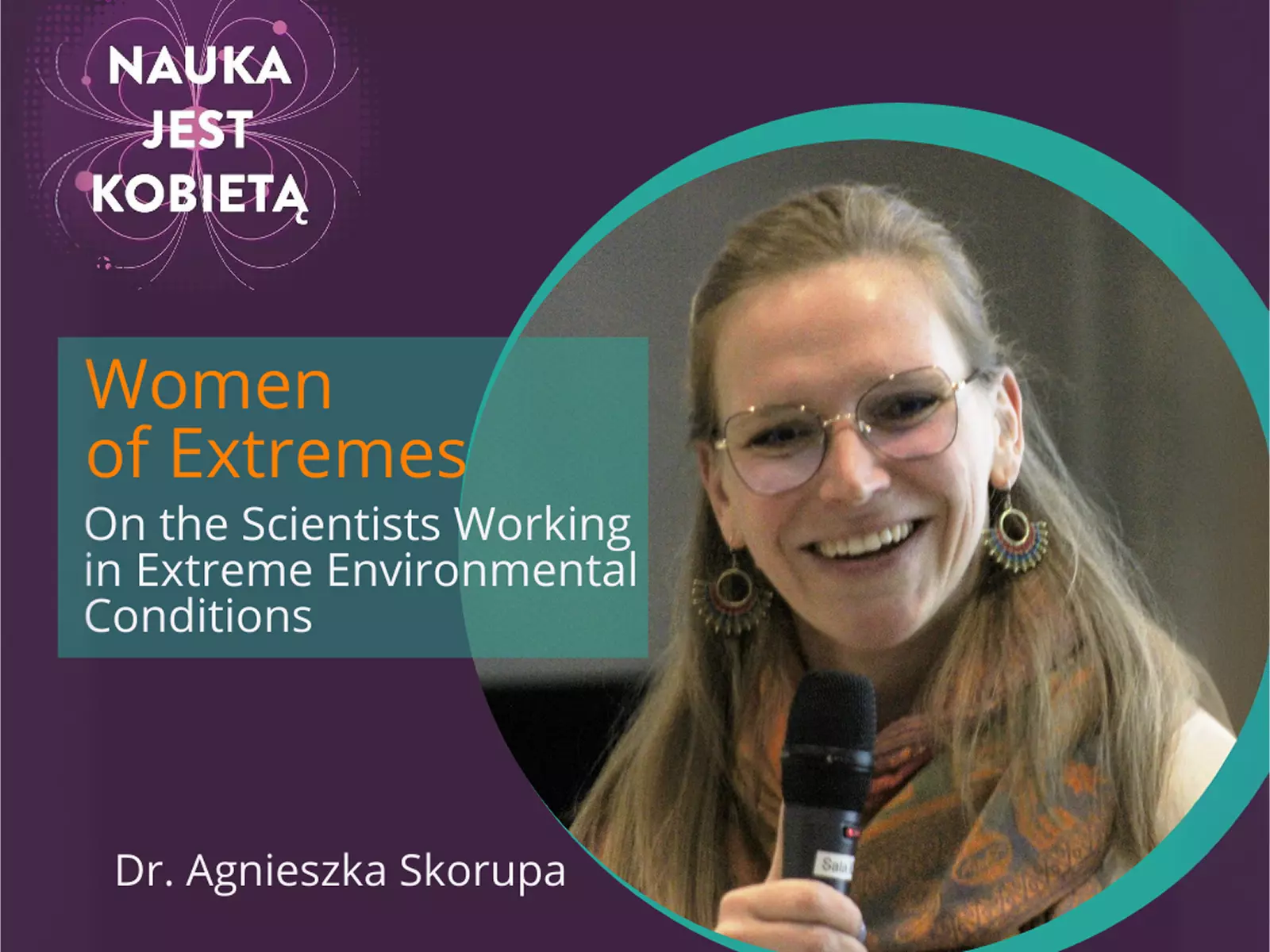
“My message is: it is not gender that matters, but competence. Let science be done by people who are competent – those who are interested in doing it.”
Dr. Agnieszka Skorupa
A psychologist working with the Institute of Psychology of the University of Silesia, therein engaged in science and teaching, researches human behaviour in extreme conditions as well as psychology of film. She leads the Astro Mental Health project – financed by the European Space Agency – which studies the mental health and behaviour of astronauts on mission at the International Space Station. She is a member of the Polar Research Committee of the Polish Academy of Sciences, and a participant of the IGNIS mission.
Extreme environments, known in psychology under the acronym ICE (Isolated, Confined, Extreme), are places where human beings cannot survive without the assistance of advanced technology and without rigorous cooperation.
Isolation within a small space poses a challenge to human nature:
“We are a mobile, moving people. Our bodies evolved in such a way that, put simply, we find it difficult to adjust to confined spaces.”
Physiology, Psychology, Relations
Working at polar facilities and space stations involves a range of hardships.
In space, these include “microgravity” and “radiation”, whereas polar regions confront humans with “radically low temperatures and polar bears on Spitsbergen”. In the Antarctic, further liabilities include “headache-inducing winds and pressure, which can increase the percentage of intragroup conflict”.
These conditions directly influence human functioning:
“when we experience pain, we complain more and get into conflicts more often”.
Environmental perturbances also affect the circadian rhythm: “From microgravity to extreme cold, these are the physical challenges. These also increase the percentages of sleep disorders […] and long-term sleep disorders can cause mental disorders such as depression.”
Notable causes of strain include monotony and isolation: “People in extreme situations are faced with tedium and repetitiveness.” Long-term isolation causes changes to the brain:
“isolation […] leads to a decrease in the number of connections in the frontal lobe and the hippocampus. The brain simply shrinks in volume.”
However, these changes are reversible: “when you return to a stimulating location, these connections regenerate”. This process is caused by the brain’s neuroplasticity.
Also strongly detrimental is the amount of stress and responsibility:
“It is a huge responsibility to travel to space as a representative of an entire nation.”
Similarly relevant is the restricted access to outside assistance: “limited possibility of evacuation or medical help”.
The working conditions also contribute to isolation: the International Space Station is located “about four hundred and twenty kilometres” from Earth, and some polar stations are “six hundred kilometres from the nearest place of human activity”.
Even in such extreme circumstances, people can function for an extended period of time, but this places on them a heavy psychological and social burden. This is especially the case in conditions of limited privacy and constant codependence within the team.
„Woman-Deserted Continent”: The History of Emancipation within Extreme Sciences
The history of women’s presence in extreme sciences constitutes a road of circumvented systemic barriers. For decades, the Antarctic was a space from which women were excluded – in the 1960s and ’70s it was termed a
“woman-deserted continent of peace. The last area without women.”
Press reported the first expeditions of women from the US to Antarctica as
“women’s invasion into the last bastion of man”.
Women researchers from Poland (from the pioneering winterings of Anna Kołakowska, through to the expeditions of Joanna Perchaluk) had to combat a narrative according to which
“women are not in their proper place, because it is man who is the explorer, the natural leader”.
An example of this difficult road towards acknowledgement of competence is the story of Dr. Sally Ride, who
“had to overcome so many obstacles. It was NASA that remained closed to the idea of women in space.”
Does Gender Matter?
The research mentioned by Dr. Agnieszka Skorupa shows that the differences between women and men, in the context of working in extreme conditions, are much smaller than stereotypes suggest.
- Self-selection: people applying for polar missions constitute a distinctive group, characterized by specific mental predispositions, regardless of gender.
- Effectiveness: results of research, such as that conducted in the Lunares habitat, indicates no relevant differences between women and men across the majority of analysed parameters.
- Physiology: the body’s reactions to stimuli, such as in the functioning of the immune system, are determined more so by the environment than by gender.
Social Barriers
Despite possessing competence equivalent to that of men, women still face cultural and social barriers.
These manifest in, e.g., double standards in judgement – when asking for help, women, more so than men, may be seen as incompetent. A particularly serious problem in isolated environments is the presence of abuse. The mentioned data demonstrate that sexual abuse poses a significant issue according to 72% of women working in the American Antarctic programme, and show that 63% of women in Australian polar stations have experienced inappropriate comments.
“Leaking Pipeline”
The “leaking pipeline” is the name of a process through which women – despite achieving excellent results in university education, including during doctoral studies – gradually “fall out of” the education system before reaching the highest steps of the career ladder. As such, it is not the result of a lack of competence, but of systemic and structural factors. These create a stepwise decrease in the numbers of women involved across successive career stages in science.
The causes of this phenomenon are multifactorial. It is influenced both by stereotypes concerning social and professional roles, as well as by the organizing model of scientific work coupled with the informal rules regarding promotions. Field- and managerial work continues to be viewed as necessitating fulltime availability, a large amount of time away from family, and significant physical resilience. All this tends to be stereotypically associated with men.
Mechanism of unconscious bias in decision processes also play an important role. Recruiters and people responsible for workplace promotions tend to favour individuals similar to themselves, which, in systems historically dominated by men, can entrench existing structures. Additional factors include differences in access to professional contact networks and mentorships, as well as informal cultural norms within the workplace.
One example which clearly illustrates the scale of such barriers is the story of Sally Ride:
“She was not asked about the nature of the fascinating science projects she will conduct. Instead, she was asked, firstly: whether she will cry after landing at the International Space Station, and secondly: how she will maintain her hairstyle.”
This example demonstrates that the issue is not one of competence, but of the way in which women are viewed in the roles of scientists and experts, where the questions they are asked are concerned not with scientific achievement, but with emotion, appearance, or their “fitness” for the role.
Competence Has No Gender
Research shows that teams which are diverse in terms of gender reach a higher level of so called collective intelligence. Diversity also fosters an interdisciplinary approach, which is of great importance to research done in extreme environments.
Modern examples of women leading science and exploration show that success in these positions is not tied to gender, but to experience, competence, and the ability to cooperate.
Dr. Agnieszka Skorupa concluded her speech with words worthy of being named the motto of contemporary science:
“My message is: it is not gender that matters, but competence. Let science be done by people who are competent – those who are interested in doing it.”
The text is based on a speech by Doctor Agnieszka Skorupa during the “Science Is a Woman” conference at the Silesian Planetarium in Chorzów, on the 14th of march 2026. We cordially thank Dr. Agnieszka Skorupa for conversing with us and for her consent to the publication of this story.