
Quotes
by Nicolaus Copernicus

[Mikołaja Kopernika, „O obrotach. Księga Pierwsza.”, OSSOLINEUM, Towarzystwo Naukowe w Toruniu – Prace Popularnonaukowe nr 50, Wrocław, 1987, str. 19., 9–21 linia]
[Mikołaj Kopernik, „Sposób bicia monety,” Pracownia Wydawnicza „Elset,” ISBN 798-83-61549-45-1, Olsztyn, 2023, str. 50, wers 1-7]
The theorem of Sines. One of the most important mathematical proofs by Nicolaus Copernicus.

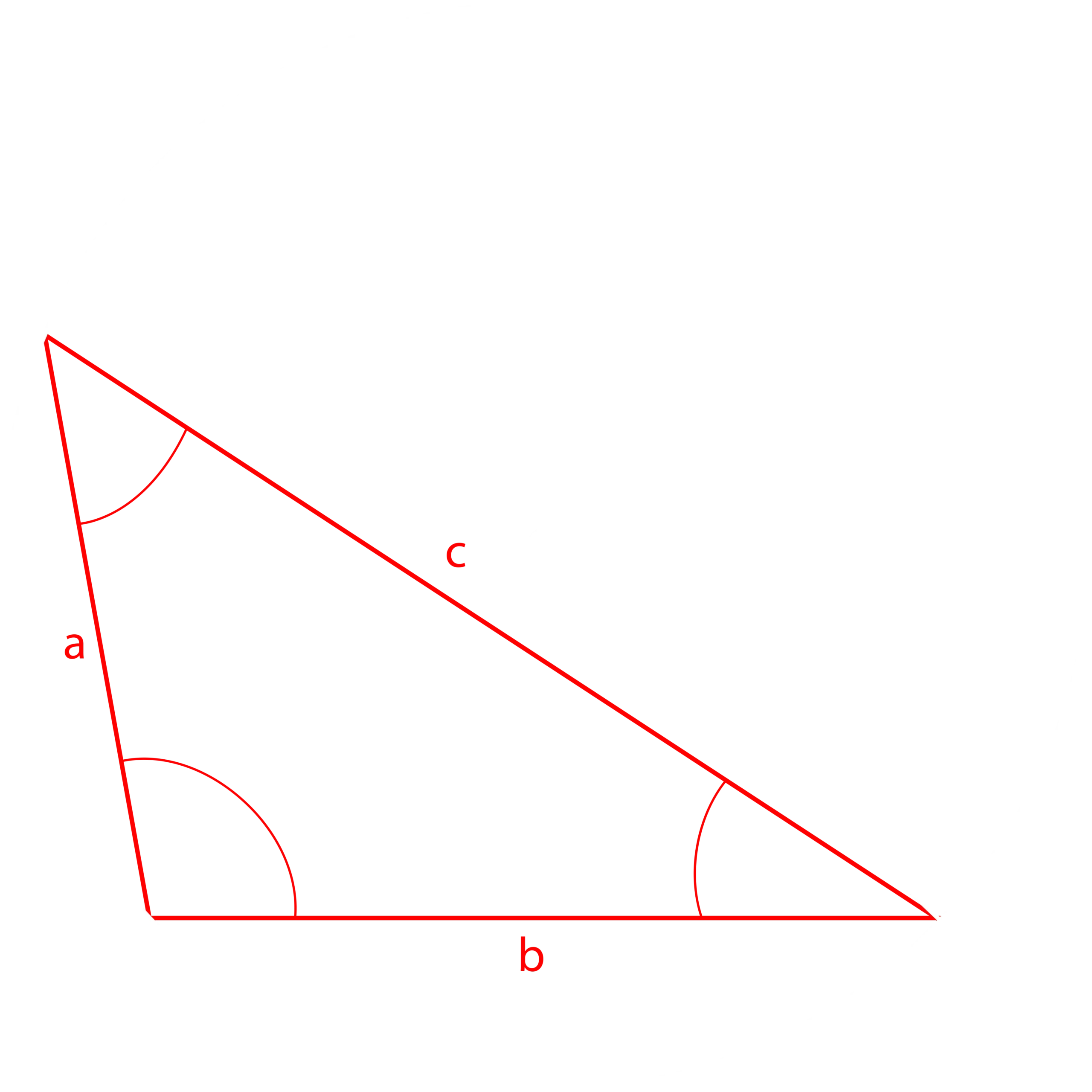
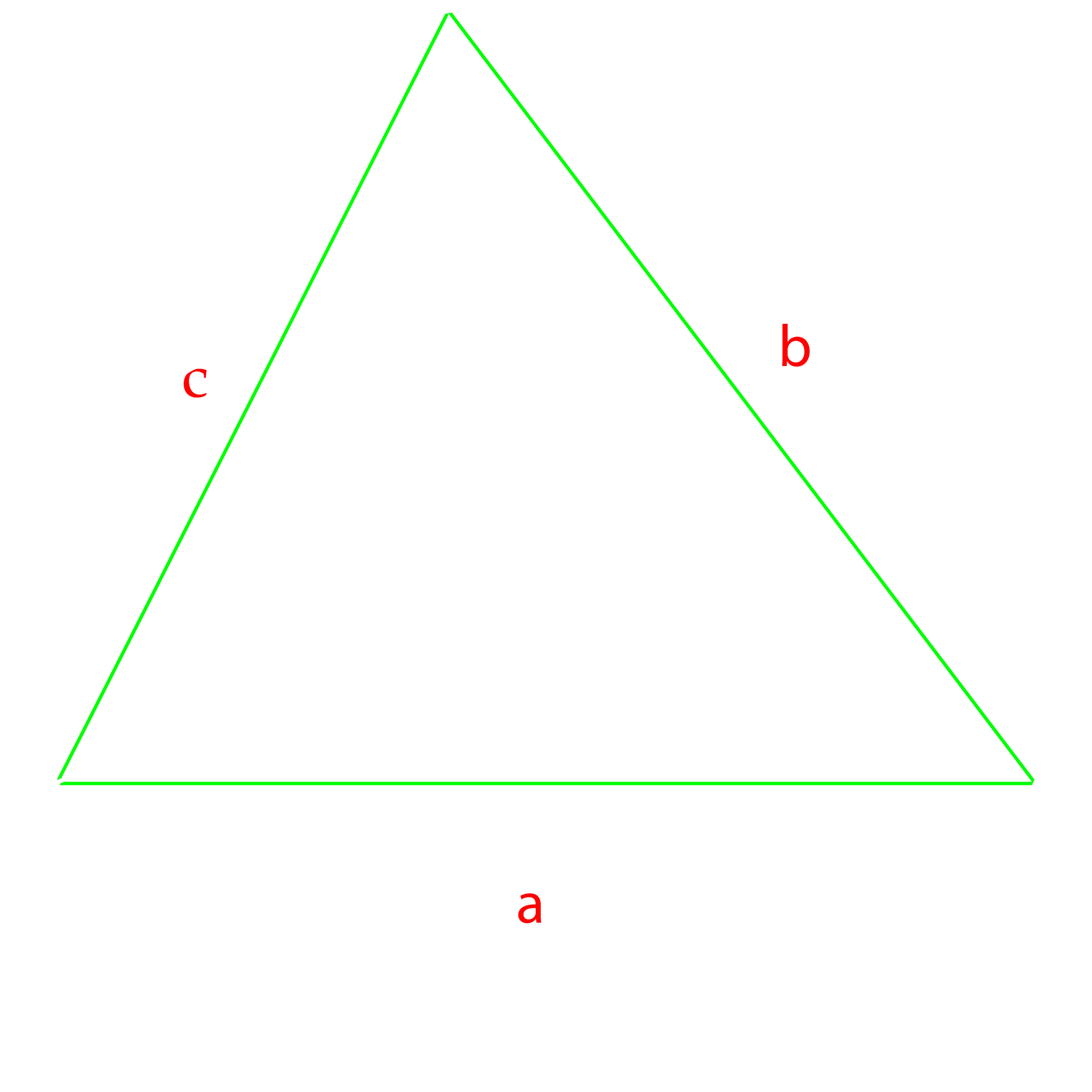
[N. Copernicus (1473-1543),”Nicolaus Copernicus of Toruń. Six Books on the Revolutions of the Heavenly Spheres.” Warsaw, Chapter XIII,p. 57]
Theorem II: “If in a triangle, one angle and two sides are given, the third side and the other two angles will be known.”
[N. Copernicus (1473-1543),”Nicolaus Copernicus of Toruń. Six Books on the Revolutions of the Heavenly Spheres.” Warsaw, Chapter XIII, p. 57}
Theorem III: “When all the sides of a triangle are given, its angles will also be known.”
[N. Copernicus (1473-1543),”Nicolaus Copernicus of Toruń. Six Books on the Revolutions of the Heavenly Spheres.” Warsaw, p. 60]

Table of chords in a circle.
Two excerpts from among a hundred similar ones compiled in Copernicus’ table
[N. Copernicus (1473-1543),”Nicolaus Copernicus of Toruń. Six Books on the Revolutions of the Heavenly Spheres.” Warsaw, Chapter XI, p. 54]
Chapter XIV
Theorems III and XII
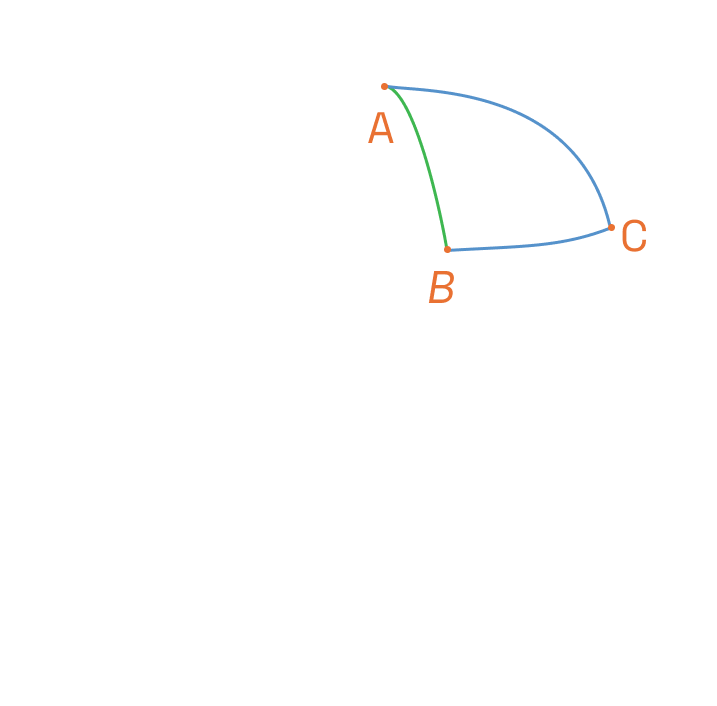
We consider three points A, B and C on a sphere of radius R. If we connect them by arcs (along great circles), we obtain a spherical triangle ABC.
We consider right-angled spherical triangles with sides shorter than a semicircle, as shown in the figure.
Copernicus’ Third Theorem:
In a right-angled spherical triangle ABC on a sphere of radius R (where angle C is a right angle), the following proportion between the sides holds:
AB / BC = R / BC
That is, the ratio of the hypotenuse to one leg equals the ratio of the radius to the adjacent leg. This means that if we know two sides, we can determine the third.
[Citation: Copernicus, Nicolaus (1473–1543), De revolutionibus orbium coelestium, Kujawsko-Pomorska Digital Library, UMK, 1854, Chapter XIII, pp. 63–64]
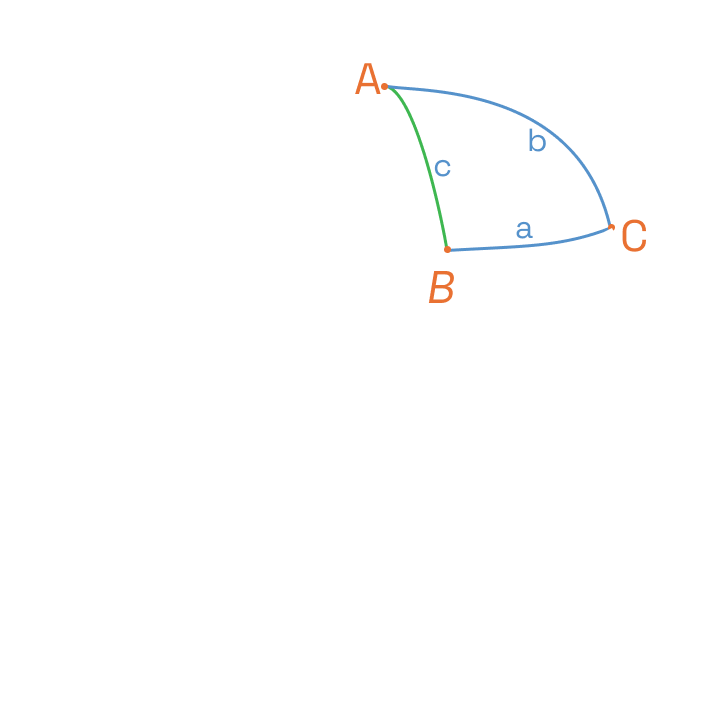
In other words, Copernicus proved a special case of the spherical law of cosines. Now, we may assume that the sphere has radius R=1.
We measure in radians the length of the side (arc) opposite to a given angle as an arc on the sphere (from the sphere’s center). We have:
AB = c BC = a AC = b
(here a, b, c are the measures of angles AOB, BOC, AOC in radians)
If angle C is right, we can write Copernicus’ theorem as:
cos c / cos b = cos a
[Citation: Copernicus, Nicolaus (1473–1543), De revolutionibus orbium coelestium, Kujawsko-Pomorska Digital Library, UMK, 1854, Chapter XIII, pp. 63–64]
Theorem of Pythagoras for spherical triangles
That is, if we know two sides, we can find the third.This is the spherical version of the Pythagorean theorem, which can be written as:
cos c = cos b  cos a
cos a
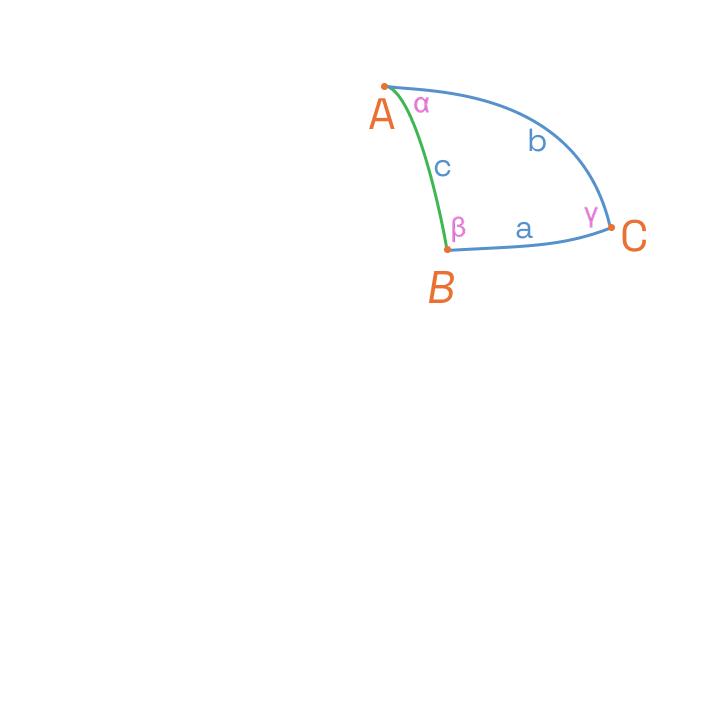
We also have the general spherical law of cosines for triangles on a sphere of radius R=1, where α,β,γ are the spherical angles of triangle ABC.
Copernicus’ Twelfth Theorem:
cos c = cos a cos b + sin a sin b cos γ
That is, if we know two sides and at least one angle, we can determine the third, which is the spherical version of the law of cosines for all plane triangles.
[Citation: Copernicus, Nicolaus (1473–1543), De revolutionibus orbium coelestium, Kujawsko-Pomorska Digital Library, UMK, 1854, Chapter XIII, p. 73]