
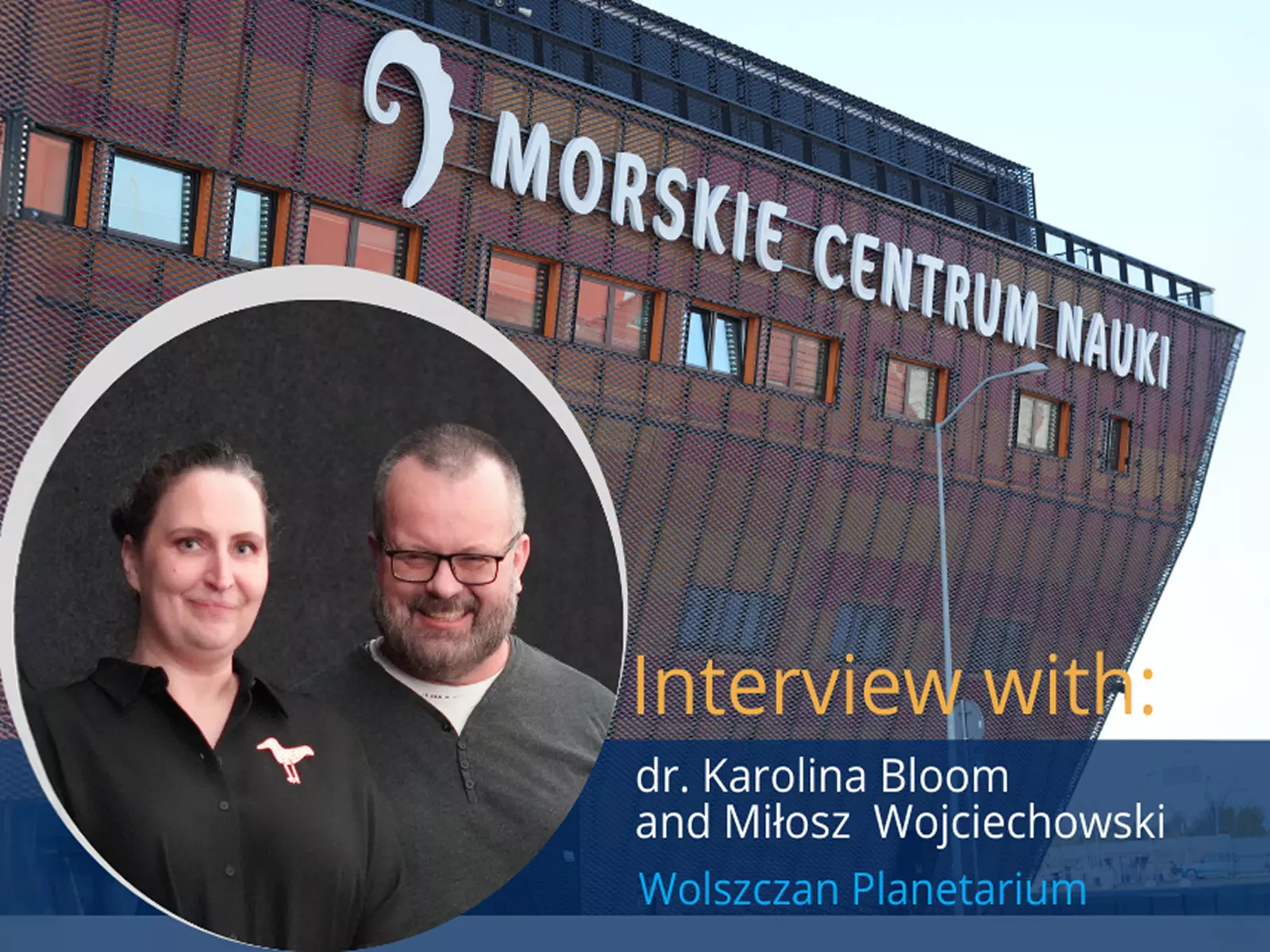
Karolina Bloom, is the Director of the Wolszczan Planetarium at the Marine Science Centre in Szczecin, and a Doctor of Biological Sciences in the field of ecology.
Miłosz Wojciechowski, is an educator at the Wolszczan Planetarium at the Marine Science Centre in Szczecin, holder of a Master’s Degree in Art Education and Journalism, and a musician.
Q: Why is it worth visiting the planetarium in Szczecin?
Dr. Karolina Bloom
The planetarium is small, but it has enormous potential. In addition to live shows, which are strictly educational in nature, we also present ready-made planetarium productions. What sets us somewhat apart from other planetaria is that we focus on the maritime environment.
The planetarium is located in the Marine Science Centre in Szczecin, which means we can also invite our visitors to productions that take them underwater and explain, for example, how coral-reef ecosystems function.
Miłosz Wojciechowski
The director spoke about the maritime aspect; I’ll talk about interdisciplinarity. Not only do we try to showcase the sky in different locations, regions, and at different times of the year, day, and night, but we also strive to diversify our activities in some way – which, to a certain extent, sets us apart from other planetaria in Poland.
We organise concerts for entertainment as well as for relaxation, designed simply to help people unwind, which is unique because very few people are actually able to sit beneath the stars and just relax. We plan to expand our concert programme to include various forms of meditation or contemplation sessions.
We also offer our visitors theatre performances, mainly for children, but who knows, perhaps we might see, for example, a monodrama that combines an actor’s performance with a visualisation of the sky or the cosmos. We are open to a very broad range of possibilities, and I think that is what sets us apart – not only us as planetarium staff, but also the place itself. As has been emphasised, the planetarium is small, but it is precisely this intimacy that can be created here that is our great strength.
Q: We also know that there is a link between the training ground for young astronomy enthusiasts – High School No. 13 in Szczecin – and the Wolszczan Planetarium. What is this link?
Dr. Karolina Bloom
Indeed.
We cannot imagine this place without young people. Our astronomy club is very active.
We have also opened the doors of the Wolszczan Planetarium to everyone taking part in the Olympiads – if only so that they can prepare for tasks involving observing the sky and identifying its features. It has worked out brilliantly. And it has paid off, because those who went on to compete further in the Olympiads achieved great success thanks to these exercises.
Miłosz Wojciechowski
I would just like to add, referring to the astronomy club, that for actual astronomical observations we also use the terrace of the Marine Science Centre, which is located on the roof of the building. We are currently equipped with telescopes, thanks to which our youth can learn not only under the dome of the planetarium, but also in what one might call field conditions, right there on the spot.
Q: Do local schools organise visits to the planetarium?
Dr. Karolina Bloom
Yes, of course – both schools and preschools. The range of people we invite is really very broad. We have shows with content suitable for preschoolers, and even for children aged 3+. There is no upper age limit.
Miłosz Wojciechowski
There really is no age limit. The Cosmos is open to everyone.
Dr. Karolina Bloom
As we say: Sky is not a limit.
Q: How does this planetarium compare to other Polish planetaria?
Dr. Karolina Bloom
We are a small planetarium, but we have truly excellent facilities. I can say that we are one of the most modern planeteria in Poland and, I would even say, in Europe. We are on a par with such planeteria as those in Paris or Berlin in terms of image and sound quality. And we are proud of that.
Miłosz Wojciechowski
We can say the same as compared to the planetarium of Brno in Czechia, which is famous throughout Europe. We know these planetaria very well so we can make the comparison, and we have nothing to be ashamed of.
Q: I’d like to ask one more, slightly provocative question to highlight a possible direction for collaboration between the Academy and the planetarium: are there any activities you’d love to see the planetarium undertake?
Dr. Karolina Bloom
That would be more people and time, as we have plenty of ideas, but sometimes we simply lack the staff and time to put them into practice.
Miłosz Wojciechowski
We have plenty of dreams. For example, I dream that we could – following the example of, say, the Silesian Park in Chorzów – create our own production using fulldome technology, which could be screened in planetaria all over the world. This would allow us to make our mark on the public consciousness also as producers, and not just as staff at the Wolszczan Planetarium.
Q: Is it possible to hold lectures at the planetarium?
Dr. Karolina Bloom
Absolutely. We have the technical facilities to host lectures both in person and online. We also have experience in organising broadcasts, so this venue is perfectly suited to serving as a lecture hall. We always emphasise that we are by no means a cinema; rather, we are a very modern classroom and lecture hall.
Q: Is this the only planetarium in Poland which is located in a facility linked to a marine centre?
Dr. Karolina Bloom
Yes, I think so. It’s also one of the highlights of our Centre.
Miłosz Wojciechowski
I haven’t come across a similar combination before.
Dr. Karolina Bloom
The Marine Science Centre has its own patron, Professor Jerzy Stelmach. For many years, he was the founding father and ideator of interactive science centres where knowledge is acquired through experience. It was the Professor’s dream that such a place should also include a planetarium. And although the professor is no longer with us, I always say that his spirit and vision are still with us.
I will also boast that, every summer, we receive a visit from Belgium by a certain boy who – as we always joke – is our most loyal fan. He’s actually seen all our productions and taken part in all our live shows.
Miłosz Wojciechowski
Often many times over, and always with admirable commitment.
Dr. Karolina Bloom
Yes. However, every time he’s in Poland, whether for the holidays or during the summer break, he tells us he can’t imagine not coming to our planetarium. We take great personal satisfaction in the fact that we have such a little volunteer and ambassador out there somewhere in the world.
Q: Could you tell us a bit about how you go about sourcing new material and, in doing so, sparking teachers’ interest in planetarium lessons?
Dr. Karolina Bloom
Because planetarium productions are very costly, we try to secure as much funding as possible. We draw on various sources of revenue, including European funds. Recently, we managed to secure funds for productions with a biological theme. We utilised funding from the Regional Fund for Environmental Protection and Water Management in Szczecin.
We secured another sponsor: a tugboat manufacturer, who paid for the licence to the film Expedition Reef.
One might think that our fields are not very closely related, but we put a lot of work and effort into convincing the company that the production they will finance will be a very good investment. In any case, the statistics show that thousands of people have already watched it. Before the screening, there is of course an acknowledgement, which serves as a form of promotion for said company.
Q: You mentioned that, thanks to the equipment acquired, children and youth can prepare for the Olympiad at the planetarium.
Miłosz Wojciechowski
The planetarium is a unique and irreplaceable tool in astronomy education. Returning to the Olympiad participants and our students – this year, in addition to preparing for the finals of the astronomy Olympiad in Chorzów, we also managed to organise the finals of the astronomy competition entirely at the Marine Science Centre.
First came the calculation section, which took place just around the corner, in our conference room. However, what is unique in this type of competition is the second part, devoted entirely to observing the sky – beneath our the dome of our planetarium. There, the participants took measurements and identified stars, constellations and other stellar formations.
This gave the students the opportunity to demonstrate their skills at a level that is, in practice, unavailable anywhere else.
Q: I think the Olympic successes of the graduates from this school are also proof that your planetarium is doing an excellent job.
Dr. Karolina Bloom
Of course. I would add that we have had some distinguished guests here. Last year, in May, we were visited by Professor Aleksander Wolszczan. We seized the opportunity of his visit to Poland and invited him to the ceremony of naming our planetarium after him.
That is why, during shows in the planetarium hall, you can hear the professor’s voice, recorded especially for the occasion:
“Aleksander Wolszczan wishes you a cosmic experience at the Marine Science Centre Planetarium.”
The professor accepted our invitation himself. It was a very inspiring, yet emotional, meeting. He spent a large part of his life in Szczecin and worked here at the University for a long time. Interestingly, he also visited his old secondary school, where he met with youth – the current students.
Miłosz Wojciechowski
Let me just add: “our school”, as I am also a graduate of the Secondary School No. 6 in Szczecin, just like Professor Wolszczan.
Dr. Karolina Bloom
Meanwhile, last December, we welcomed astronaut Sławosz Uznański-Wiśniewski under the domed roof of our planetarium. His visit here was a highlight of his trip to Szczecin, and we are very proud of that.
We wondered if there was anything we could show him – anything he hadn’t seen before. It turned out that we have a visualisation of the International Space Station, which you can not only view from every angle, but also “step inside”. In fact, Mr Sławosz gave us a tour of the Station during our virtual visit. It was incredible: he would walk into a room and say, “There are three cupboards here,” and sure enough, they were there.
Miłosz Wojciechowski
He even said, “You’ve done a brilliant job with this – that computer is actually standing right here”.
Dr. Karolina Bloom
The young people who took part in this meeting will certainly remember this experience for a long time.
Miłosz Wojciechowski
After Sławosz had such a great time with this ISS model, it was clear that this was something special he hadn’t encountered before. Elsewhere, his visits tended to take the form of conferences and demonstrations. But here, it was simply a walk through the International Space Station with a man who had just returned from it.
Q: What age group is the Wolszczan Planetarium aimed at?
Dr. Karolina Bloom
The Wolszczan Planetarium in Szczecin is for three-year-olds and one-hundred-year-olds alike.
For those who love science. For those who love special effects. For those who want to relax a little, or listen to some good music.
Miłosz Wojciechowski
For those who love gazing at the sky, and for those who don’t have time for the sky, but who might just look up at it after meeting us.
Dr. Karolina Bloom
And that is something which inspires us.
Miłosz Wojciechowski
If we can instil a love for the Universe, a love for the stars, and a love for astronomy in everyone who comes here, then for us that is nothing but an added bonus.
We extend our wishes that the graduates of Secondary School No. 13 and all those interested in visiting your planetarium will one day return to support the further development of this institution for Szczecin and for Poland.