
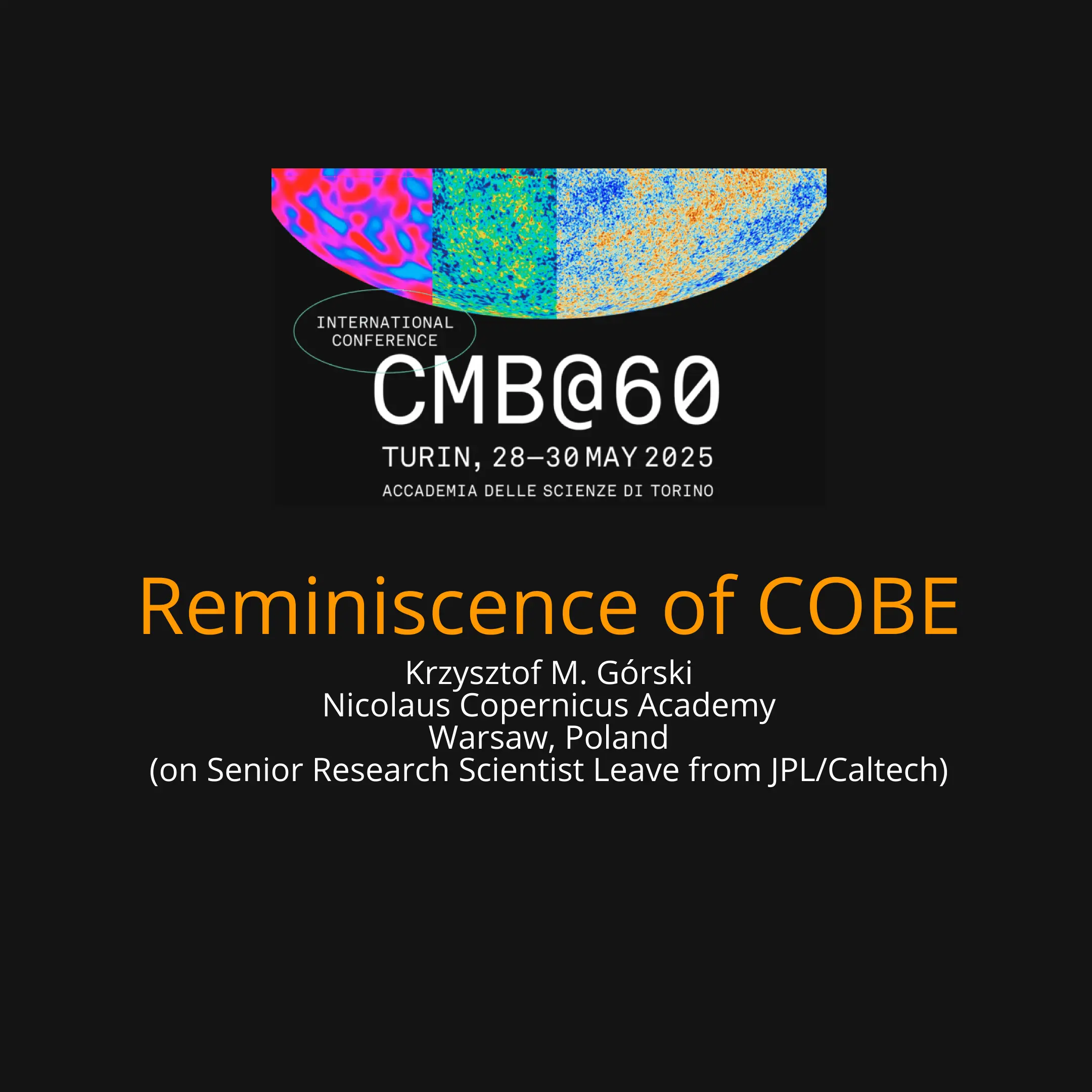
In his speech, Professor Górski described the history and significance of the groundbreaking COBE (Cosmic Background Explorer) satellite mission, which launched a new era in cosmological research.
From a Rejected Proposal to the Nobel Prize
COBE was born out of determination; the original proposal submitted to NASA in 1974 was rejected. However, by 1977, a coherent concept emerged to combine three research instruments—FIRAS, DIRBE, and DMR—on a single satellite platform. The turning point came after the Challenger shuttle disaster in 1986. The suspension of the Space Shuttle program forced the team to radically redesign the entire COBE satellite. To be launched by a rocket, the satellite had to be “slimmed down” by 50%. Thanks to these efforts, COBE was finally launched into orbit on November 18, 1989.
The FIRAS instrument quickly confirmed that the background radiation has a nearly perfect blackbody spectrum, which solidified the Big Bang theory.
However, the real breakthrough came from DMR, which recorded fluctuations in the cosmic microwave background for the first time in history—anisotropies that served as the seeds for today’s galaxies and cosmic structures. This result was later honored with the 2006 Nobel Prize for John Mather and George Smoot, the lead investigators for the FIRAS and DMR experiments.
Prof. Górski recalled that initially, the media and the scientific community awaited the DMR results with great impatience, and even concerns regarding a “lack of data” and “scientist uncertainty.” Ultimately, the 1992 presentation of the revelatory DMR results at the American Physical Society conference went down in history. “Three days later, I saw the image from COBE on the screen of a plane flying to Paris—it was an incredible feeling,” the professor recalled.
The Legacy of COBE
The findings established by COBE initiated the era of precision cartography of the Universe. As Prof. Górski noted, what took humanity 500 years in the case of mapping the Earth, cosmology achieved in just two decades—from the first maps of background fluctuations to the detailed all-sky measurements by the WMAP and Planck missions.
“It is as if we recreated the topography of the Universe, just as we previously created a map of the Earth—only much faster,” Prof. Górski concluded.
COBE was a mission at the edge of the technical capabilities of its time, but its data transformed science. They showed that the Universe is not only expanding but is full of structures, the evolutionary origins of which we can study today thanks to background radiation—the oldest light in the Universe.
“And it all started with COBE.”