
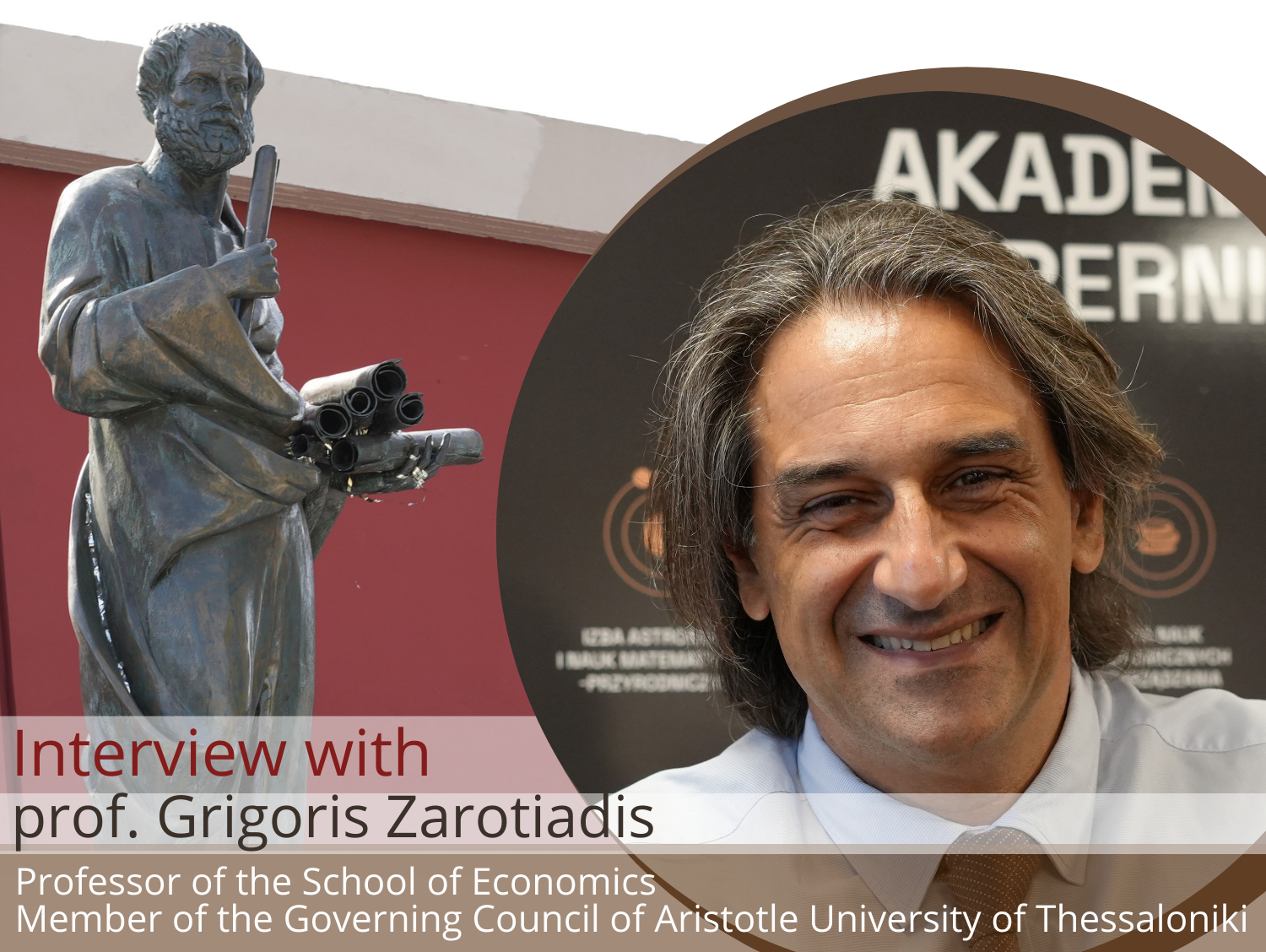
Last year’s 11th Congress of Polish Economists provided a forum to discuss the state and challenges of the modern economy, while also leaving us with many crucially important and timely questions.
We build upon the issues raised at the congress in our conversation with Prof. Grigoris Zarotiadis—Professor at the School of Economics and Member of the Board of Directors of the Aristotle University of Thessaloniki (AUTh), President of the Association of Economic Universities of South-Eastern Europe and the Black Sea Region (ASECU), and Director of the Interdisciplinary Laboratory for Black Sea and Mediterranean Studies (ILABSEM).
The Nicolaus Copernicus Academy also shares a Memorandum of Understanding with the Aristotle University of Thessaloniki, established through its School of Economics.
We invite you to read the interview below:
The slogan of the 11th Congress of Polish Economists was “Economics and the Economy in Times of Uncertainty.” This is not just an academic topic – it affects every one of us.
Professor, I would like to ask how you, as an economist, see this uncertainty.
Q: At the Congress, participants described the uncertainty we are experiencing as a sign of a profound civilizational shift.
Over the past several years, Greece has gone through the very difficult experience of an economic crisis and far-reaching reforms. How has the Greek economy—and Greek society itself—changed during this time? Has the experience of the crisis changed the way the average Greek views the state, the economy, and their own economic future?
prof. Grigoris Zarotiadis:
First of all, let me start by saying that we can all agree that there is a structural change taking place – what you call here in your question a civilizational shift. And let me also state that
Now, to your question about Greece, it is true that Greece went through a very important period in its contemporary history. Nevertheless, the changes and incidents Greek society and the economy had to experience are not necessarily part of the aforementioned structural change. What I mean is that Greece’s changes have to do with Greece itself, not necessarily with the broader structural change. Greece itself, in a way, was unfortunate because it was a case of a state where the inefficiencies, strong inefficiencies of its public functioning, coincided with the strong crisis of the international financial system. Therefore, Greece had to go into a period of very strong and, as you are saying, far-reaching reforms.
Nevertheless, in my view, these reforms and the strategy foreign powers imposed on Greece were not in the right direction. Why am I saying that? Because Greece lost 1/4 of its GDP as the price it had to pay for the reforms. Nevertheless, although we paid the price, the reforms imposed did not improve Greece’s position in international competition.
And I’m saying that because, although in the last 10 years, a bit less, Greece is showing stronger GDP growth rates than the average of the European Union (keeping in mind that the European Union went down with respect to its dynamic evolution), on the other hand, despite the relatively strong GDP growth rates, there are two important problems that show that Greece did not solve its structural problems.
First, despite the relative improvement in the public debt-to-GDP ratio, private-sector debt has worsened much more sharply as a percentage of GDP. The second problem is that, measured in terms of productivity, the Greek economy remains quite low in overall global competitiveness. Clear proof of this is that the Greek economy is reproducing trade deficits similar to those it had before 2009, before the crisis.
So, overall, the reforms applied to the Greek economy, in my view, were not successful. On the other hand, they had a strong effect on the real purchasing power of households and of small and medium enterprises. And therefore, coming to the last part of your question, the way Greeks understand the state and the economic future is not positive – it is a very critical one.
Q: At the Congress, many speakers discussed the limitations of universal economic models and the need for solutions tailored to the specific circumstances of individual countries. In your view, do we need a new model of development today? If so, what should it look like?
prof. Grigoris Zarotiadis:
Your question builds upon the previous understanding that we are living in a period of profound structural change or civilizational shift. Therefore, it’s quite understandable that the contributors to the Polish Economists Congress focused on the limitations of the current economic model.
I think that after a long period of believing in the absolute supremacy of the so-called free economic model during the 90s and the first part of the 21st century, international literature is returning to a critical perspective. There is a recognition that the so-called free economy model, or in other words, the capitalist model, can produce technological improvements that, compared with previous phases of human history, were unexpected. However, it is unable to secure the efficient utilization of this technological change – efficient in terms of social, but also environmental efficiency. Therefore, more and more scholars understand that we are necessarily searching for a new economic model.
Now, your question adds an additional dimension, which is very well included. Not only are we questioning ourselves about an alternative economic model of functioning, but we’re also realizing that whichever the new economic model will be, it has to be adjustable to the specific circumstances of individual countries and regions.
Now, in my view, first of all, it is necessary to speak of a new socioeconomic model because, as I said, capitalism – like all the pre-existing phases of socioeconomic development – has achieved quite a few things for humanity. For instance, globalization itself, or this enormous, unbelievable technological evolution. Yet it has also shown that it cannot secure the future sustainably. We need a new development model.
Now we are approaching the most difficult question: what should it look like? This is not easy, because it is easy to understand today’s difficulties, but not easy to imagine what should be done. And most of the time, the academic community, the scholars, the scientists can push this discussion forward, but in the end, it is social and political evolution that will prove which system is the right one.
In any case, not to avoid the question, I think that for the future we have to think in the following ways:
- Environmental Sustainability: We need to secure the availability of natural resources for future generations as much as possible.
- Social Fairness: We are living in a period—and this is the conclusion of the last 15 years of the OECD, a systemic global institution—where social inequality is deepening so much that it is questioning the functioning of the economy itself.
- Spatial Fairness: We need to think in the direction of a fair and efficient way of distributing wealth not only among social classes, but among different regions.
These three elements – environmental efficiency, social fairness, and spatial fairness – should be the characteristics of a new socioeconomic system,characteristics which have been proven not to be compatible with capitalist development.
For me, in place of the so-called generalized commercialization, or in other words, the free economic system, we should gradually move into a system where more and more social processes decide how much to produce, what to produce, and for whom to produce. As we move forward, markets are proving incapable of answering these questions.
Q: At the Poznań Congress, one speaker quoted a famous line from Michelangelo: “The greatest danger for most of us is not that we aim too high and miss the mark, but that we aim too low and reach it.” What role should economic education and universities play in overcoming uncertainty today? Do you think we are preparing students to aim high enough?
prof. Grigoris Zarotiadis:
First of all, who am I to question Michelangelo’s quote? However, what I dare to do is not to question it, but to amend it – to add something.
It is not a one-dimensional question; it is multidimensional. In other words, the thing is not only whether we dare to aim high, but what direction we dare to aim in.
I mean, there are some things which are objective, for instance, environmental sustainability. Whatever other interests you choose to support, you need to have environmental sustainability, because otherwise none of us will live. But despite that, the orientation of socioeconomic development is not an objective question – it is a question that has to do with which interests you choose to support from an ethical and ideological standpoint.
So in that sense, I fully agree that we should dare to visualize the highest possible aims, but on the other hand, we should also dare to visualize aims that are perhaps against the presently dominant point of view.
As I said, I fully understand the need for education for applied reasons, because if we stay only in theological and theoretical discussion, we won’t be able to deal with the very demanding challenges of our time. But overall,
Q: In your academic work, you emphasize that economics should serve the well-being of society and intergenerational solidarity, rather than focusing solely on GDP growth. This approach seems close to the thinking of Adam Smith, who connected economics with moral philosophy, and Nicolaus Copernicus, who drew attention to justice and the value of money. How can we reconcile the pursuit of development and profit with responsibility toward society today?
prof. Grigoris Zarotiadis:
Let me start by saying that I really admire your holistic view of Adam Smith’s legacy. Because, erroneously, in the last decade, the majority of scholars of economic history – of the history of economic thought – tend to understand Adam Smith in a very limited way and to say that Adam Smith is the father of the doctrine of liberal economy and so on, which is not the case.
So if you ask someone, “What do you think is the major rule of Adam Smith?”, he or she would say it is the rule of the invisible hand – meaning that the economy has its own way of dealing with all matters with no exogenous intervention, as a self-regulated system.
This is not the case. Adam Smith did indeed argue about that, but not only about that. And I admire – I’m repeating myself – the fact that you see in Adam Smith’s doctrine another direction: the connection of economics with moral philosophy.
Also, although I’m not a very well-educated scholar of Nicolaus Copernicus, as far as I know, Copernicus questioned the mercantilist/bourgeois understanding of the value of money and, thereby, the efficiency of the so-called system of generalized commercialization of capitalism.
We are living in a time when these critical approaches are becoming increasingly familiar to scholars discussing the present economic situation, and they are returning with renewed significance.
For me, there are two major evolutions in the contemporary world that obviously reveal the fact that we need a dramatic change in the socioeconomic system:
- The Explosive Growth of Technology and Labor Productivity.
The first is the fact that technology is developing so fast – meaning that the productivity of labor is developing so fast – that there is no need anymore to have commodities in the traditional sense. Why am I saying that? To sell something as a commodity, you need to invest a large amount of initial capital, and you also need a specific amount of capital to reproduce that economic good. As labor productivity increases because of technological evolution, the cost of reproducing this good tends to zero.
Imagine a factory that is completely functional with automation and robots. You only need to push a button and you have the final result. In this situation, human labor productivity is enormous. Your only limitation is natural resources and energy.
In such a system, where labor productivity is so high that the limitation of final production is only natural resources and energy, markets cannot tell you what to produce – whether to produce water, cookies, telephones, furniture, or cars. They cannot tell you because the system of commercialization is not functioning in such an environment. That is why we are saying: the more capitalism, through competition, generates technological expansion, the more it is, in fact, preparing the system for systemic change. So that is the first thing. - The Changing Nature of Money.
The second is also very interesting and has to do with the change in the nature of money. Money went through different phases over the history of humanity:- Commodity money: A silver or gold coin where the exchange value of the coin was the same as the material it was made of.
- Fiat money: Where the exchange value is much more than the actual value of the paper it is produced on, because we recognize the state’s power to issue it.
- Digital money: Which is also fiat money, but not tangible – accessed through phones or credit cards.
However, we are approaching a new phase. We don’t only have fiat money and digital money; additionally, we have cryptocurrencies. What is the specific characteristic of cryptocurrencies? If you ask me, their key characteristic is that they are not issued by state power, but by the economic power of private companies.
So what you have now is that – although until now there was a global consensus that money can be recognized by all of us only if it is issued by state power- gradually, more and more of us recognize and exchange value into something which is not issued by state power, but by companies. This is a tremendous change.
In other words, it is a change which leads to the privatization of the money supply, and this has a very strong effect.
Q: What comes to mind when I say ‘Copernicus’?
prof. Grigoris Zarotiadis:
The first thing that comes to mind is his contributions to physics and astronomy. However, through my contacts with the Copernicus Academy and our discussions, I realized it is not only that; Copernicus also contributed significantly to socioeconomic thinking.
So the only thing I can say is that I realize I need to learn more about his legacy in relation to socioeconomic development.
Thank you Professor.
prof. Grigoris Zarotiadis:
Thank you.