
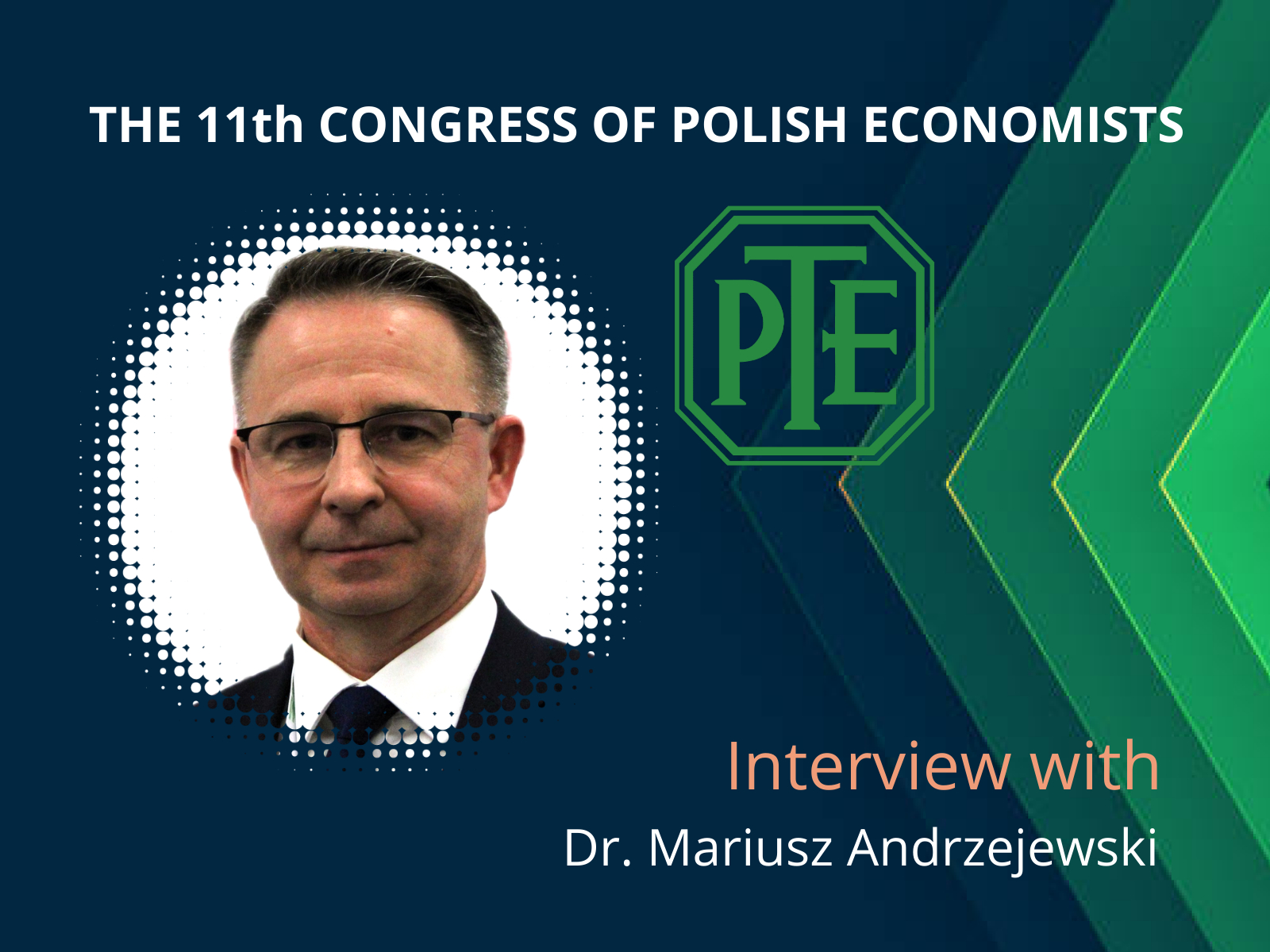
Dr. hab. Mariusz Andrzejewski is a professor at the Cracow University of Economics, where he heads the Department of Financial Accounting. He has a triple academic background in automation and robotics, accounting, and computer science. His research and professional interests focus on accounting, auditing, and corporate finance. He is a certified statutory auditor and has experience in corporate governance, including roles at PKP PLK SA and PKO BP SA.
He has received several state honors: the Silver Cross of Merit (2024), the Bronze Cross of Merit (2004), the Silver Medal for Long Service (2017), and the Medal of the National Education Commission (2018). He is the author of numerous academic publications, a participant in international conferences and research fellowships, and a member of the Nicolaus Copernicus Academy, Chamber of Economic Sciences and Management.
Q: Thank you very much for taking the time to speak briefly with the Copernican Academy. We have just attended the panel titled Poland’s Transformation: Success or Failure? so we would like to ask: in your view, what has been the greatest success and the greatest failure of the transformation? During the panel, you suggested that monetary policy was the greatest success, while demography was the greatest failure.
Dr. hab. Mariusz Andrzejewski: Yes, I reflected on how to approach this issue in a reasonably objective way and how to find measures that would allow for such an assessment. Other panelists, whom I had the honor to join in this discussion, proposed GDP or GDP per capita as evaluation measures. However, we all know that these indicators do not fully reflect economic conditions from the perspective of citizens as individuals, or from the point of view of small and medium-sized enterprises. In general terms, GDP has its advantages, but it also has clear limitations.
That is why I proposed something like a survey. Ideally, it would involve the more than six hundred economists who gathered here at the 11th Congress of the Polish Economic Society. They could assess each area of the economy on a scale from zero to minus ten to reflect failures, and from zero to plus ten to reflect successes. We could then plot the results on a chart, with successes on one axis and failures on the other, to show the overall outcome.
In my opinion, demography deserves the most extremely negative assessment in our economy. Today, the situation has reached a very low level. The fertility rate in Poland stands at around one, or perhaps even below one, which represents a very poor result. France, for example, has a fertility rate above two. Not long ago, Poland’s rate stood at about 1.3, which was already low, but still significantly higher than it is today. When I pointed to failures and successes of our economy, I highlighted this issue because I firmly believe it will have the strongest impact on Poland’s economic condition in the future.
Today, this issue resembles an atomic bomb—hidden for now, unnoticed or deliberately ignored. Yet if current trends continue, low population growth will wreak havoc on the Polish economy over the coming decades.
Above all, these problems will manifest themselves in a lack of public funds to provide decent pensions for people who are currently active in the labor market. With too few working-age individuals, the economy will struggle to grow, which will most likely translate into low—or even negative—GDP growth.
From an economic perspective, demography therefore represents, in my view, the greatest failure of Poland’s economic transformation over the past 35 years.
By contrast,
I would identify the creation and effective functioning of an independent monetary policy as the greatest success of Poland’s economic transformation.
As a result of a well-managed and independent monetary policy, for which the National Bank of Poland is responsible and which is shaped by decisions of the Monetary Policy Council, Poland has recently won the fight against inflation. Not long ago, external factors pushed inflation to as high as 18 percent, but today it stands close to the NBP’s inflation target. At the right moment, the Monetary Policy Council raised interest rates to a high level of 6.75 percent. In doing so, it once again demonstrated independence from political pressure, collective wisdom, and prudence in decision-making, all aimed at safeguarding economic stability and the strength of the Polish złoty.
Poland has faced crisis situations before, such as the global financial crisis triggered by the collapse of Lehman Brothers in 2008. In such moments, the Polish economy and the Monetary Policy Council have consistently risen to the challenge.
For these reasons, among the many successes of Poland’s 35-year economic transformation, I—as an economist—point to the development of key attributes of Polish monetary policy: a high degree of independence of the National Bank of Poland, a freely floating exchange rate of the złoty and its relative stability, as well as a significant increase in foreign exchange reserves, with particular emphasis on the growth of gold reserves.
In my opinion, these factors underpin Poland’s economic security and the security of its citizens, while also significantly strengthening Poland’s position in the international economic arena.
When pointing to the failures of Poland’s economic transformation, after demography—which I mentioned earlier—I ranked the condition of the healthcare system second. What is happening in healthcare today poses a serious threat to the Polish economy. In my view, the current situation calls for revolutionary changes. I hope such changes will finally take place, although we express this hope every year and, so far, the healthcare system has not been fixed.
I also drew attention to the low level of investment. Despite the government’s announcement in February of this year that it would be a breakthrough year for investment, the ratio of investment spending to GDP remains far too low. For the economy to grow in a satisfactory way, Poland needs investment at a level of around 25 percent of GDP. At present, investment stands at roughly 17 percent. This is an issue we should openly discuss and debate, and the government should address it directly in its economic development strategy in order to reverse this unfavorable trend.
Importantly, investment remains so low even though Poland has access to substantial European Union funds, including resources allocated under the National Recovery Plan (KPO) and the next EU budget perspective.
According to the evaluation methodology I proposed for assessing these 35 years of Poland’s economic transformation—namely, an expert assessment by economists participating in the 11th Congress of the Polish Economic Society, using surveys and assigning scores from minus ten to plus ten for the most important areas of the economy—I am convinced that the final, aggregated result would still be positive.
In my own individual assessment, I view the development of Polish entrepreneurship very positively. I am referring above all to the strength of small and medium-sized enterprises, which today generate about 60 percent of Poland’s GDP. This represents a major success of our economy. Public finances also deserve a slightly more positive than negative assessment. Why? Because Poland’s public debt has so far stood at around 50 percent of GDP. It is now approaching 55 percent, but compared with countries such as France, Italy, and other Western European economies—where this ratio often exceeds 100 percent—Poland still looks relatively strong. Germany, admittedly, has debt of around 60 percent of GDP, but even that exceeds the 60 percent threshold set by the European Union.
For this reason, when we consider the full 35-year period of economic transformation, Poland’s economy deserves a predominance of positive evaluations in this area. That is my opinion. I would also note that some governments even came close to eliminating the budget deficit entirely, approaching a balance between revenues and expenditures. This is another aspect of the economy we assess relative to GDP—what we often call, somewhat colloquially, the “budget hole.”
Only in the past two years has the budget deficit reached extremely high levels of around 270–280 billion. By comparison, in the final year of the previous government, the deficit amounted to just over 80 billion. Even then, I considered that figure very large. However, looking at the past as a whole shows that the situation was not as bad as it is today. When we evaluate the full 35 years rather than focusing solely on the last two—during which the budget deficit situation has been very poor—the earlier period allows us to view this aspect of Poland’s economy as a success.
We will see what 2026 and the following years bring. Still, we must note that in recent years the government has spent significant sums on armaments, which represents the main reason for the sharp increase in the so-called budget hole in Poland.
And then there is industry, Ladies and Gentlemen—another area that, in my opinion, represents a failure of our economy. I am referring to what I describe, somewhat ironically and in quotation marks, as the “shrinking” of industry: the inability of industry to develop and the burden of high energy costs. The energy sector itself also counts as a failure in my view. The introduction of what is essentially a tax—namely the ETS—has been highly unfavorable for our economy. On top of that, we failed to build nuclear power plants over the past 35 years, even though we had ample time to do so. We also lack other alternative, but more efficient, energy sources. In addition, our energy grids are outdated, largely because we neglected major investment spending in this area. All of these issues fall into the category of what I would call “non-successes,” since I do not particularly like the word “failure.”
Among the successes of the Polish economy, however, we should also include the banking system and commercial banks. In Poland, this system ranks among the strongest in Europe, as evidenced by the results of stress tests, in which commercial banks operating in our country perform very well. This is a major achievement. Of course, foreign-currency mortgage loans—so-called Swiss franc loans—and the limited availability of fixed-rate mortgage products should be assessed negatively, as we discussed earlier. Still, overall, the Polish banking system represents a pillar of the economy and, in my view, stands as a clear success of the 35 years of economic transformation.
Without trying to list the entire set of 20 economic areas I considered during my participation in the panel session titled Poland’s Transformation: Success or Failure?, I wanted to encourage—and I believe I succeeded in encouraging—the participants to engage in a deeper discussion. We should not assess the Polish economy solely on the basis of GDP growth. Excuse me, but if we go out into the street and ask Poles whether they think everything is going so wonderfully, the answer may be quite different. Today, we heard that Poland recorded GDP growth of around 300 percent over these 35 years. Yes, that is true. But does the average citizen feel this growth and take satisfaction from it? Not necessarily. That is why I believe we need to examine more detailed, individual components of the economy and discuss them with greater precision.
At the same time, I did not want to end on failures alone. I also spoke about the stock market, noting that the Warsaw Stock Exchange has been developing well. I mentioned the pension system, which allows for private retirement savings, and I noted that the broader insurance system has also developed quite solidly in Poland. Overall, the tax system deserves a neutral assessment. Tax levels are not excessively high, but the system is certainly too complex. Over the past 35 years, Poland has reformed its tax system many times, and most of these changes have had a positive impact on the economy.
To sum up, based on the detailed assessment I proposed across 20 selected areas of the economy, the positives clearly outweigh the negatives. In other words, Poland has achieved more successes than failures. I am glad I had the opportunity to join fellow economists at the 11th Congress of the Polish Economic Society and to engage in such an in-depth discussion of the problems and challenges facing our economy. In my view, the overall balance of these assessments is decidedly positive.
Q: Professor, of course demography is crucial in the long term, but if we take a shorter horizon—the next decade—and consider the themes discussed in various congress panels, including AI, demography, and geopolitics, what do you believe will matter most for the competitiveness of the Polish economy over the next ten years?
Dr. hab. Mariusz Andrzejewski: The competitiveness of the Polish economy over the next decade will depend above all on energy costs and the labor market.
I hope that the trend we are now seeing—a return from an “employee’s market” to an employer’s market—does not deepen further. Unemployment is rising, group layoffs are becoming more frequent, and job offers are declining. I am concerned that certain social groups and regions will face serious difficulties in finding work. In fact, we already see signs of this situation in today’s labor market, and it will remain a key challenge in the coming years.
If we managed to bring energy costs under control, that alone would significantly improve competitiveness. It would be enough to lower the fees for CO₂ emission allowances or introduce a price cap on ETS certificates. The ETS functions, in practice, as a European Union tax imposed on member states, and it ultimately burdens households and businesses through higher energy prices. The system raises energy costs not only for consumers but also for industry.
We also need to say this clearly: ETS2 would further undermine the competitiveness of the Polish economy. Introducing this system in its proposed form would have a much stronger negative impact on Poland than on countries such as Germany or France, because coal still accounts for a much larger share of Poland’s energy mix. This is the core of what I see as an unfair competition framework. Before ETS and ETS2, the Polish economy was more competitive. Today, it is losing that edge. We must address this issue openly with our partners in the European Union and make them understand that, from Poland’s perspective, this solution is unfair and harmful because it significantly reduces our economic competitiveness.
From the standpoint of competitiveness, I am also concerned about the lack of continuity in strategic investments, particularly the Central Communication Port (CPK). Once built, this hub would ensure that most goods imported into Poland are cleared through customs in Poland rather than in Hamburg.
For the same reason, we should continue expanding our seaports. We must also press ahead with infrastructure investments in railways, roads, and highways.
Returning to energy, building nuclear power plants in Poland is essential for ensuring energy security. If Europe faces blackouts in the future—which would pose a serious threat to any economy—nuclear power could protect us from such disruptions. For this reason, Poland should build the nuclear plants its economy urgently needs, and it should do so as quickly as possible. At the same time, we should continue investing in efficient renewable energy sources.
In the context of competitiveness, we must also acknowledge that some investments currently under way—such as certain wind or photovoltaic projects—may soon prove inefficient. The example of heat pumps is telling: in some cases, they have led to very high electricity bills for households. We cannot continue investing in solutions that turn out to be inefficient, because that would directly undermine the competitiveness of the Polish economy.
Lower energy costs, a revival of industrial development, and a renewed willingness of entrepreneurs to invest in production facilities are all essential. An economy cannot survive on services alone.
Competitiveness also depends on the development and application of artificial intelligence and advanced information technologies in both industry and services. Today, these technologies already play a decisive role in economic growth and will shape the future of our economy. Poland also benefits from a well-educated younger generation. The students entering the labor market are among the best of the best. That is why I remain optimistic about the next ten years. The country’s economic future will depend on this young generation, and I see enormous potential in them. For this reason, I am confident about Poland’s continued economic development. Things will turn out well.