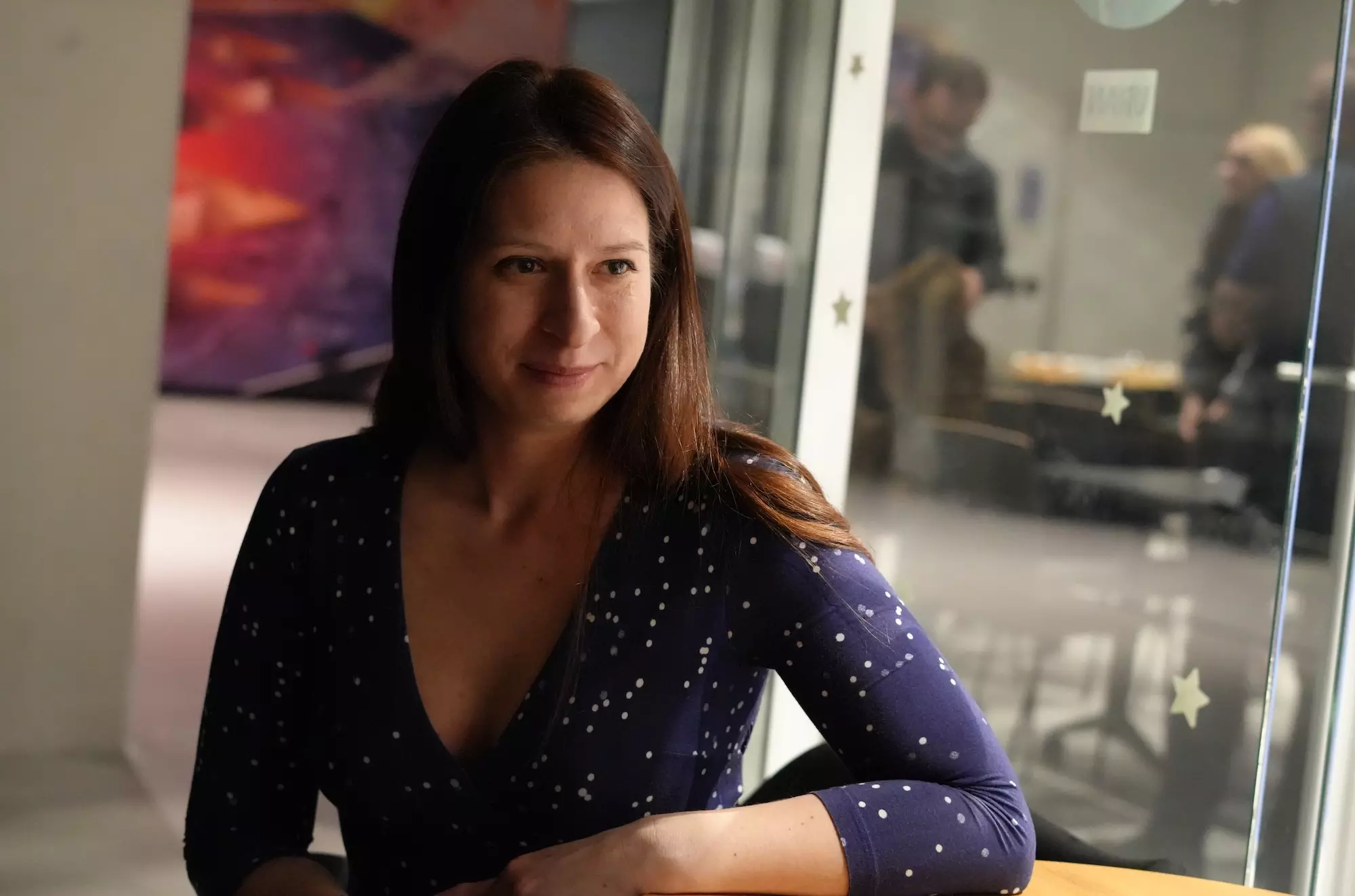
It is said that science begins with surprise. Barbara Handzlik has nurtured this sense of wonder within herself from a very young age. Join us for a conversation about the world as seen through the eyes of a woman scientist who began her quest for knowledge already in childhood with questions about what can be seen in the night sky, and who today – as a qualified scientist – is trying to answer these inquiries. The conversation also touches upon many other fascinating aspects of a life as a woman in the world of science.
“Nicolaus Copernicus inspires me, above all, not to succumb to external pressure. His theories were truly revolutionary for the time, which is why so many influential people disagreed with him. To resist societal expectations, you need to be quite stubborn.”
Barbara Handzlik is an astronomer, graduate of the Jagiellonian University and the University of Warsaw, affiliated with the Silesian Planetarium. She is involved in popularizing astronomy by leading classes, screenings, and skywatching events, as well by collaborating on educational projects. She is a doctoral student at the Jagiellonian University, researching comets and other small bodies in the Solar System, with a particular focus on their rotation as observed using radio methods.
Q: If Copernicus, then…?
Barbara Handzlik: Perseverance.
Q: How did you come to be interested in astronomy?
Barbara Handzlik: My interest in astronomy really began by asking questions; it’s as simple as that. When I looked up at the sky, I didn’t see it as just part of the background; instead, I started asking myself: what’s up there? How far away is it? Why is it like that? I started thinking about it, and then, most importantly, I started looking for answers.
I came across various articles, then visited a nearby astronomical observatory. I’m from Wrocław, and that’s where I had my first encounter with professional astronomy. After that, everything snowballed: my degree, student placements, doctoral studies, trips abroad and observations…
But what has driven me from the very beginning is curiosity about the world. Without it, none of these things would have happened. Above all, I was curious about what was happening up there above us, what was out there.
Q: Did Copernicus have any influence on your passion for astronomy and on the questions that arose? Because he, too, asked himself many questions and sought answers.
Barbara Handzlik: Yes. Nicolaus Copernicus inspires me, above all, not to succumb to external pressure. His theories were truly revolutionary for the time, which is why so many influential people disagreed with him. To resist societal expectations, you need to be quite stubborn.
If someone believes they are right about something, yet everyone around them says they are not, you need incredible self-confidence to stick to your convictions and be able to prove them, because the rationale is what matters most. If someone thinks they are right but cannot prove it, that immediately suggests that something is wrong.
Copernicus had a basis for his reasoning; he didn’t give up despite having many opponents, and that is precisely what impresses me so much. That is exactly why I associate Copernicus with such tenacity and perseverance.
Q: And how did it come about that, as a result of these questions, you took up a scientific career?
Barbara Handzlik: You can read about various scientific curiosities every day, and that’s one thing, but it wasn’t enough for me. For me, it was simply too superficial, and I wanted to explore this world, to investigate what it’s made of, everything I see around me.
A scientific career is a bit of a lifestyle choice – we decide to constantly delve deeper into what we see around us. Above all, it is curiosity – curiosity about the world.
I find that incredibly appealing, and I always wanted to link my future to something along those lines, so that I wouldn’t stop asking these questions, wouldn’t stop being curious.
Q: What is it like to be a woman scientist? You’re already doing research; we’ve seen that across many stations. What is it like to be a woman astronomer?
Barbara Handzlik: For me, it’s above all a passion and a fascinating adventure. At the same time, being a woman in science comes with certain challenges. The very fact that we’re asking such questions suggests that there’s something to it.
I would like to strive for a world where such questions simply aren’t necessary, but, currently, it is no secret that these difficulties do in fact exist.
Q: Or that there are few women in science?
Barbara Handzlik: Yes, there are few women, and men are still more numerous in the upper echelons of science. But this, indeed, is changing slowly, and in astronomy, for example, I see more and more women students. It seems to me that we are heading in the right direction. I still see certain challenges that women have to deal with on their own.
We’ve just heard an interesting lecture on psychological research, which touched on issues such as the tendency for women to doubt themselves far more often.
And I see this in myself as well as in the women I work with – we simply have a lot of self-doubt, which is, in fact, a major obstacle to advancing our scientific careers.
Q: But it can’t stem from your character, because you’ve been asking questions and seeking answers since your youth, and you’re continuing in that direction. You’re acquiring academic degrees. So is it possible that the source of this self-doubt, as demonstrated in that research, is external?
Barbara Handzlik: Yes. It often stems from one’s environment. There is no denying the influence of one’s circumstances on who we are.
Q: Let’s focus on the positive side – that which you gain from this academic journey, which gives you strength. What message would you like to share to inspire other women, particularly young students, to pursue an academic future? Perhaps a reflection on what you are learning, or what is increasingly giving you strength along this path?
Barbara Handzlik: The older we get, the more our minds are occupied with mundane, everyday matters, and we tend to forget a little about what is happening around us. Meanwhile, all these things from various fields – astronomy, biology or chemistry – are so fascinating that I would wish for everyone that this scientific world and perspective would become our new everyday reality.
It is worth being curious. It is worth reading. It is worth taking an interest in a particular field. You can choose any field you like – one in which you simply delve deeper into your knowledge. I believe this is incredibly fascinating and also incredibly stimulating for the brain.
By acquiring and expanding our knowledge, we really work our brains and our understanding of the world, of who we are and what place we occupy in the Universe.
And to all women thinking about a future in science, I wish both perseverance in pursuing your goals and the ability to enjoy every success, no matter how small.
Q: So astronomy is for women as well?
Barbara Handzlik: Yes, definitely. There are no barriers here. Anyone can ask questions; anyone can seek answers. The more you get into it, the more fascinating it becomes; it gives me immense satisfaction. I would like others to be able to experience that too.
We would like to thank Ms. Barbara Handzlik for speaking with us and wish her continued scientific success.