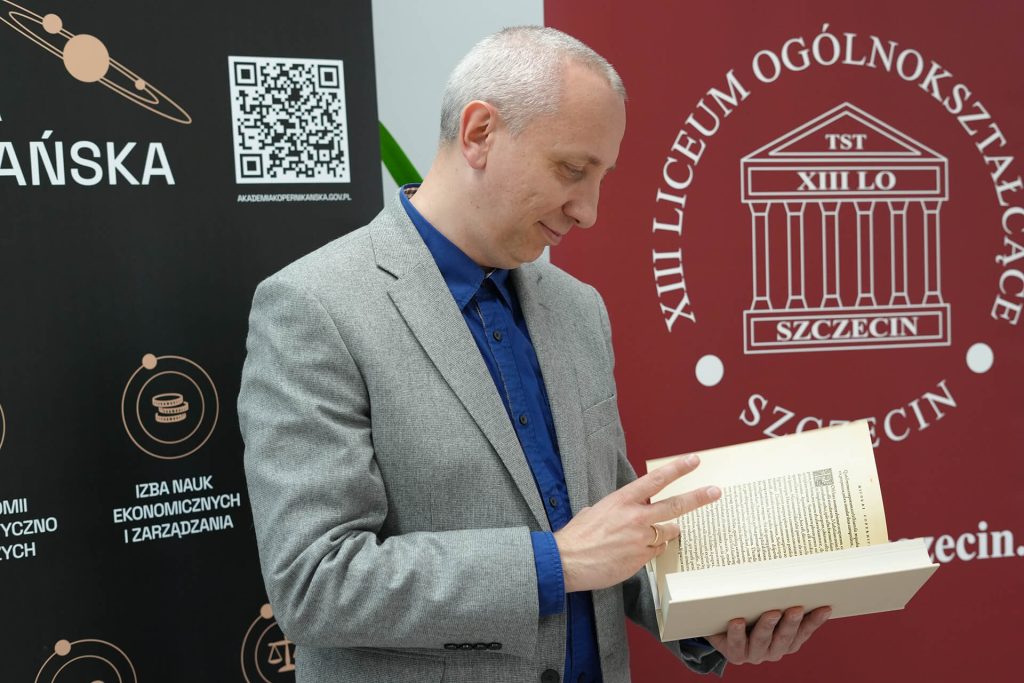
Tomasz Skowron is a physics teacher at Szczecin’s Secondary School No. 13, initiator and main organizer of its Astronomical Competition.
Q: How did you become interested in physics and astronomy?
Tomasz Skowron:
I first became interested in physics and astronomy while in secondary school, thanks to my teacher, who was a runner and got me into running. While running, we talked a lot about physics.
And so I went on to study physics, and there I met Professor Ewa Szuszkiewicz, who specialised in astrophysics. At that time, Professor Wolszczan was still working at the university for a short while. We had a group there that focused specifically on astrophysics.
Later, I ended up here, at this school. After about two years of working here, I met Professor Lech Mankiewicz from the Centre for Theoretical Physics of the Polish Academy of Sciences in Warsaw. He was helping teachers in implementing astronomy education.
A European project emerged, which provided schools with webcams for astronomical observations. We didn’t have a telescope at the time, just a small spyglass, but it turned out that you could do some decent astronomy with that camera – Jupiter, Jovian moons, and our own Moon. Many students attended the sessions – not just those specializing in from mathematics and physics.
We took part in asteroid search campaigns. We have five asteroid discoveries to our name so far.
Out students are registered as discoverers by the International Astronomical Union.
We had the opportunity to name one such discovery; the Szczecin planetoid now orbits in the belt between Mars and Jupiter. We’re also preparing to name another one.
We also conducted observations remotely. In was great in that we didn’t have our own telescopes, but online we had the opportunity to use telescopes in Chile, Australia, and Hawaii. Two-metre telescopes were the largest we worked with. This was thanks to the UK consulate, and we have operated this way many years.
It later turned out that a student who was leaving the school had left a telescope behind; the school then bought another one, and the project gradually grew. We no longer observe remotely. We carry out our own observations, but that was the beginning – very laborious and difficult, but I suppose that’s how it is with everything. Today it’s a really big operation, so to speak, running very smoothly.
It includes the astronomy camps we organise yearly, so every summer over twenty people go on such a camp to learn astronomy.
I remember the first camp we went to – we travelled in a single car; that is, apart from me, there were four other people. Now the astronomy camps are really something that operates systematically.
Q: What you’ve just described sounds as though it were happening at a university. Such observational achievements, collaboration with international centres, and the use of instruments abroad. How does that translate into your own academic and professional development?
Tomasz Skowron:
Well, not in an academic sense, of course, because I don’t do research. Nobody here at the school does research; rather, we help students establish contact with research institutions where they can fulfil their potential.
My professional development, on the other hand, is certainly accelerating rapidly, because I don’t do anything on my own. The students don’t do anything on their own either. We are a team, and we always stress that.
They need me, I need them, and together we work and help one another, because their success is my success. I can say I’ve had some successes, but that’s thanks to them, isn’t it? And they owe a bit to me, and somehow it all works out.
It is precisely through these connections, forged over many years, that I try to guide these students into the world of science – for example, to the University of Warsaw’s Astronomical Observatory, where we go for classes. One of our students went there for a three-week research placement even before starting his degree. He’s now in his third year of study. He also spent three months on an internship at an institute in California and is currently considering whether to continue his career in the United States or to wait a while longer before moving there.
Another group is currently working on issues relating to the movement of satellites between Earth and the Moon. This is somewhat connected to what we’re dealing with today, namely flights to the Moon. This, in turn, involves collaboration with the Space Research Centre. There, we’re working with Tomasz Barciński, and the group is learning to program. They simulate what will happen to a satellite if it accidently breaks apart, if there is a malfunction – how the parts will move in the gravitational field, how to retrieve them, and so on.
So, through our contacts, we are really trying to establish cooperation with various institutions. Of course, this kind of specialised research isn’t carried out in a typical school setting.
Q: Could you tell us about the Astronomical Competition and the Polish National Olympiad? Your school and its students have achieved great success in this field, and you, as the Competition organiser, are perhaps one of its leading figures in Szczecin.
Tomasz Skowron:
Yes, that was also a difficult and laborious journey. At the start, when you haven’t had any success and no one has done astronomy here before, it’s hard to tell the students: “Work hard, it’ll definitely work out great”, because it’s very tough work. Once the first successes come, the group always grows, and then the task becomes easier.
As for the Competition, which is now in its fifteenth year, the idea had been maturing over several years of effort.
We wanted to organise it, but of course I was still a relatively inexperienced teacher at the time and didn’t quite know how to go about it. Initially, it was a one-stage and two-stage competition.
We’ve now reached a point where it’s actually starting to resemble a mini-Olympiad – there are tasks at the planetarium, as well as mathematical and theoretical problems. The Competition consists of three stages, so it has developed significantly over the past fifteen years.
Additionally, our students take part in the Junior Astronomy Olympiad.
Our students and graduates form part of the Olympiad committee – today, these are students of physics and astronomy who themselves previously participated in the Olympic competition here. Now they compose the questions themselves, serve on the committee, and evaluate the entries.
This year marks the second edition of this Olympiad, in which our students are also achieving success.
The main contest is, of course, the Astronomical Olympiad. For many years, it was difficult for us to make our mark there – occasionally someone would reach the finals, at other times they would not. However, from a certain point onwards, when our current graduate, a doctoral student at the University of Tokyo, achieved success, everything changed. In his third year of middle school, he already became a finalist in the high school Olympiad. This was an inspiration to everyone.
After that edition, in a surge of positive energy, he even wrote a guidebook for Olympiad participants, entitled The Astronomy Enthusiast’s Handbook (Vademecum miłośnika astronomii). He printed two hundred copies himself and handed them out to friends. He left a few with me so that future generations could learn from them.
Since then, the group has grown considerably. Within a few years, he himself had competed in the International Olympiad, where he won a medal, and others followed in his footsteps.
In recent years, between three and five students from our school have been among the twenty finalists. Over the last four years, at least one student has gone on to compete in the International Olympiad.
We also have the pleasure of running preparatory camps for international Olympians, organized by the General Committee. The team meets during the summer holidays. This year I’m also heading to Niepołomice to the Astronomical Observatory, where we’ll spend a week preparing for the International Olympiad on Astronomy and Astrophysics at secondary-school level.
Q: You mentioned that the winners of the Astronomical Competition of the West Pomeranian Voivodeship support you in preparing the questions and conducting the competition.
Tomasz Skowron:
Yes, it looks a bit as though I’m on my own in the Competition committee. However, there are three of our graduates on the committee who now study astronomy and astrophysics, and who help me draft the questions for the Competition. This is, of course, because a three-stage undertaking like this is no longer a job for one person – it simply isn’t feasible.
Q: Last year, we had the pleasure of meeting your pupils, the winners of last year’s International Olympiad on Astronomy, who told us during their stay at the Academy that their greatest inspiration was their teacher. They have brought for you a present from us. We are delighted to meet you today and to hear that this gift has arrived, and we hope it serves as a token of appreciation for your work in nurturing hopeful future Copernicuses.
Tomasz Skowron:
I am also very pleased, thank you.
Let me also say that visiting you last year was Jasmina Nurković, our graduate, and a year earlier it was her colleague Michał Jagodziński, who also became an International Olympiad medallist. He too supports me in this competition, comes to our summer camp and runs classes for future generations.
At this school, it seems that the greatest strength, besides us teachers, lies with the students and graduates.
We educate them in such a way that they support us and help run classes for the younger students. I wouldn’t have been able to organise this summer camp on my own – it’s simply not possible when there are over twenty people taking part.
At the moment, we’re running separate sessions for each year group, and every graduate prepares sessions for years one, two, three and four. I also lead the youngest group, introducing them to the programme. The older students, who have more Olympiad experience than me – as I’ve never competed in an Olympiad in my life – take care of working with the older pupils.
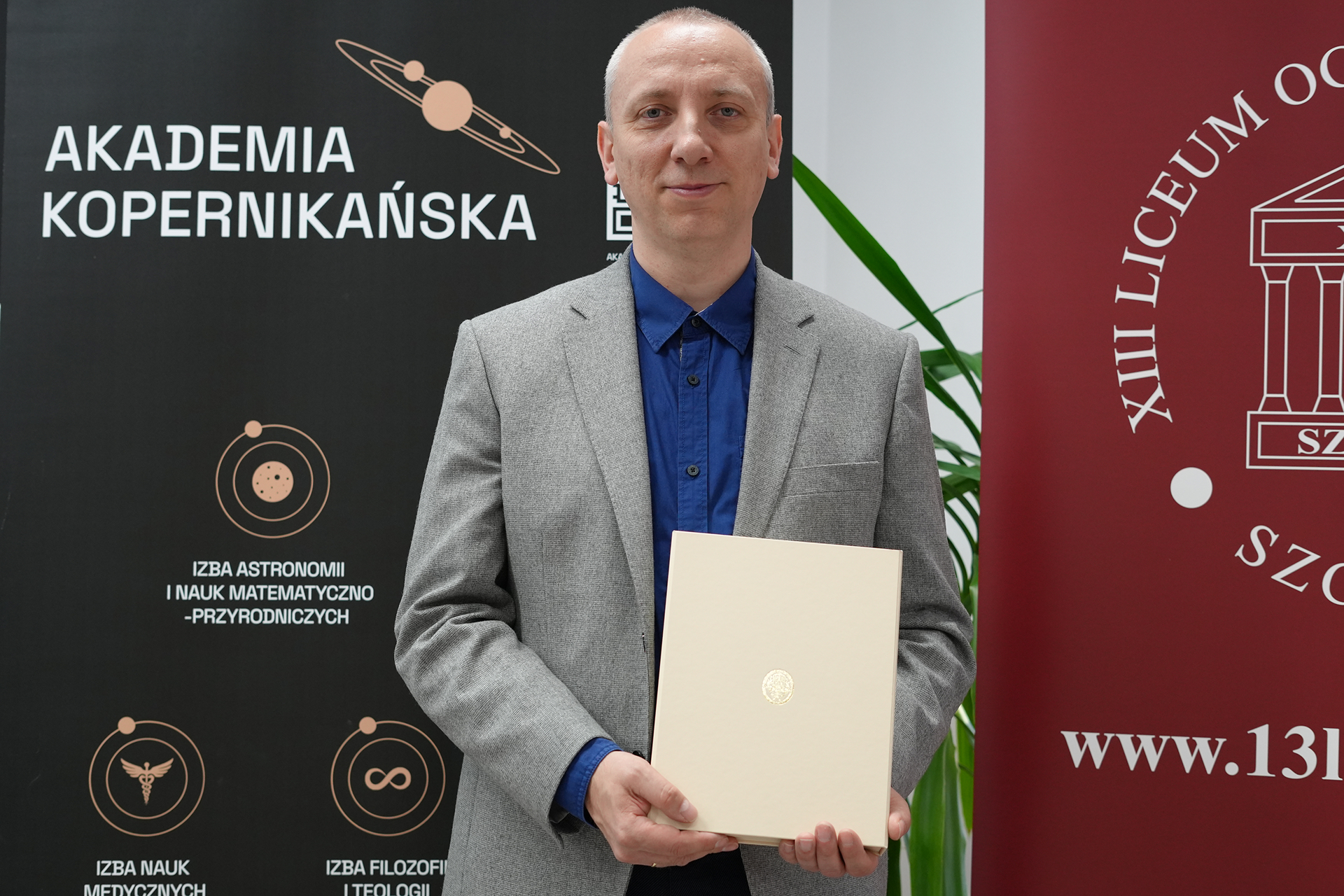
The photo shows Mr. Tomasz Skowron holding “The Revolutionibus Celesti”[PT1] , a gift from the Copernican Academy to Jasmina Nurković, which she passed on to her physics teacher in gratitude for his many years of dedication and her success in the Olympiad.
Q: You began your journey towards astronomy in a multidisciplinary manner – sports played a significant role in it. We also know that past winners support their schools and younger Olympians, a trend that can also be observed in other centres, such as in Krosno. This demonstrates openness and continuity in the cultivation of passion and knowledge.
What advice would you give to physics teachers? How can such centres be established and developed in Poland?
Tomasz Skowron:
This is a very difficult topic, because, unfortunately, the compensation for this profession in no way motivates teachers. The fact that teaching works out for me stems only from the fact that I simply enjoy it. Someone once spread this enjoyment onto me, and I do many things without thinking about the financial side of things. But it’s hard to expect teachers in Poland to act in the same way.
I could say that they should definitely pass on their passion to their students, but that involves a huge sacrifice of their personal time, and it’s hard to expect that of them. It’s complicated in that teachers are expected to give the job their absolute best. I enjoy it, so this is just how I operate, but there aren’t many teachers like that, and that’s hardly surprising.
AK: Copernicus was also passionate about astronomy and didn’t count the time he devoted to it.
Tomasz Skowron:
Indeed.
AK: With that in mind, we wish Poland as many such enthusiasts as possible – people who don’t treat the time spent inspiring young people as a waste, but as something valuable and rewarding.
Tomasz Skowron:
Of course, I agree that it’s worth devoting oneself to one’s passion. Our graduates who come to the summer camps and support me in organising the competition do so out of passion too.
That is probably because we met along the way. They do not get paid for it – they sacrifice their holidays, the hours spent on preparations, and their personal time. In a way, that passion is infectious. It is not about money or a lack of difficulties – for them, it is only natural to make sacrifices.
But I realise that, in a wider context, that may be difficult.
Q: Could you tell us a bit more about the teacher who was honoured here today?
Tomasz Skowron:
That would be Ms. Elżbieta Bartków from Gryfino – we’ve known each other for over a decade. She’s the sort of passionate person who doesn’t count the hours she commits to her work or worry about whether she’s being paid to run her club. She always has crowds of students. She brings them here on Saturdays, in her own free time.
I also know that they have a tradition where, after our celebrations, Ms Elżbieta takes the students out for pizza at her own expense and they celebrate in their own way. She really is someone who spreads a love of astronomy in Gryfino.
We also have a former student in common – Dr Piotr Kołaczek-Szymański, who is now a doctor of astrophysics. He began his journey in Gryfino, continued it with us, and now supports us himself. We’re still in touch – we call and meet each other.
That is also very nice, because although the students move away and could forget about us, we still keep in touch. It’s a kind of intangible reward – we call each other during the holidays, write to one another, and sometimes meet for coffee when possible.
They’re often scattered across the globe, so contact isn’t always direct.
I visit Warsaw quite often – many of our graduates live there, and so we organise meetings with the students there.
We would like to sincerely thank Mr. Tomasz Skowron for this interview and wish him further success in his teaching career.