
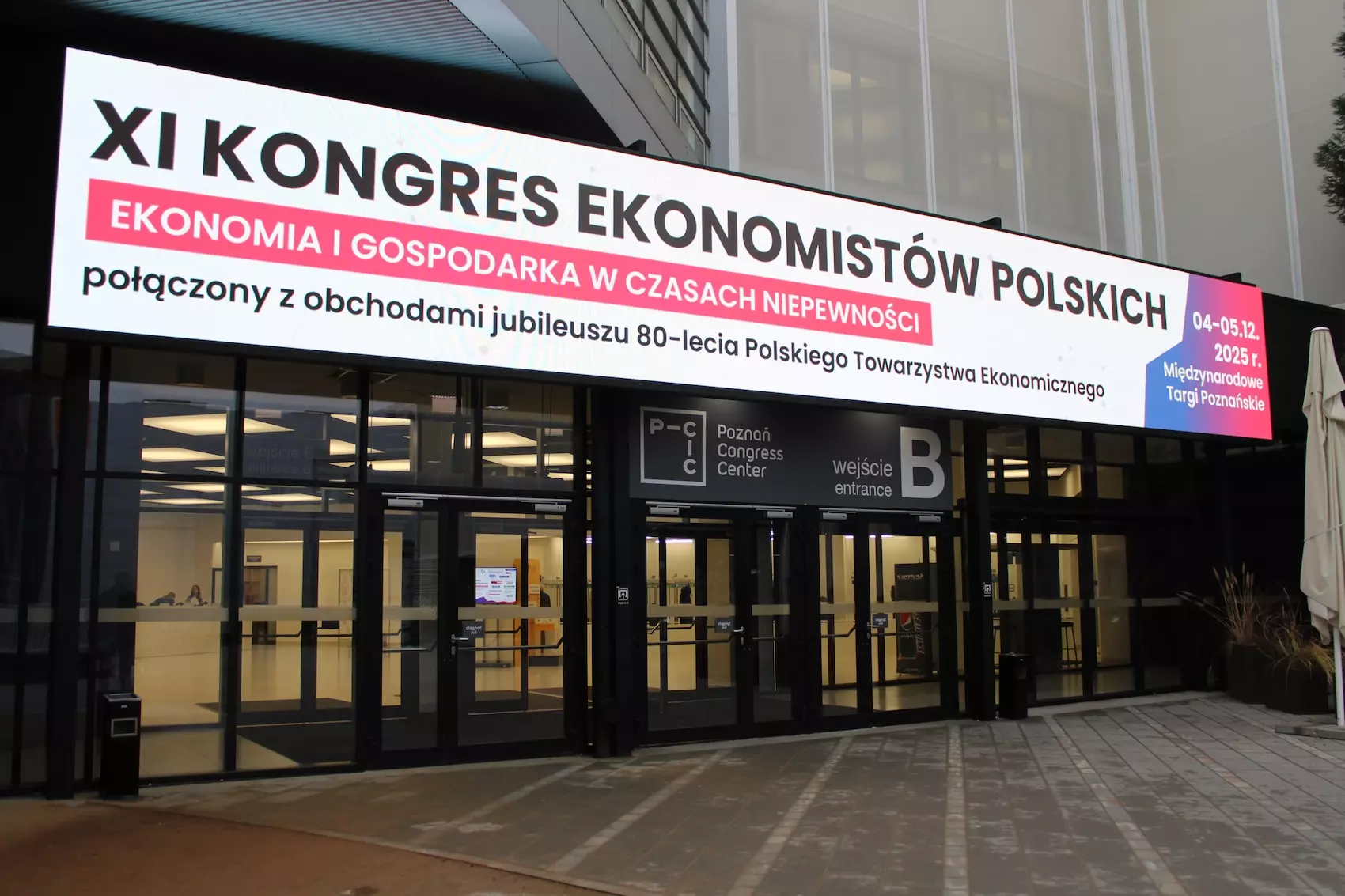
The 11th Congress of Polish Economists was an event of exceptional importance for Polish economic thought, public debate, and the future of the country’s economy. This year’s edition took place under the theme “Economics and the Economy in Times of Uncertainty,” aptly capturing the nature of the challenges facing Poland and the world today.
Organized on the 80th anniversary of the Polish Economic Society (PTE), the Congress was not only a gathering of outstanding economists, but above all a platform for serious, interdisciplinary discussion on Poland’s development paths and on ways to strengthen the country’s competitiveness.
As emphasized by the President of PTE, Professor Marian Gorynia, the Congress represents an event of exceptional intellectual and social significance. Among the eleven reasons for organizing it, he highlighted in particular:
- continuing the long-standing tradition of meetings among Polish economists,
- taking stock of the changes of recent decades and setting directions for the years ahead,
- strengthening economic awareness in society and showing the real determinants of economic life,
- inspiring reflection on Poland as an economy that uses its resources efficiently,
- conducting an honest debate about challenges, mistakes, and future scenarios that can enhance the country’s competitiveness.
“The economy is not only about numbers. It is also about citizens’ quality of life, their security, opportunities for development, and their sense of agency.”
A New Program Structure
This year’s Congress introduced an expanded and more structured academic program, as noted by Marek Kośny, Chair of the PTE Scientific Council. The program rested on three complementary pillars:
- Plenary sessions– keynote addresses that set the direction for the entire Congress, featuring world-class experts such as:
- Dani Rodrik (Harvard University) – a renowned economist known for his work on globalization and economic policy,
- Beata Javorcik (University of Oxford) – an internationally recognized expert on foreign investment and economic integration.
- Panel sessions – thematic discussions devoted to globalization, demography, prosperity, climate change, democracy, and artificial intelligence.
- Paper sessions – a new element of the program, allowing researchers to present their work and creating space especially for younger scholars.
In total, the Congress hosted 54 sessions and 161 presented papers, demonstrating both the breadth and depth of the debate.
The Congress took place under the patronage of the President of the Republic of Poland. During the opening ceremony, Bogdan Ślusarz, Vice President of PTE, thanked all partners and sponsors of the Congress, including strategic sponsors such as the Copernican Academy.
The Vice Marshal of the Greater Poland Voivodeship, Wojciech Jankowiak, and the Mayor of Poznań, Jacek Jaśkowiak—both honorary guests—underscored the role of the Congress as a forum that connects regional policy analysis, local government experience, and the country’s scientific potential. They pointed out that the development of cities and regions closely depends on the quality of education, research, and innovation, and that Poland’s future requires stronger cooperation between academia and the economy.
“If we do not invest in technology and science today, if our universities cannot compete with the best in the world, we will not overcome the next stage of development (…) We must place strong emphasis on science and on its authority—without that, we will achieve very little.”
Poland’s Economic “Golden Age”
Marcin Piątkowski—a Polish economist with more than 25 years of academic experience at SGH Warsaw School of Economics and Kozminski University, an adviser to nearly 20 countries, and currently the World Bank’s lead economist for South Asia—argued that Poland is experiencing its economic golden age: a period of the fastest growth in Europe that creates room for long-term planning. In his view, for Poland to move from being a “champion of catching up” to a “champion of leading,” the country needs a new vision built around five pillars:
institutions, investment, innovation, smart migration, inclusiveness.
He concluded his speech with a quote attributed to Michelangelo:
“The greatest danger is not that we aim too high and fail, but that we aim too low and succeed.”
A Business Perspective
Krzysztof Domarecki (Selena Group) began his remarks by recalling Poland’s economic success—something that seemed almost impossible three decades ago, when Europe viewed Poland more as a problem than as a candidate for the group of the world’s fastest-growing economies. Today, after reaching a GDP level of USD 1 trillion, Poland faces the challenge of doubling the size of its economy. He identified four key challenges:
demographics, energy costs, ownership structure, entrepreneurial culture.
Further growth will require courage, a search for new sources of development, and a departure from outdated ways of thinking—especially in energy policy and attitudes toward private capital. In his view, Polish entrepreneurs and private companies hold the largest, still underused potential to lead the economy toward a second trillion dollars in GDP.
“One trillion dollars is not enough—in a world of tensions and rivalry, economic strength determines a country’s security.”
The 11th Congress of Polish Economists was not merely a regular meeting held every five to six years. Above all, it served as a forum for reflection on Poland’s economy and as a place where ambitious ideas and development-oriented recommendations take shape.
The Nicolaus Copernicus Academy was proud to accompany this event, whose outcomes and conclusions will make an important contribution to the debate on Poland’s future.
More information about the Congress, along with an excellent photo gallery, is available at
https://kongres2025.pte.pl/relacje-z-kongresu/.
We warmly encourage you to visit the website.