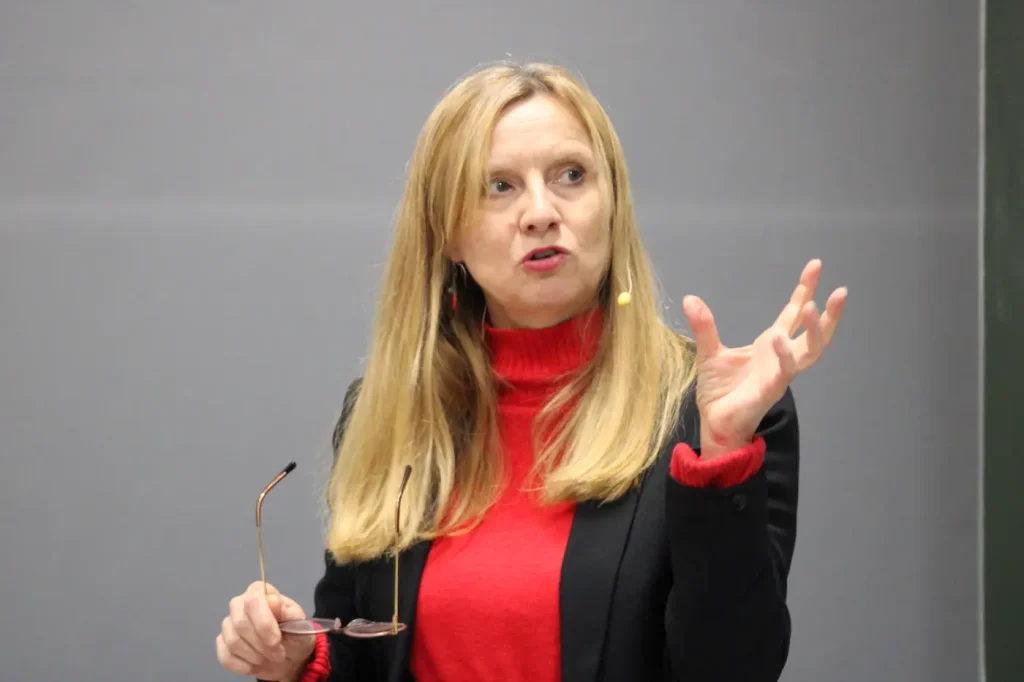
During this year’s Congress, we had the opportunity to speak with Agnieszka Marianowicz-Szczygieł, a psychologist and journalist, and President of the She and He Foundation. On the first day of the Congress, she led workshops focused on recognizing and countering fake news.
Ms. Marianowicz-Szczygieł pointed out that we still too easily get carried away by new technologies. First comes enthusiasm; reflection follows only later—often bitterly—and then we are left to “clean up” the consequences.
This is particularly dangerous in a world where fake news can instantly shape our emotions and decisions before we have a chance to verify it. Such content can also cause real social harm by undermining trust in institutions and deepening divisions between people. What we lack is not only regulation, but also vigilance and critical thinking.
How can we protect ourselves from fake news?
Above all—by checking. A practical tool here is the I VERIFY acronym developed by NASK (Poland’s National Research Institute), which helps quickly assess whether information may be false. It encourages users to verify, among other things:
- evidence and sources,
- the author
- the credibility of the message,
- the presence of sensationalism, provocation, or manipulation.
Most importantly, however, we should always ask ourselves one simple question:
“Why was this information published, and who does it serve?”
The topic of fake news closely aligned with a lecture by Olaf Szymański from the Institute for Internet and Social Media Research, who spoke about attention algorithms and the influence of Big Tech on young users.
Today’s platforms are not competing primarily for data, as the average internet user might think. They compete for our time, our emotions, and above all—our attention. Algorithms analyze thousands of reactions per minute, designing content feeds to keep users engaged for as long as possible. They are not neutral; they are designed to manipulate our attention.
The group most vulnerable to their impact is young people aged 13–18, whose brains are still developing and whose capacity for self-control is still forming. We must remember that platforms are not designed to educate—they exist to generate profit from time spent on screens. The consequences for young users are becoming increasingly serious and increasingly well documented.
Research and high-profile scandals reveal that platforms:
- increase anxiety and depression,
- lower self-esteem,
- lead to behavioral addictions similar to gambling,
- deepen problems with concentration.
That is why it is so important for parents, educators, and young people themselves to understand how digital mechanisms work and to learn how to set boundaries.
This is not about restricting technological development or treating technology as inherently harmful. It is about developing the skills needed to use it thoughtfully, responsibly, and with awareness.