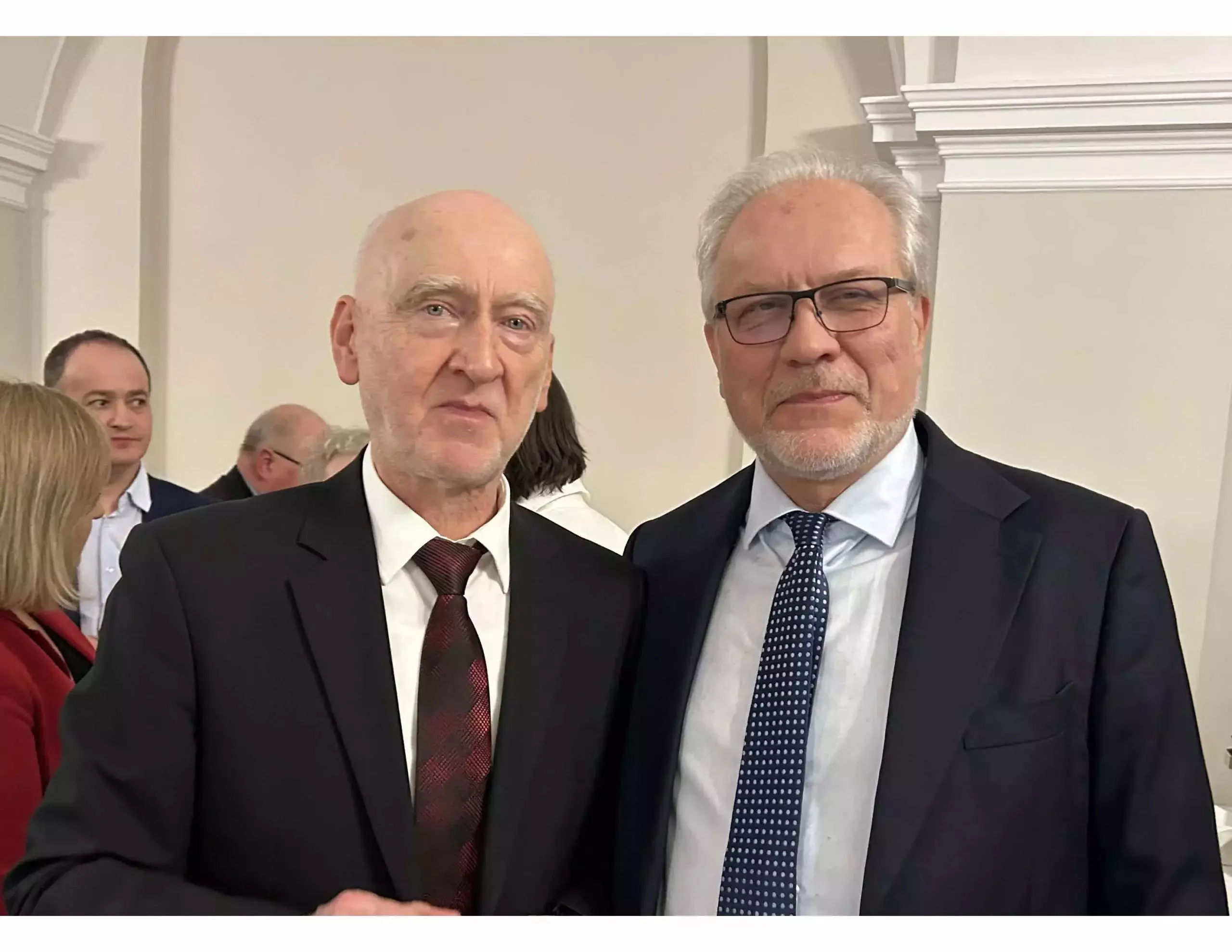

How can we mathematically “stretch out” the celestial sphere on a flat map, without losing precious data on the beginning of the Universe? We invite you to listen to a programme hosting Professor Górski – NASA JPL and Caltech astrophysicist, and current Secretary General of the Nicolaus Copernicus Academy.
The conversation focuses on the evolution of precise cosmology and the tools which became world-standard across missions such as COBE or Planck.
- On the “bottleneck” of contemporary science:
“It has been created with mathematical premises of a kind which will allow us to do what in contemporary science is, generally, a bottleneck […] It allows us to more quickly make mathematical calculations, and so we can more easily engage in interpreting models and confront theories.”
- On the paradox of dark matter and dark energy:
“It defined a mathematical model which leaves us facing a paradox – […] a mathematical model in which unknowns constitute the lion’s share of defining factors.”
- On the search for the traces of cosmic inflation (the LiteBird mission):
[T]his effect will, hopefully, allow us to solve another mystery related to the currently dominant physical model, which is reliant on the existence of an era of cosmic inflation shortly after the Big Bang.
- On the transition from theory to precise measurements:
“Now, […] most numerical parameters in the mathematical model which describes the universe are known with precision much greater than one percent.”
Additionally, Professor Górski shines a spotlight onto the factors underlying international scientific cooperation, as well as onto the chances of Poland’s involvement in upcoming groundbreaking orbital missions.
Krzysztof Michalski, editor
In this segment of Eureka: “Explorers’ Evening” and the aforementioned conversation with one of the most world-renowned astrophysicists, engaged in research on cosmology, author of celestial-mapping software, laureate of the Prize of the Foundation for Polish Science, decadeslong researcher at NASA’s Jet Propulsion Laboratory at the California Institute of Technology – that is, Caltech – in Pasadena.
My guest is also a joint laureate of the most prestigious international award in the field of astrophysics – the Gruber Prize in Cosmology. In Poland, he has worked many years at the Astronomical Observatory of the University of Warsaw, and, since 2023, is the Secretary General of the Nicolaus Copernicus Academy.
Joining me in the studio is Professor Krzysztof Górski. Welcome, Professor.
Professor Krzysztof Górski
Good day, thank you, and good day to our audience
Krzysztof Michalski
Professor, you received the “Polish Nobel Prize” (the Prize of the Foundation for Polish Science) for developing and implementing a methodology of analysing maps of microwave background radiation, also known as relic radiation. It is the oldest known type of radiation in the universe. It can be said that it’s a trace of the Big Bang. You developed an instrument of analysing astronomical data from scans of the entire sky – the HEALPix[PT1] method. Could you tell us about this instrument? What can it do? It is, after all, used not only in scientific research.
Prof. Krzysztof Górski
On the fundamental, mathematical level it is a method of projecting a sphere onto a flat surface, that is, of creating maps which, like those in an atlas, we study from Earth using various methods.
Krzysztof Michalski
So it is converting a three-dimensional object into a flat one. Is that correct?
Prof. Krzysztof Górski
Exactly. It has been created with mathematical premises of a kind which will allow us to do what in contemporary science is, generally, a bottleneck, especially when we enter a further stage of research and use stronger or, in other words, more efficient instruments. It allows us to more quickly make mathematical calculations, and so, we can more easily engage in interpreting models and confront theories. Thanks to this, the algorithm has been so successful, that it now plays a crucial role in the field of background radiation research. By now, it has spread throughout all of astronomy, since it is used, generally speaking, by everyone who makes celestial maps, whether partial or comprehensive. In a way, it turned out to be the biggest surprise of my life as a scientist, seeing as the article we wrote in 2025 has already been cited by professionals over 5000 times. It is a gigantic number, and it keeps growing, as does the number of the algorithm’s users – researchers both young and senior.
Krzysztof Michalski
It seems there are already some 100 thousand users of this method.
So, Professor, it is a net, which allows astronomers to transfer a three-dimensional image of the sky onto a flat surface without distortions, and this solution has become a world-wide standard, including in NASA and in ESA – the European Space Agency. You mentioned that this tool is used not only by researchers studying space, but also by those researching Earth, is that right?
Prof. Krzysztof Górski
Exactly. Already in the Jet Propulsion Laboratory, I have come across colleagues who model and organize Earth observations.
Krzysztof Michalski
That is to say, in meteorology and seismology, correct?
Prof. Krzysztof Górski
For example, yes. They have found the instrument useful. We also used it to model the surfaces of other planets. In other words, we’re working on the Solar System, on astronomy, and on the surface of Earth.
Krzysztof Michalski
Does that also mean working on gravitational waves?
Prof. Krzysztof Górski
In the future – yes. Some of our tools have, of course, been used to correlate measurement date of gravitational waves with other aspects of astrophysics. That is, to interpret what gravitational waves show us. It’s an unending process, and it has been an endless success so far.
Krzysztof Michalski
However, the algorithm has been used not only in large-scale observation of the entire sky. You truly became one of the most world-renowned experts in mathematical construction and celestial-map analysis, Professor. You have been in engaged with some of the most important space missions, such as COBE and Planck.
Let’s begin, with the COBE mission, and remember that it was the first artificial satellite constructed by NASA, back in the ’80s.
It was equipped with an instrument for detecting irregularities in the microwave background radiation. The mission lasted four years. Could you please tell us about your involvement in this groundbreaking mission?
Prof. Krzysztof Górski
I was a relatively young man back then – just two postdocs into my career.
Krzysztof Michalski
Yes, you were a little more than 30 years old, Professor.
Prof. Krzysztof Górski
Yes, I landed a position at the Goddard Space Flight Center and had been in a transitional period between being engaged with that large-scale structure and seriously involving myself in researching background radiation.
COBE gave me that option. It was a groundbreaking event in my life or, rather, in my professional development. And so, I worked at COBE on what I have been working on since.
That was the early 1990s. There was no HEALPix yet, and we were using other mathematical instruments for data analysis. But the knowledge I had while working with those data eventually lead, some years later, to HEALPix’s creation – when instruments much more powerful and advanced than COBE began to be realized, such as WMAP and, later, Planck.
That is exactly what I worked on. COBE gave us celestial maps which showed some six thousand independent elements. Numerically speaking, it was trivial work from today’s perspective.
Krzysztof Michalski
But that was more than 30 years ago, Professor.
Prof. Krzysztof Gorski
That was the beginning and period of transition into a much more advanced mathematical-algebraic methodology in data analysis. There, I made use of the knowledge I gained in Poland, since that was what I studied at university.
Krzysztof Michalski
At Nicolaus Copernicus University, and then at the Nicolaus Copernicus Astronomical Center.
Prof. Krzysztof Górski
Exactly. In that way, it is all a logical progression, and describes my scientific career.
Krzysztof Michalski
Speaking about that progression, you were also a key member of the 2009–2013 Planck mission team, which, one could say, provided astronomers with the most precise data on background microwave radiation.
It was a mission of NASA and the European Space Agency. What was your role in that mission, Professor?
Prof. Krzysztof Górski
Well, here we have to look at a broader timescale, since the COBE mission ended in 1996. I moved to Europe for some years, and got involved with the Planck mission, which was just emerging. At that time, satellite projects were being implemented, but the science team was just forming. It was since then, since 1997, that I took part in it. Then, since the need arose, I developed the HEALPix method, which was meant to handle the sea of data that Planck generated. The satellite itself was launched only in 2009, but that was preceded by a some 10–20 years of work, and it came to a close only at the end of the 2010s.
That was, I think, in 2015, ’16, or ’17, depending on how we want to look at it, so it was a long-term, long-lasting process. And what was my role there?
Well, I was already an expert when I got involved in the Planck mission, since I had experience at COBE. I brought with me new tools, became involved in some aspects of both planning and development of the entire instrument, and, later, in simulating the astrophysical effects it was to observe.
When data appeared, they had to be analysed, and those processes needed to be developed.
Krzysztof Michalski
And there were a lot of data, were there not?
Prof. Krzysztof Górski
Given the times, yes, it was a flood of data. That is one of the fields that is now changing very quickly, and 20 years later it would have been a small issue. At the time, though, it was a problem in need of a solution, which we were then developing.
Some years later, in 2003, I moved from Europe to the Jet Propulsion Laboratory in Pasadena. There, I educated my younger colleagues and organized the team which developed scientific algorithms for analysing that type of data.
The goal was to manage the creation and operation of the instrument together with interpreting scientific data – in such a way that we could create a model for describing the universe. It is a whole mountain of work – administering these data, etc. That is what I worked on.
Krzysztof Michalski
Let me remind our audience: it was thanks to this research, and thanks to Planck, that it was possible to determine that the universe was born 13.7 billion years ago. The cosmic background which was researched came from 370 thousand years after the Big Bang. What is a mere 370 thousand years? Isn’t that right, Professor?
Prof. Krzysztof Górski
Well, yes, these are the ramifications of our understanding of the universe. The way in which we understand it and express our understanding with mathematical and physical models is based on a foundation which has largely been created through research on background radiation.
My entire field was wholly non-existent before 1965 – background radiation was discovered in 1965. In 1992, using COBE, we noticed its effects, which revolutionized cosmology.
The models which were being developed throughout the 1980s turned out to be incorrect. Everything needed to be adjusted. The accuracy of measurements did not satiate the researchers.
Because of this, projects of the American WMAP satellite and the European-American Planck very quickly emerged. We achieved that in a few short decades, with the help of a sequence of three satellites dedicated to such measurements. In cosmology, such a transition is almost unimaginable.
When I was still a student and a postdoc, cosmology was a funny field – we joked about how much of an achievement it was say anything with a precision of a factor of two.
Now, Planck has led us into a new era, in which most numerical parameters in the mathematical model which describes the universe are known with precision much greater than one percent. It is the field of so-called precise cosmology. Just some 10–20 years ago, this name would sound like an oxymoron.
But now, that term is in use, and it handcuffs all my astronomer colleagues who research other phenomena; so much so, that they are no longer free to jump from one limitless model to another.
They have to be very careful, because they need to work with the Planck-defined model and its limits – mostly in terms of the precision it imposes.
Krzysztof Michalski
Was it not the Planck mission that also established the composition of the universe? It was remarkable, that ordinary matter turned out to make up only 5 percent of it, with the rest being dark matter at 26 percent, and dark energy at 69 percent. That, too, was a groundbreaking discovery. It is surprising to this day, because we still don’t really know what hides behind the terms “dark matter” and “dark energy”. Isn’t that true?
Prof. Krzysztof Górski
Yes, Planck also contributed to this strong foundation of measurement precision. It defined a mathematical model which leaves us facing a paradox – one which we will need to solve.
Future generations might – will have to – bring us someone who will, hopefully, answer these questions. I need to underscore the breadth of the phenomena we research. That scope is the entire universe, as described by a theory of physics which is as of yet incomplete with regards to our understanding of its various effects. It also extends to microscopic phenomena. Here, we are discussing the precision of a mathematical model in which unknowns constitute the lion’s share of defining factors.
As you said, dark matter and dark energy are physically unidentified. They remain wholly untouched by any physicist in any laboratory. Through astronomical methods, we are trying to understand them.
Without them, our model makes no sense, whereas with them, it is precise, exact, and describes the universe as if it were incredibly simple and mathematically uncomplicated.
This is why I said it is a paradox. It needs to be solved on a fundamental level.
Krzysztof Michalski
Since you also mentioned the future and the present: while Planck is still contemporary in some sense, you are also involved in the international Japanese LiteBIRD satellite mission, which is meant to investigate the earliest moments of the universe’s existence. It seems that its first launch was scheduled for 2030, but has now been moved to 2032.
Could you tell us about the main goals and expectations of this mission?
Prof. Krzysztof Górski
The goals of what took place at COBE – that is WMAP, Planck, and various nonorbital experiments – were mainly focused on investigating the temperature of background radiation, its distribution across the sky, and precise measurements, as well as aligning all of this with mathematical models.
Another aspect of background radiation – which was, until recently, unmeasurable – is its slight polarization. Radial effects upon the surface of the last scattering is such that it presents us with a polarized signal on the level a few percent.
If we can conclusively measure it – precisely and in a large range of physical scales – this effect will, hopefully, allow us to solve another mystery related to the currently dominant physical model, which is reliant on the existence of an era of cosmic inflation shortly after the Big Bang. This inflation should have left a sea of gravitational waves in the form of relic radiation across the universe. Its effects on background radiation have specific signatures, which might someday be measurable.
At this moment, these are outside of our measuring range. In order to create instruments capable of making those measurements, we will likely have to wait some two decades, since nobody has enough money dedicated towards this goal.
Perhaps in the 2040s, a new space mission able to measure all this will materialize. LiteBIRD, started by Japanese researchers, is a more modest project.
Krzysztof Michalski
It is international, though, is it not? It has been joined by Americans, and 10–20 European countries.
Prof. Krzysztof Górski
That is exactly right. The project was meant to measure – on some level – precisely these signatures resulting from the existence of gravitational waves across the universe.
Its goal is to find them, since we have not, as of yet, observed them conclusively. For now, only the upper limits for their existence are in place. The project was more modest in terms of the resolution, sensitivity, etc., that it was meant to achieve.
These are technical aspects, but it could have been an intermediary step towards a much bigger and more powerful instrument, which, hopefully, will be created in the future. I wanted to create a situation in which Poland would enter this project – in which we became a partner.
Some years ago, we have had talks which were meant to end with such a partnership. We were already promised funding. I wanted to lay the ground for the government to commit to financing the project for about 10 years, so as to keep it secure. Well, for now it is all thoroughly suspended. The political situation has changed, and, for now, I have little idea of what will come of it.
We had already exchanged letters of intent, and were supposed to take part in the project.
Krzysztof Michalski
Yes, I did see photos of your conversation with the Japanese representatives of the project. Am I not mistaken?
Prof. Krzysztof Górski
Not at all. In brief, I expected to be able to use my reputation and history of working on such projects to introduce Poland into this cooperation. That is what I wanted to achieve, and I do think that the path towards it was clear. It still remains clear, but we will see what the future holds.
Krzysztof Michalski
Indeed. With that, I think we can conclude our conversation. However, I would like to ask one more question: what can we wish you, Professor, as well as Polish astrophysicists broadly?
Prof. Krzysztof Górski
Polish astrophysics is excellent across many fields which I am not personally involved with. I do have amazing colleagues in various centres. We should wish them, simply, a broader understanding that, as a community, Polish astronomers stand out – in my opinion – from the average in Polish science, as far as their achievements are concerned.
And we should also wish them stability – speaking plainly: this always comes down to funding – and further successes. I wish them all of this. As for myself, I wish some of the ideas I mentioned would come into fruition.
Krzysztof Michalski
Then this is also what I wish for you, Professor, and what I wish Polish science and Poland. Today’s guest at the “Explorers’ Evening” in Eureka has been Professor Krzysztof Górski, one of the most world-renowned astrophysicists, author of celestial-mapping algorithms and software, a decadeslong researcher both at NASA’s Jet Propulsion Laboratory at Caltech in the United States, and at the University of Warsaw, joint laureate of the Prize of the Foundation for Polish Science and the Gruber Prize, and, since several years, Secretary General of the Nicolaus Copernicus Academy.
Thank you very much once again, Professor.
Prof. Krzysztof Górski
Thank you.
Krzysztof Michalski
Until next time, I have been Krzysztof Michalski.