
Based on:
Monuments of Nicolaus Copernicus in Frombork, Jagoda Semków (Nicolaus Copernicus Museum in Frombork). pp. 549-562 [in:] Nicolaus Copernicus and Warmia: On Regional Memory on the 550th Anniversary of His Birth and 480th Death / Edited by Andrzej Kopiczko. Pelplin, 2023.
The full article is available below.
Nicolaus Copernicus, the brilliant Renaissance astronomer, spent most of his adult life in Frombork – over 30 years. As a canon of the Warmia Chapter, he performed ecclesiastical and administrative duties here, managed the chapter’s estates, and, above all, conducted astronomical observations and wrote his groundbreaking work De revolutionibus orbium coelestium. Frombork became the place of his death in 1543 and burial in the archcathedral basilica. Despite this, the commemoration of Copernicus in this city was delayed – for centuries, epitaph plaques dominated, and the first monuments did not appear until the 20th century.
Today, Frombork boasts several monuments and forms of remembrance that pay tribute to the scholar in various styles and historical contexts.
The first attempts to commemorate Copernicus in Frombork date back to the 16th-18th centuries, but were limited to plaques in the cathedral. In 1581, Bishop Marcin Kromer funded an epitaph, which has been lost, and in 1735, the chapter added another one with a portrait of the astronomer, which has been preserved to this day on a pillar in the north nave. Plans for a larger monument, conceived by Bishop Ignacy Krasicki and King Frederick II of Prussia, among others, were never realized.
The breakthrough came at the beginning of the 20th century. In 1909, thanks to the initiative of the Warmia Historical Society and the support of Emperor Wilhelm II (who donated 20,000 marks), a monumental monument was unveiled on the western side of Cathedral Hill. The architectural design was prepared by Max Emanuel Meckel, and the sculptural elements by Joseph Julius Seitz. It was a nearly 30-meter-high brick tower on a granite base, topped with turrets and the Prussian eagle. A bronze portrait of Copernicus with a lily of the valley and a Latin inscription about the search for truth was placed in a niche. Above it were symbols of the planets and the zodiac, and at the top were the names of great astronomers: Galileo, Kepler, Newton, and Gauss. The monument, visible from afar, survived until 1946, when it was destroyed after the war. The surviving bust is now in the Nicolaus Copernicus Museum in Frombork.
A true renaissance of commemorations came in 1973, which was declared the International Year of Copernicus by UNESCO, on the occasion of the 500th anniversary of the astronomer’s birth. Several monuments were erected in Frombork at that time, reflecting the involvement of various groups: scouts, the public, the authorities, and the Church.
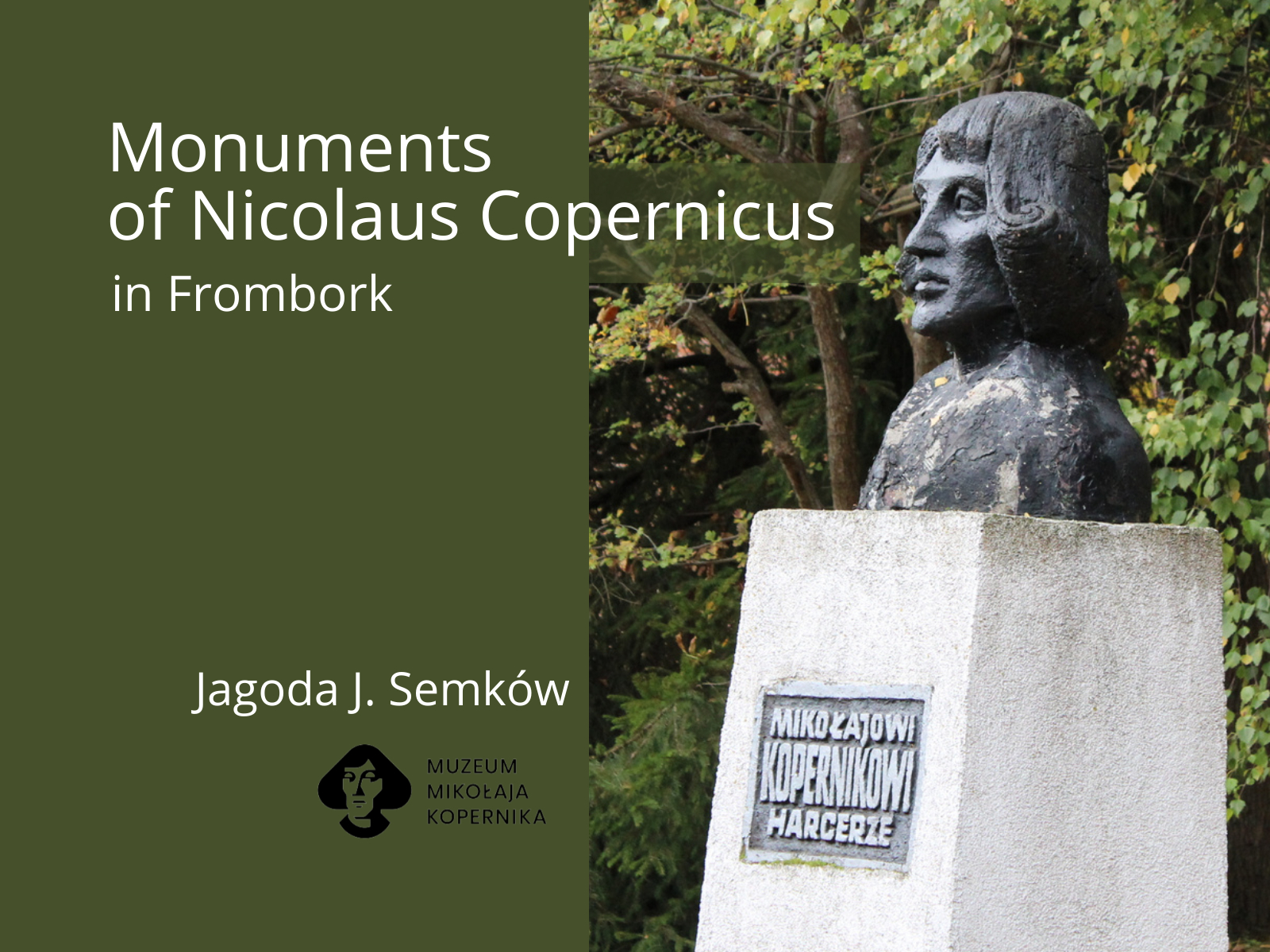
The first, in 1971, was a bust of Copernicus by Genowefa Nowak, funded by the scouts. The ceramic sculpture depicted the astronomer with an astrolabe, on a pedestal with the inscription “To Nicolaus Copernicus, Scouts.” Destroyed in 1996, it was restored in 2010 and placed in front of the school building in Frombork (albeit without some of the original details).
The most famous is the monumental statue from 1973, the winning design by Mieczysław Welter from a nationwide competition. Unveiled on July 15 by Prime Minister Piotr Jaroszewicz, it stands at the foot of Cathedral Hill. The six-meter bronze figure on granite boulders depicts the powerful, static figure of Copernicus with a lily of the valley in his hand placed on his heart, symbolizing his medical and botanical interests. It is surrounded by the circular orbits of the planets.
In the same year, the residents of Frombork, on the initiative of the Frombork Lovers’ Society, funded a simple monument made of a granite boulder (from an older monument). The bronze plaque bears the inscription “To Nicolaus Copernicus, the Community of Frombork 1473–1543.” It stands in the former Evangelical cemetery on the south side of the town; its foundations were reinforced in 2010.
Also in 1973, the Warmia Cathedral Chapter funded a bust in the basilica, created by Hubert Maciejczyk. The bronze sculpture depicts Copernicus with a spherical astrolabe, dressed in a canon’s robe with a cross. The pedestal bears the inscription: “To Nicolaus Copernicus on the 500th anniversary of his birth, in tribute from the Warmia Cathedral Chapter.” It was unveiled by Primate Stefan Wyszyński during church ceremonies.
The most recent commemoration is the “Copernicus bench” from 2015, designed by Dawid Wawrzyniak, located in the Old Town Square. As part of the revitalization of the square, the orbits of the planets were incorporated into granite blocks, and on one of them, a bench with a seated astronomer holding cards with a heliocentric drawing. Next to it are plaques with cities associated with Copernicus and a quote from De revolutionibus.
The monuments in Frombork reflect the turbulent history of the region – from the Prussian Empire, through post-war destruction, to the rebirth in the People’s Republic of Poland and the present day. They are not as numerous as in Toruń or Olsztyn, but they are deeply connected to the place where Copernicus lived and worked.
As Horace wrote, a true monument is the memory in people’s minds – and Frombork, with its cathedral and hill, is a living testimony to this.