
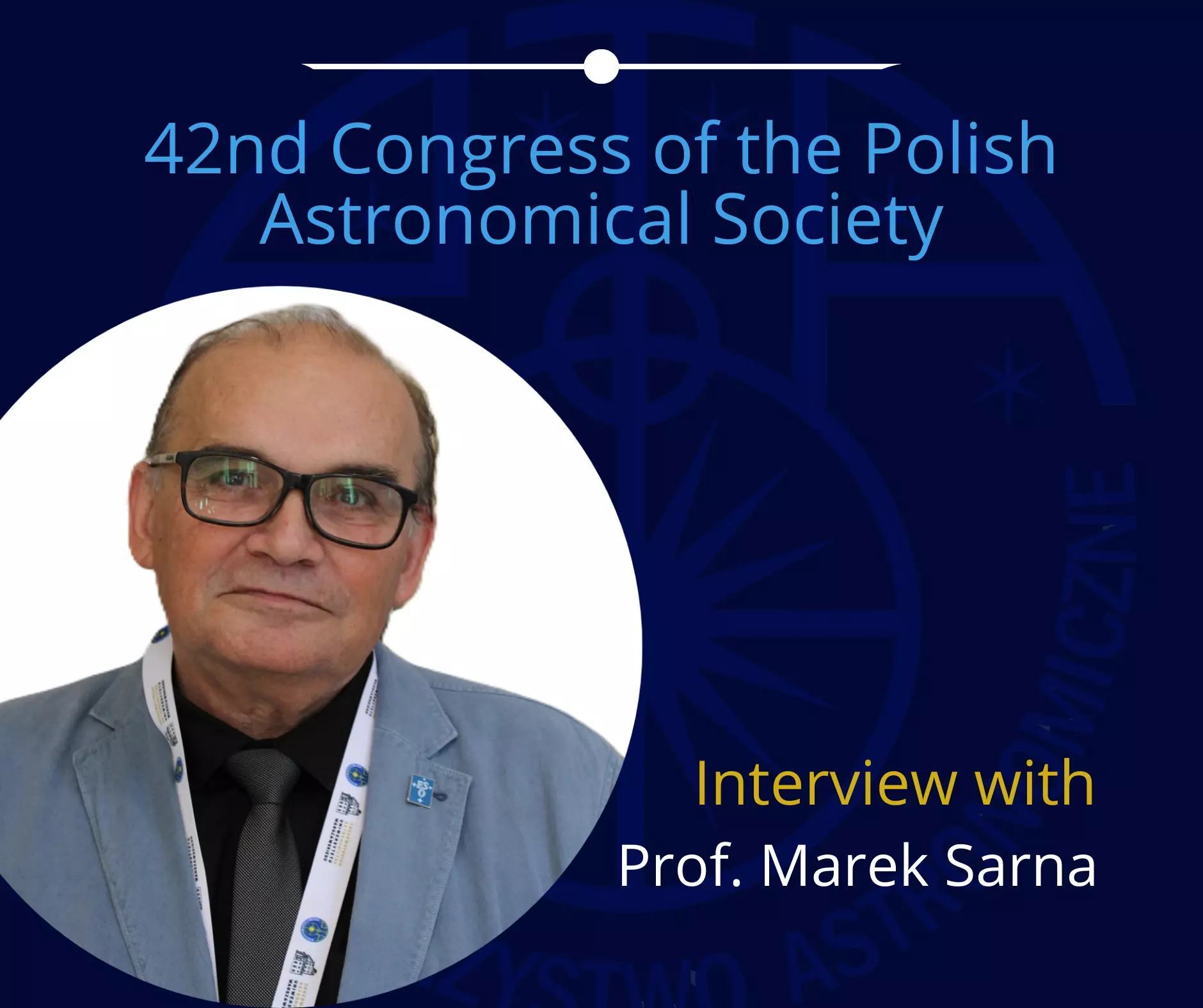
During the 42nd Congress of the Polish Astronomical Society (PTA) on September 8, 2025, we spoke with Prof. Marek Sarna, former president of the PTA (2017–2025) and member of the Chamber of Astronomy of the Nicolaus Copernicus Academy.
In this interview, the professor summarizes the achievements of Polish astronomy, the significance of projects like OGLE, Poland’s membership in ESO and ESA, and the challenges facing the Nicolaus Copernicus Academy and the scientific community at large.
We invite you to read the full conversation.
The Polish Astronomical Society is present at the 200th anniversary of the University of Warsaw Astronomical Observatory. In your opinion, what are the current successes and challenges facing Polish astronomy?
Prof. Marek Sarna: The matter is complex. Regarding the Polish Astronomical Society, we initiate and develop connections between various astronomical centers. Every two years, we organize the PTA Congresses, where the best and most recent scientific results are presented. It serves as a biennial summary of our progress.
Astronomical centers in Poland are of two types: university institutes/observatories and the institutes of the Polish Academy of Sciences. A leading center is the University of Warsaw Astronomical Observatory (OA UW), which is celebrating its 200th anniversary this year. Its origins date back to 1825, though interestingly, the Chair of Astronomy led by Dr. Franciszek Armiński – the builder of the observatory – is older than the University itself, having begun its activities in 1816.
These congresses allow us to exchange experiences, track the latest research, and present national and international projects funded by both domestic and European/global sources.
OA UW coordinates one of the most important instrumental and scientific projects in Polish astronomy: OGLE (The Optical Gravitational Lensing Experiment). Launched in 1992, it utilizes a 1.3-meter photometric telescope at the Las Campanas Observatory in Chile. Colleagues led by Prof. Andrzej Udalski were the first to observe a gravitational microlens and have discovered many new types of variable stars and periodic processes in astrophysical objects.
Furthermore, Polish astronomers have access to the 10-meter SALT spectroscopic telescope in South Africa. Since 2015, we have been members of the European Southern Observatory (ESO), which provides access to state-of-the-art research equipment, internships, PhD programs, and student placements. Poland’s membership in the European Space Agency (ESA) also offers comprehensive opportunities to use and participate in the construction of scientific satellites.
The Polish astronomical community has grown so much that PTA Congresses provide vital networking opportunities between senior and junior colleagues. They also serve as a forum for scientific exchange and personnel mobility, for example, within National Science Centre (NCN) research projects.
The 1st World Copernican Congress attracted the attention of the global scientific community. How do you assess its significance for promoting Polish science and astronomy internationally?
Prof. Marek Sarna: That question isn’t entirely for me; it would be better directed to our foreign colleagues. Our chamber has ten members – five from Poland and five from abroad. Recently, Prof. Masashi Hazumi from Japan sent a letter regarding this to the Secretary of the Academy, Prof. Krzysztof M. Górski.
My view on the functioning of the Nicolaus Copernicus Academy (AK) and the Nicolaus Copernicus Superior School (SGMK) diverges from how the Polish authorities understand their role. The SGMK was intended as an initiative to build something entirely new from the ground up. Such initiatives happen worldwide; state-funded universities are established to fulfill a specific mission and conclude their activities once that mission is complete.
I don’t want to be too harsh, but in my opinion, AK and SGMK were never given the chance to truly begin their mission. There is a lack of proper communication and a willingness to understand or discuss the matter from political decision-makers. Due to the lack of a Prime Minister’s countersignature, the individual chambers of the Academy have yet to reach their full membership. I know from Prof. Górski and others that even the possibility of meeting with representatives from the Ministry of Science is very limited, which makes solving problems difficult. That is my perspective on the situation.
What do you believe are the main goals of the Nicolaus Copernicus Academy, and how do you evaluate their implementation so far?
Prof. Marek Sarna: Many elements stipulated in the Act that the Nicolaus Copernicus Academy was supposed to implement could not be realized due to a 50% budget cut. The systems for funding scientific grants, ambassadors, and Academy awards were never launched.
Despite these financial difficulties, SGMK has begun its activities. The College of Astronomy has conducted two recruitments for doctoral studies. In fact, two of our students presented their scientific results at this very PTA Congress. Personally, whenever I am asked for help regarding the Academy, I feel a duty to assist as a member.
We produced a series of broadcasts for Radio Niepokalanów, two of which I participated in. Now, we are working on the biographies of Copernicus and Hevelius for TV World. We are also planning lectures about the era of Copernicus in “Copernican cities” (the nearest being Frombork). Whenever I can provide information or give interviews – like today or for Wprost – I try to do so, though my resources are limited.
In your opinion, does the Academy still have the potential to achieve its goals?
Of course, but the financial blockade and the negative media narrative, which currently severely restrict our activities, must disappear. A lack of finances is nothing new to me. Having worked for years in the Polish Astronomical Society, the SALT Consortium, and many other initiatives, I operate pro publico bono and can continue to do so. However, on the scale for which the Academy was originally designed, it is impossible to realize its objectives without adequate funding.