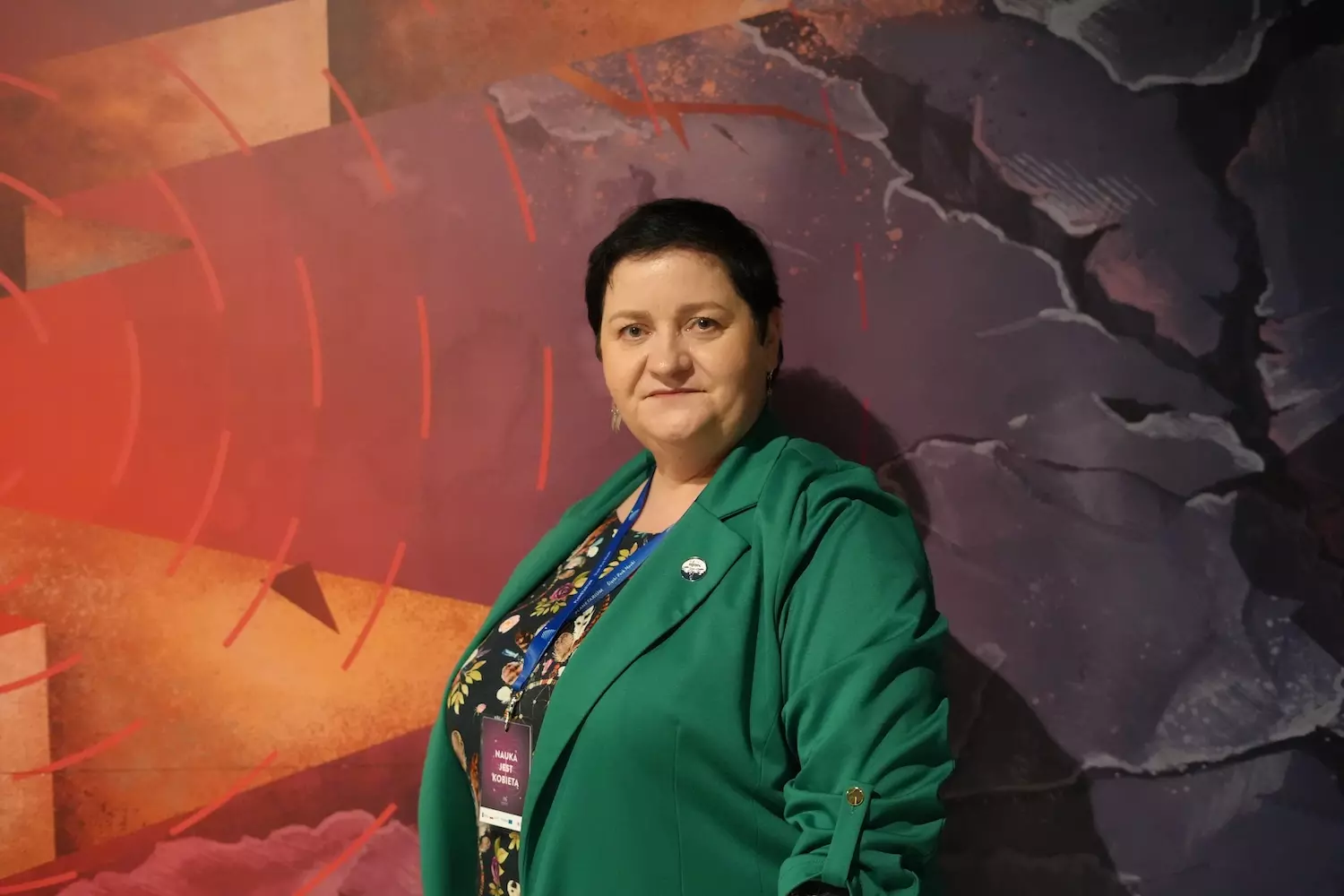
“… I’m constantly learning. Because, unfortunately, as a woman scientist – or indeed as a scientist, regardless of gender – we have to continually develop ourselves, because the world keeps moving forward.”
This excerpt from the conversation with Dr. Izabela Poprawa aptly captures the dynamics and essence of the work of a scientist – the necessity of constant learning, pushing the boundaries of one’s own knowledge, and openness to new fields. Dr. Poprawa talks about a journey that began with chance and curiosity, working with young researchers on projects that literally reach for the stars, and about a scientific passion that, as it turns out, can completely consume you. For her, pursuing science is not just a profession, but above all a way of thinking and living.
dr hab. Izabela Poprawa is a professor at the University of Silesia, a biologist and tardigradologist, affiliated with the Institute of Biology, Biotechnology and Environmental Protection. She specialises in histology, developmental biology and animal cell biology, focusing her research on tardigrades and their ability to survive in extreme conditions. A member of the team for the first Polish scientific and technological mission, Ignis, to the International Space Station, investigating the potential of tardigrade proteins in enhancing organisms’ resistance to microgravity. She publishes actively, collaborates with national and international centres, and popularizes science.
Q: If Copernicus, then…?
dr hab. Izabela Poprawa
– High school.
Q: How did you come to specialise in this field of science – related to the natural sciences, which Copernicus was passionate about?
Dr. Izabela Poprawa
I must admit that it was because of the reviewer of my master’s thesis, who said he couldn’t imagine me not going on to do a PhD. It was a few days before my master’s thesis defence, so I thought that, if that was the case, perhaps it was worth trying. And as I happened upon the wonderful Professor Jerzy Klag, who showed me how to be a scientist, how to conduct research, and how to keep that childlike curiosity alive within myself, I stayed.
Q: Today, we talk a lot about women in science. What is it like for you to be a woman in science?
Dr. Izabela Poprawa
To be honest, for me it has no special significance; for the time being, I don’t see – at least in my discipline, which is biology – any difference between being a man in science and a woman in science.
We have a relatively high level of gender parity, so I have no problem balancing my academic work with my everyday life, so to speak. I’m happy with what I do; it’s my passion, and that’s what matters most to me right now.
Q: Has being a woman scientist contributed significantly to your experience, to your personal development?
Dr. Izabela Poprawa
Definitely, since what my parents always laugh about is that I’m constantly learning. Because, unfortunately, as a woman scientist – or indeed as a scientist, regardless of gender – we have to continually develop ourselves, because the world keeps moving forward.
So, when I take on new projects, I have to study the literature on the subject. I have to obtain new knowledge, acquire new skills and learn new methods. As such, it’s a constant drive to move forward.
On the other hand, it is also fascinating that, as a woman scientist, I am also a role model for young people, whom I can inspire and guide.
A current example is my grant: Yeast TardigradeGene, where a large part of my team consists of young people. One doctoral student, two master’s students – people at the start of their careers, but already able to engage with so-called world-class science, because they are studying the contents of space.
Q: So participating in such large-scale, exciting, contemporary projects is one of the ways in which you encourage your students. From your experience, are there any other proven ways to inspire students to choose an academic career and develop a passion for research?
Dr. Izabela Poprawa
As well as being a researcher, I am also an academic tutor.
For this reason, I run various types of tutoring classes where, working one-on-one with a volunteer student, I show them the possibilities of conducting various types of biological experiments – ones they have devised themselves, which they can plan and carry out from start to finish.
Or, if they don’t have any ideas, I give them one of my projects or concepts, and together we try to carry it out. This also gives them the chance to engage with science and the techniques we use. Perhaps in the future this will actually lead to someone thinking: “Perhaps a doctorate, a career in science is the path for me”.
Q: Did Copernicus in any way spark inspiration in your academic life?
Dr. Izabela Poprawa
Not in my academic life, but most certainly so in recent times.
Why did I say at the start that Copernicus meant high school to me? Because I was invited as a speaker for the school’s patron’s day precisely at the Nicolaus Copernicus High School in Bielsko-Biała. I come from Bielsko-Biała, but I wasn’t a graduate of that high school. I was a graduate of a school that was in fierce competition with it at the time, namely the Stefan Żeromski High School. So I had the pleasure of actually being within the walls of the Copernicus High School for the first time, as an expert speaking about the Yeast TardigradeGene programme.
- Exactly, the last speaker, a Doctor of Psychology, mentioned the multidisciplinarity of women. Copernicus became famous for astronomy, which was his hobby, not his professional activity.
Dr. Izabela Poprawa
Yes, after all, he was a doctor. He was a philosopher…
- A lawyer, an economist.
Dr. Izabela Poprawa
think a mathematician too.
Q: What are your hobbies, Doctor?
My hobbies? I love mountains. That’s one thing. Recently, I’ve discovered that I love handicraft. I realised this when I was with my godson, as I needed to keep him occupied. And suddenly I realised that I enjoy doing it; it brings me joy. So I started making things, like various types of holiday decorations.
I’m also a bookworm. If I can, I read in bulk, and I also love travelling – the more exotic the destination, the better.
Q: If you were to give advice to women who are hesitating to take that final step towards beginning a scientific career, what would you say?
Dr. Izabela Poprawa
My advice will be rather ambiguous. I suggest they think very seriously about whether they really want this. Because once you take that first step, you’re all in, because it’s very hard to back out – it’s just so fascinating. We’re constantly discovering something new, and we have the opportunity to develop in so many ways that it’s hard to walk away from it later on.
Q: Can science become boring? Can being a scientist become boring?
Dr. Izabela Poprawa
No. Being a scientist will certainly not get boring, because it constantly reveals new horizons, new perspectives and new possibilities.
What can be tiring are various types of problems that crop up here and there. For example, administrative issues or things of that sort. So-called roadblocks at a time, for instance, when you want to focus on research or work, but you’re faced with a mountain of paperwork to sort through. Well, that’s not exactly something that makes academic work any easier.
Q: Apart from biology, do you study other scientific disciplines that support your current research work?
Dr. Izabela Poprawa
At the moment, I need to focus more on chemistry – which I did study at university, of course, but which I then lost touch with – because my other projects involve analysing the effect of non-steroidal anti-inflammatory drugs on tardigrades. So chemistry is coming back into the picture for me right now.
I also need to delve a little into physics, a bit into biophysics, and into astrobiology, because tardigrades also pull one towards the astrobiological. And, of course, into biotechnology, which is also very closely linked to biology. So these are various fields I need to explore.
And also a bit of psychology, because I work with a young team, so I also need to manage them well and be able to sense or diagnose various types of problems that arise in such groups of young people who are just beginning their scientific journey.
We would like to thank you for speaking with us, Doctor, and wish you continued scientific success.