
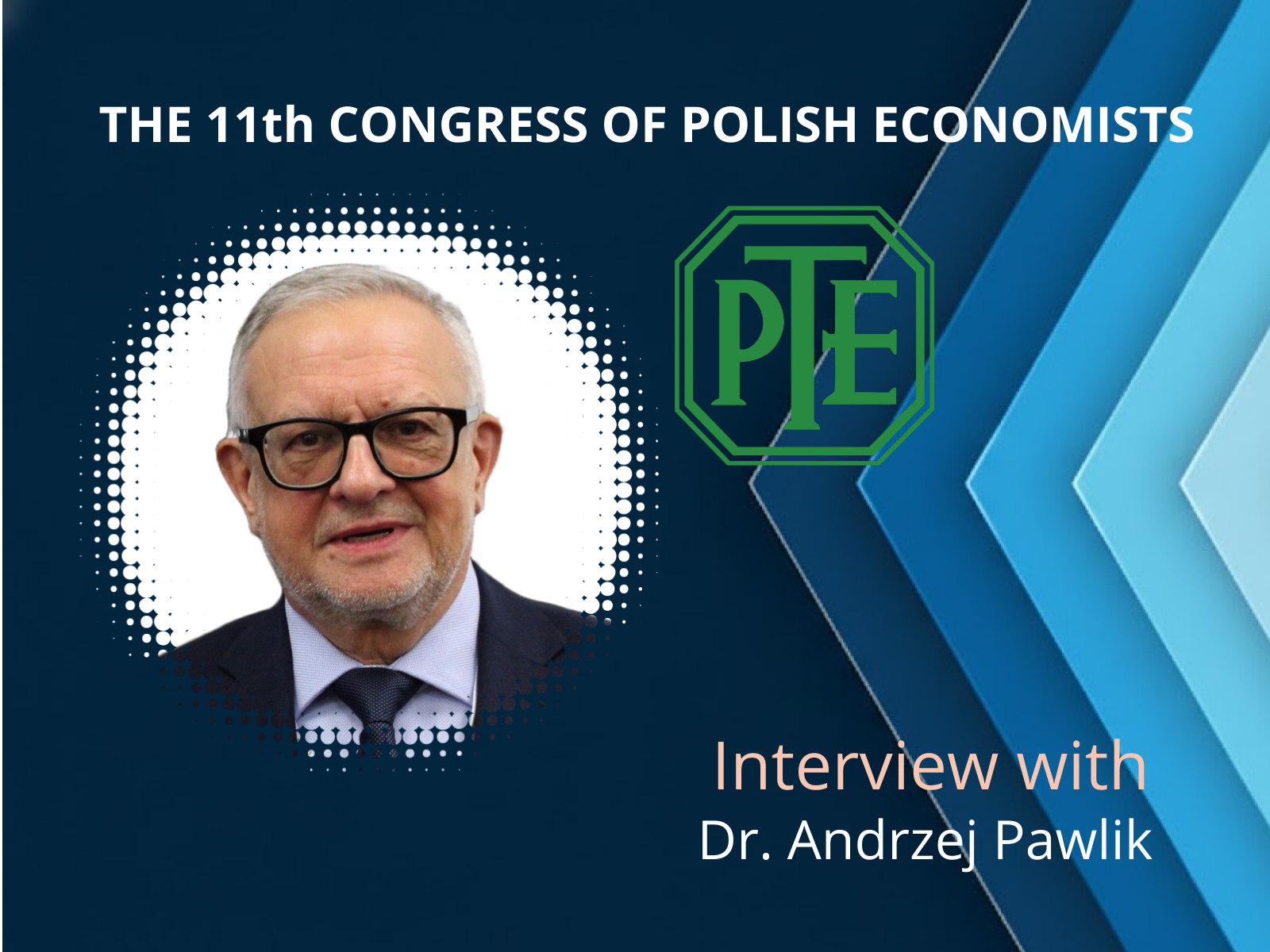
Dr. hab. Andrzej Pawlik is an economist, professor at Jan Kochanowski University in Kielce, an expert for the Ministry of National Education, and a member of the Main Committee of the Economic Knowledge Olympiad. For more than 15 years, he has focused on regional and local economies, with particular emphasis on innovation and the development of cities and municipalities in Poland. He is the author of over 150 academic publications, including monographs and articles in Polish and international journals, and has extensive teaching and practical experience in managing educational institutions as well as serving on supervisory boards of companies.
Q: At a session devoted to Poland’s transformation, titled “Poland’s Economic Transformation – Success or Failure?”, Professor Andrzejewski said that demography is one of the biggest problems. So I have a question for you, Professor: can economics realistically do something about this, or is it already more of a cultural issue—that we are in a trend where fertility rates will not increase significantly? Does economics still have any “silver bullets” that could help address this in the long run?
Dr. hab. Andrzej Pawlik: As you pointed out, there are many factors influencing this. Economists are increasingly talking about them, but assessments vary. I believe, however, that the Polish economy “slept through” an important element that could have had a real impact on the demographic situation—namely, the conditions under which young people start families. Providing them with a stable economic foundation—no fear for women of losing their jobs and guaranteed access to a place for a child in kindergarten, daycare, or school—gives young families a sense of security. It seems we should have started with housing policy. This element was to some extent overlooked, and the economy now needs many years to restore conditions that allow young families to function comfortably.
In 2023, statistics show that not a single child was born in 502 municipalities in Poland. In the Świętokrzyskie Voivodeship, there are 18 such municipalities. Rebuilding this potential, taking into account population aging, the demographic dependency ratio, and migration, will be an enormous challenge. This is not a problem—it is a demographic catastrophe.
I have statistical data from municipalities in the Świętokrzyskie Voivodeship. I deal with regional development, and I must say these figures are alarming. They are not only troubling but also show the irreversibility of this phenomenon.
Municipalities with more than 3,000 residents in the Świętokrzyskie Voivodeship – live births in 2023:
- Ruda Maleniecka – 11
- Słupia Konecka – 14
- Czarnocin – 17
These are small municipalities, but if we look at medium-sized cities:
- Starachowice (approx. 45,000 residents) – 235
- Ostrowiec Świętokrzyski (approx. 60,000 residents) – 243
- Busko-Zdrój (approx. 15,000) – 170
- Jędrzejów (approx. 15,000) – 154
- Kielce (nearly 180,000) – 1,244
When we translate this into a seven-year or four-year perspective—for example, in the context of daycare centers—we see that we have led ourselves into a situation we now regret. What can be done? In the long run, the economy will probably fill this gap through migration, meaning an inflow of people from outside. We have to accept this and be prepared for it. If it is migration from the East, for example from Ukraine—that’s good; but if it comes from other countries, we also need to be ready.
Showing children from an early age—in preschools and schools—peers from different communities is not a problem for them. I think the older generation will also accept diversity, because it may become a strength that ensures the economy has an adequate workforce and that pension systems remain viable. Of course, many potential risks may arise in this process.
Q: Professor, the theme of the congress is “Economics and the Economy in Times of Uncertainty.” I would like to ask about geopolitics: in such a situation, where is the boundary between the free market and state intervention necessary for security? How can we reconcile a free market with the risk of unpredictable geopolitical “black swans”?
Dr. hab. Andrzej Pawlik: I see the easing of this situation in the role of the state. State interventionism should, in a way, soften market mechanisms. We need to look at the state in a more friendly way—until now, some theorists, such as Milton Friedman, viewed everything that was state-run as bad. Meanwhile, it turns out that the state can act as a regulator that eases tensions and calms situations.
If we agreed that a greater role for the state can reduce divisions, this would be beneficial. We simply cannot leave everything to the market one hundred percent.
I wanted to leave this congress with an optimistic attitude, looking globally at economic development. We are optimists and believe that after a period of doubt, we can show that further development lies ahead of us on a European and global scale. Countries such as China and India are increasingly demonstrating their capabilities—until now, they may have been somewhat overshadowed by the major economies of the United States and the European Union. The most important thing is that calm and peace prevail.