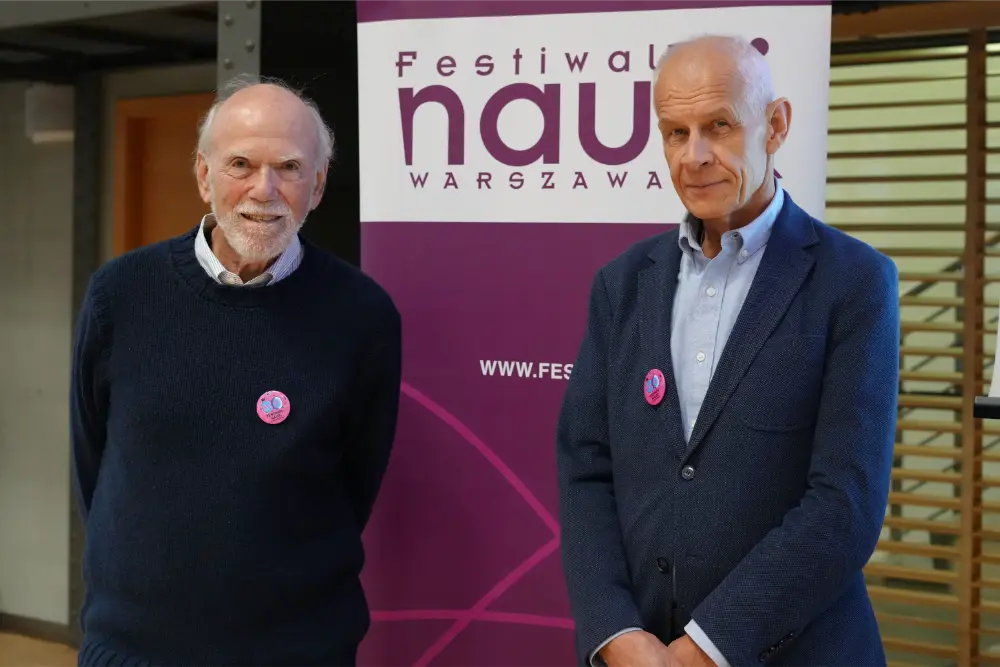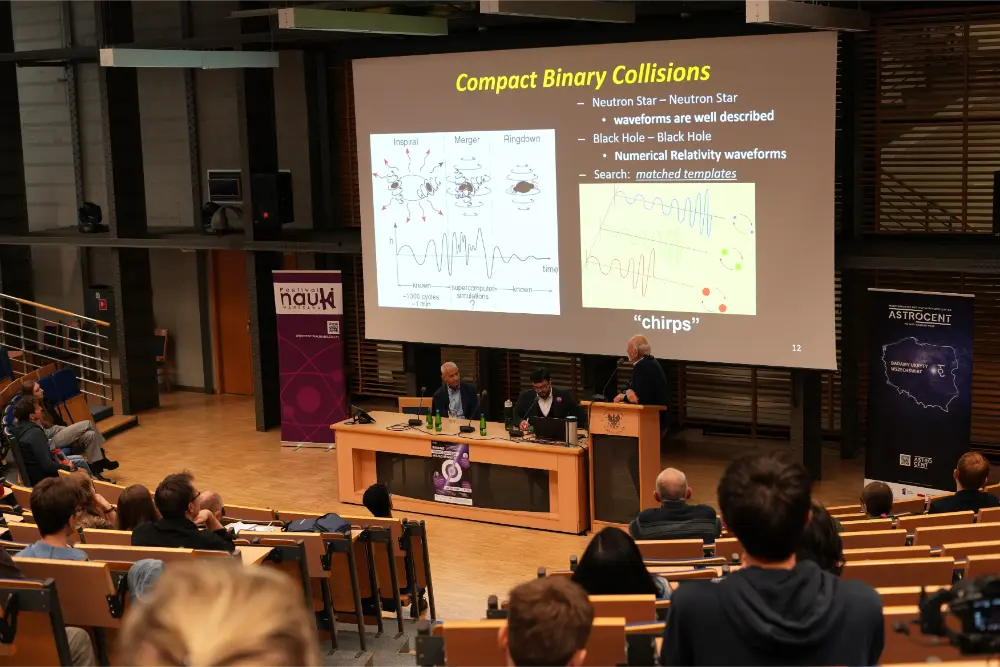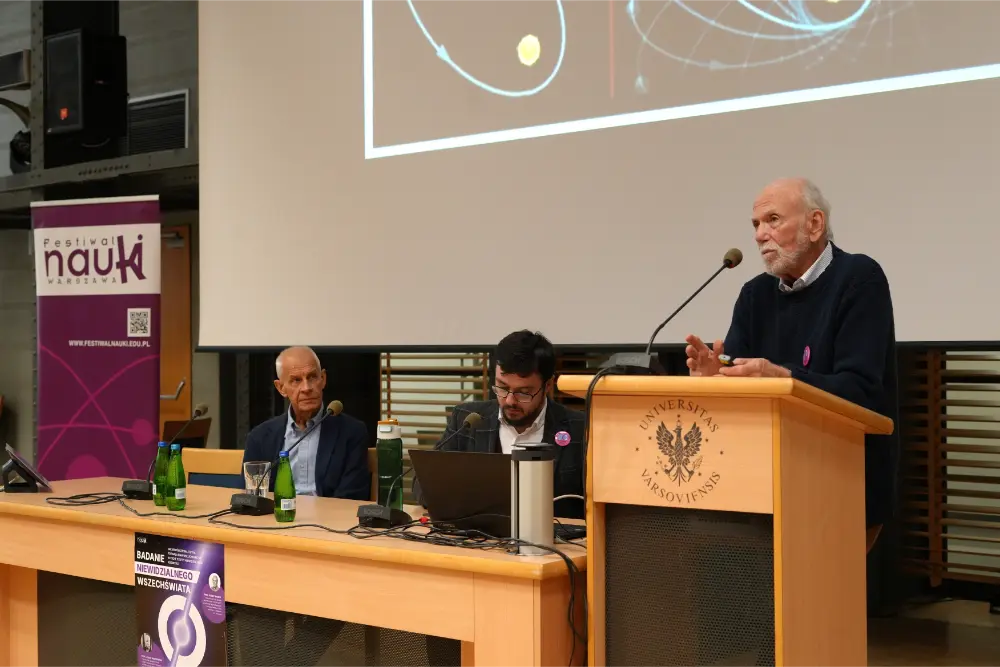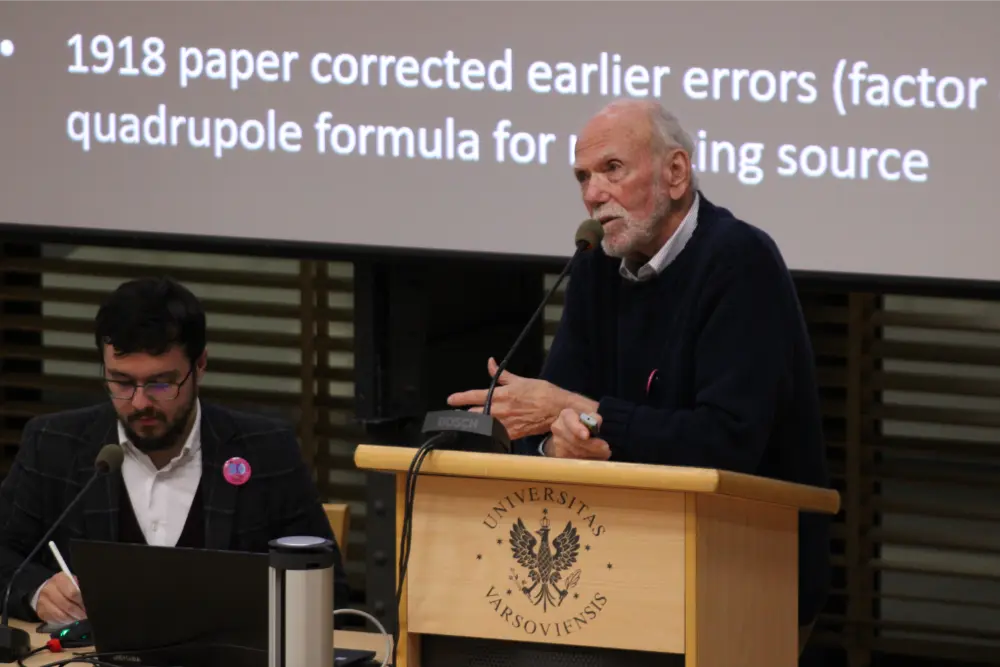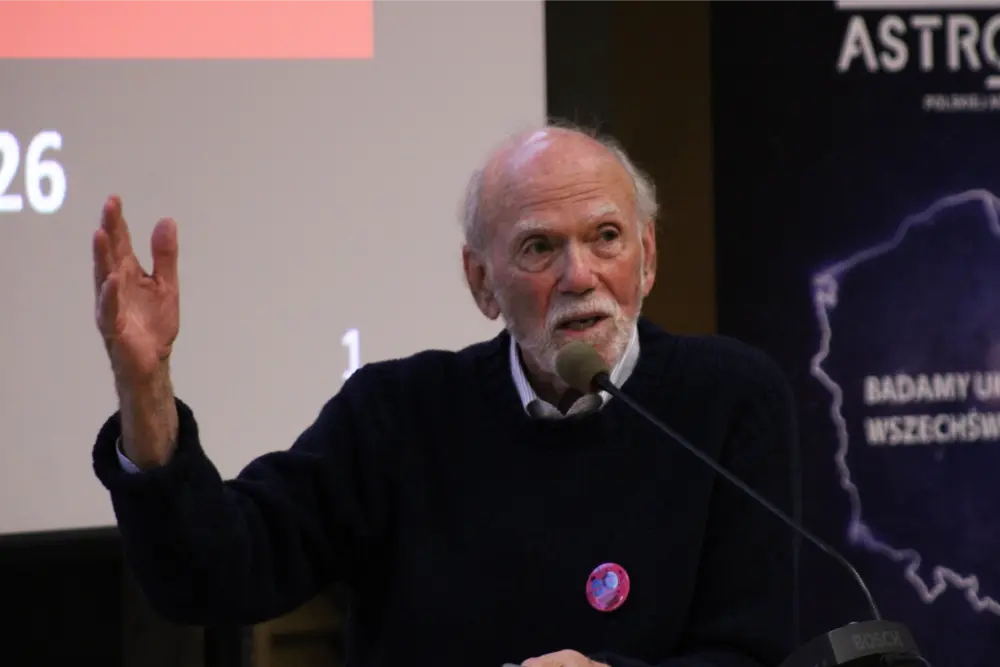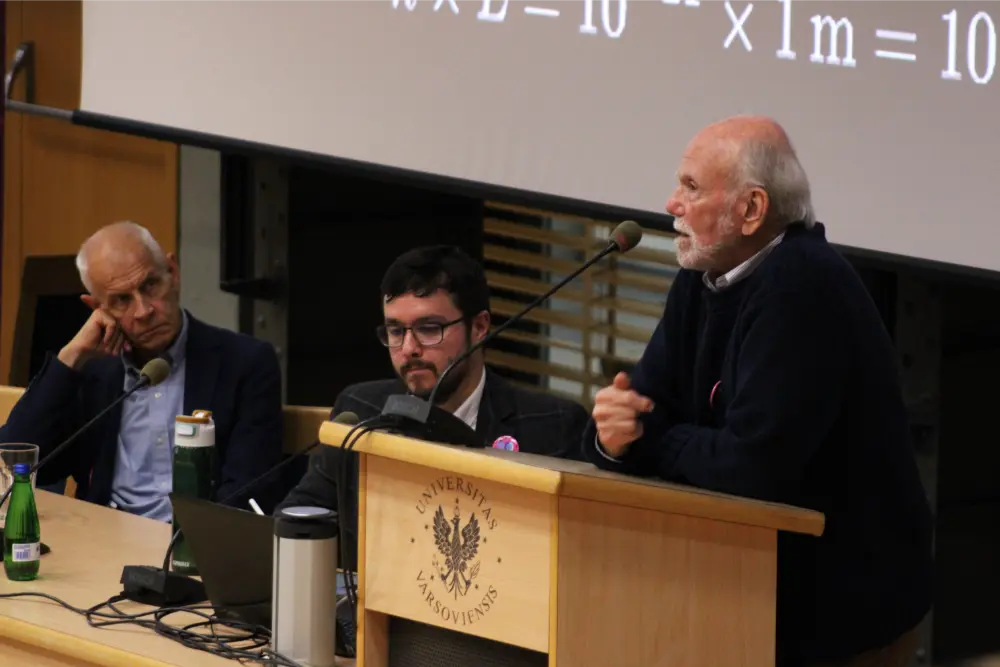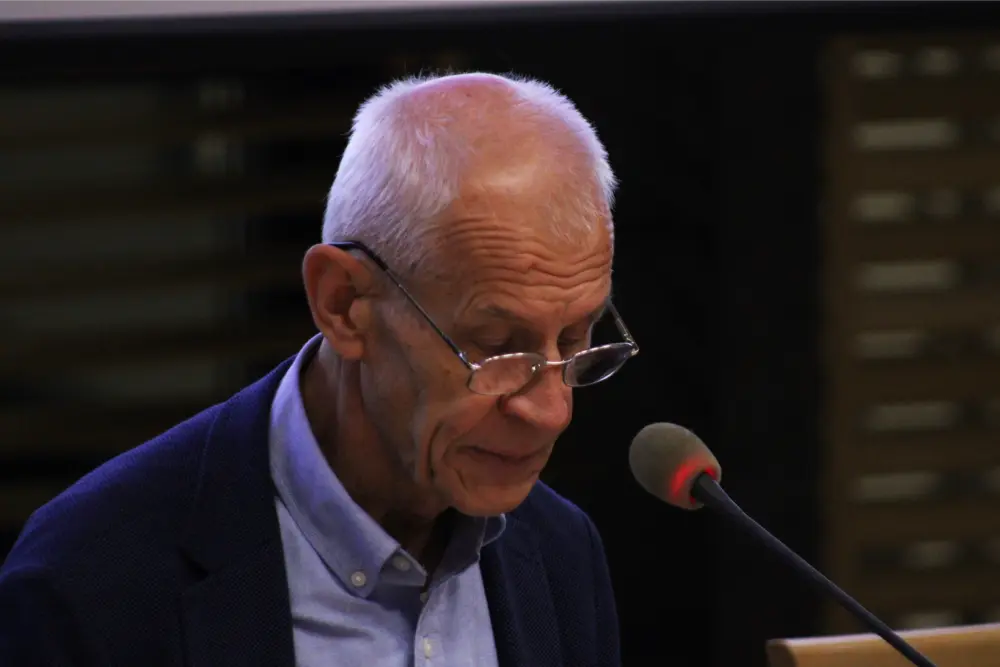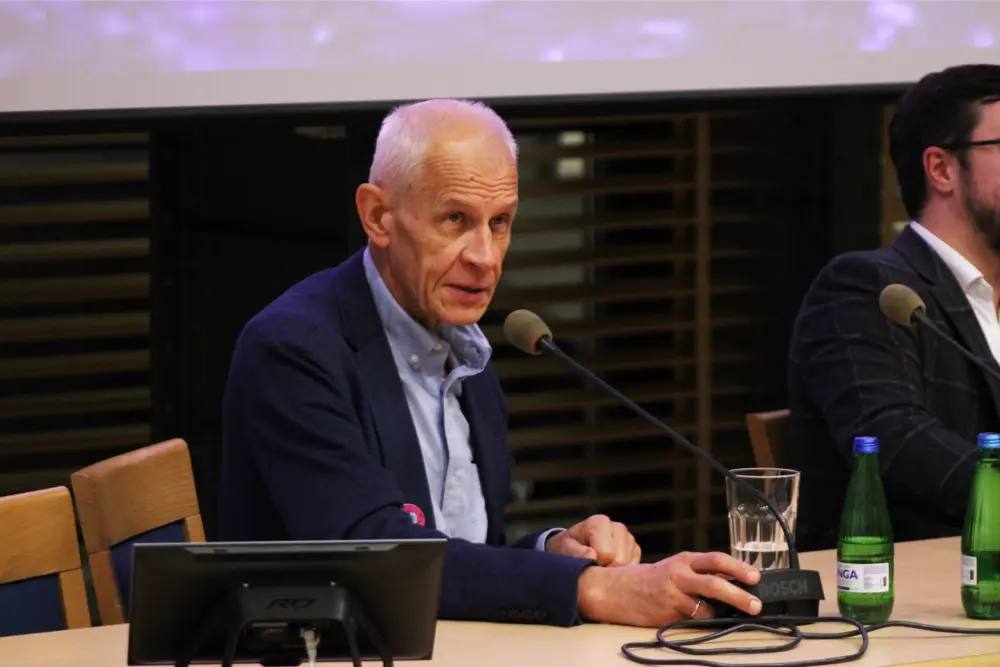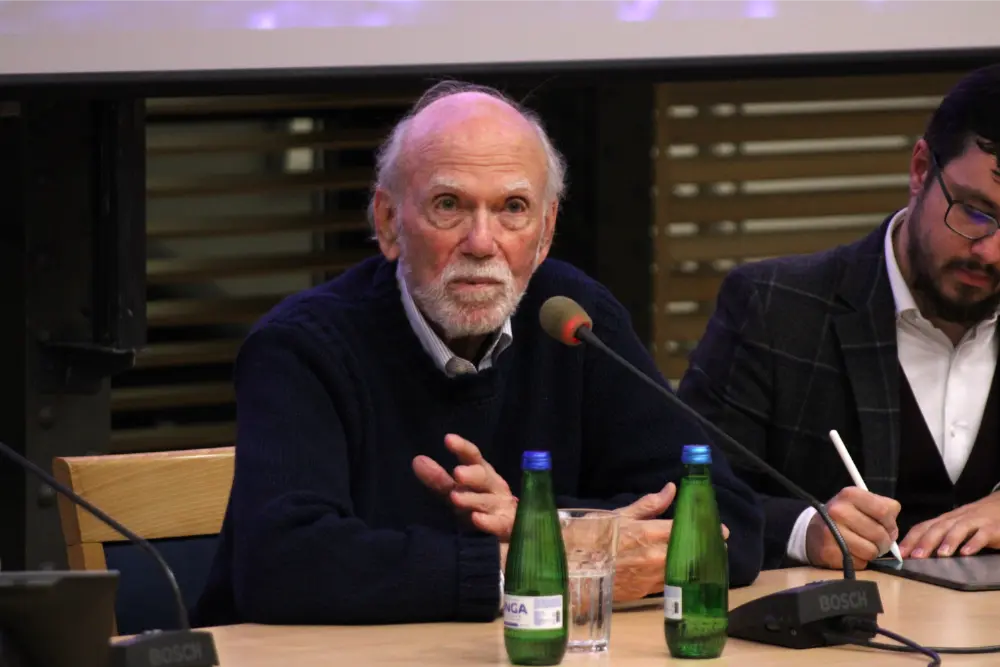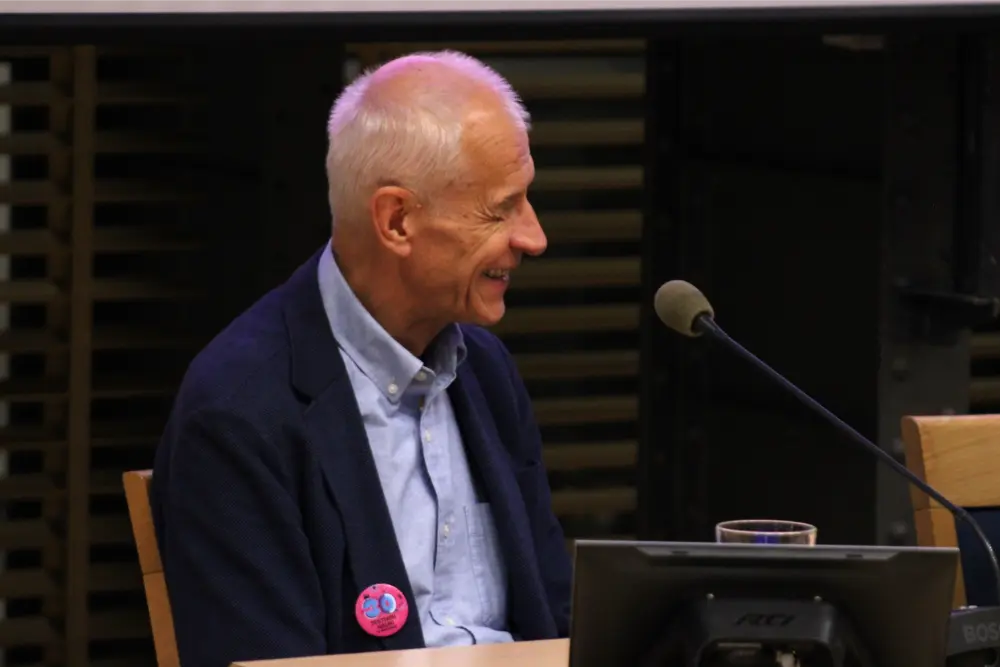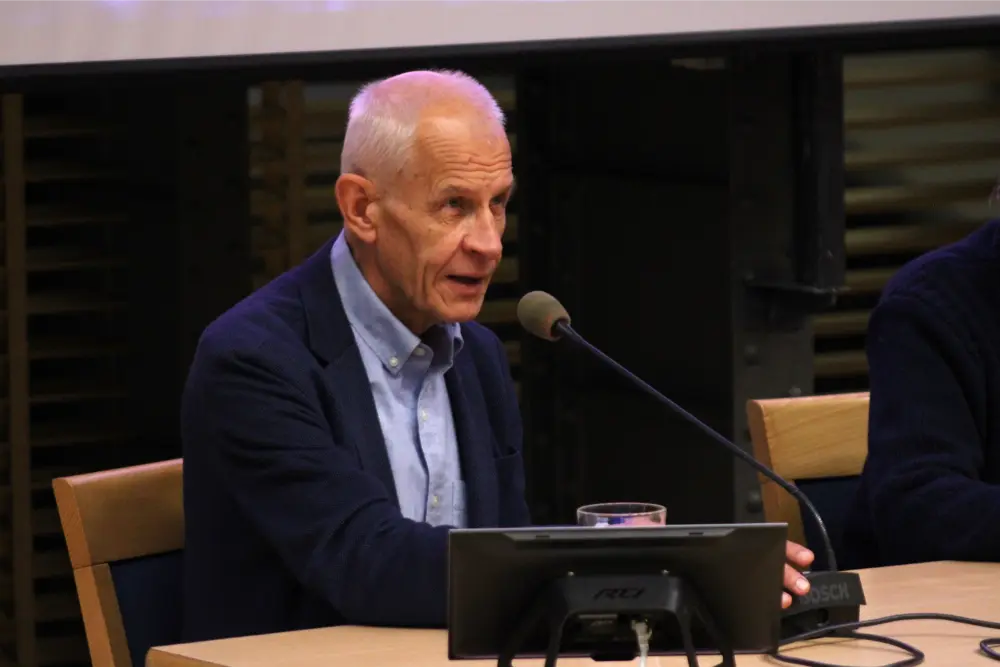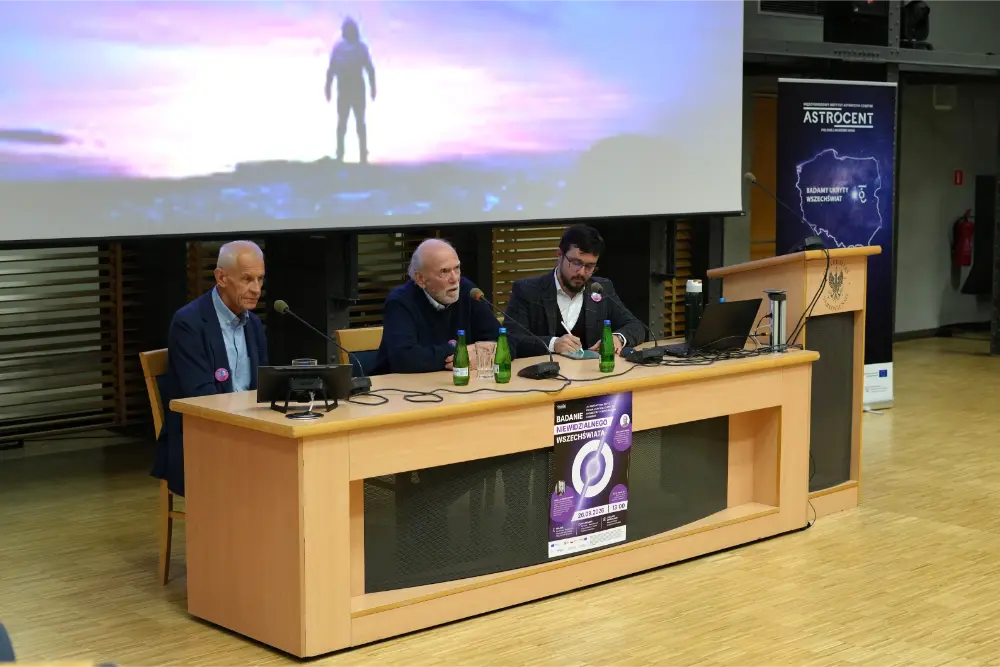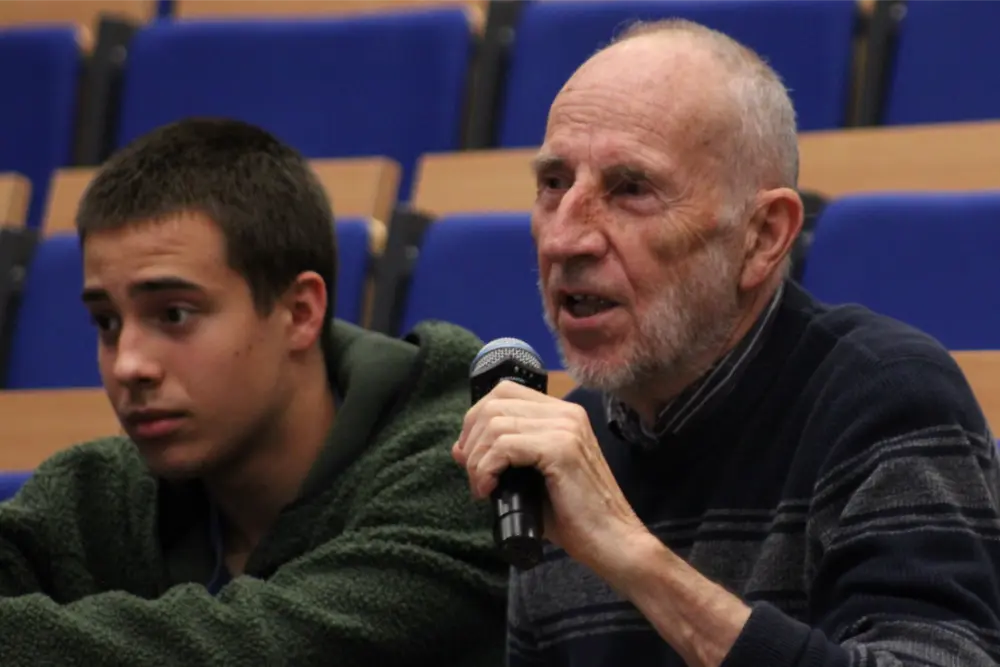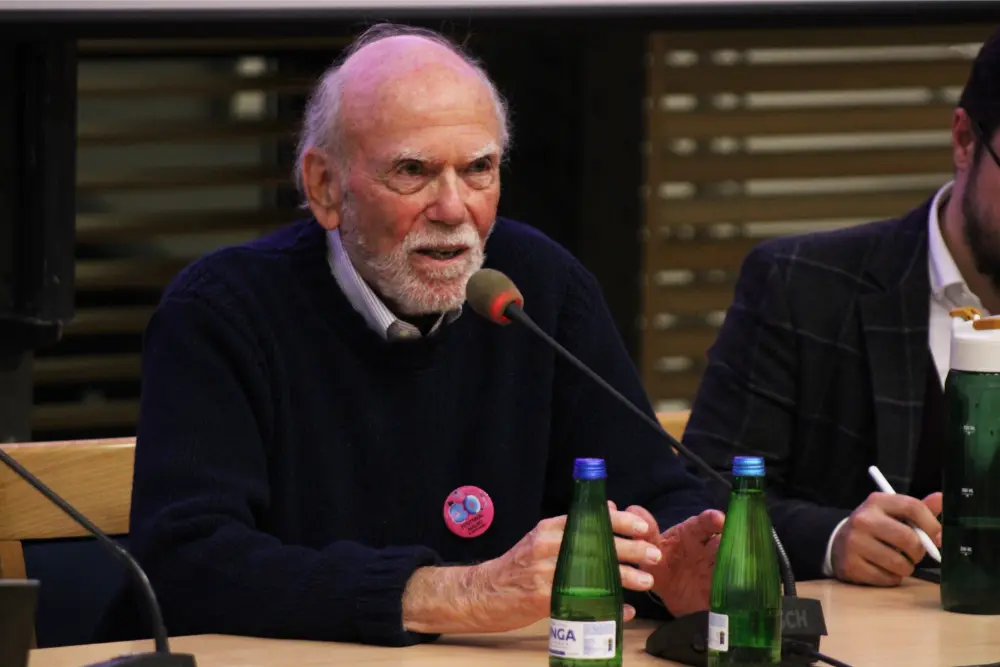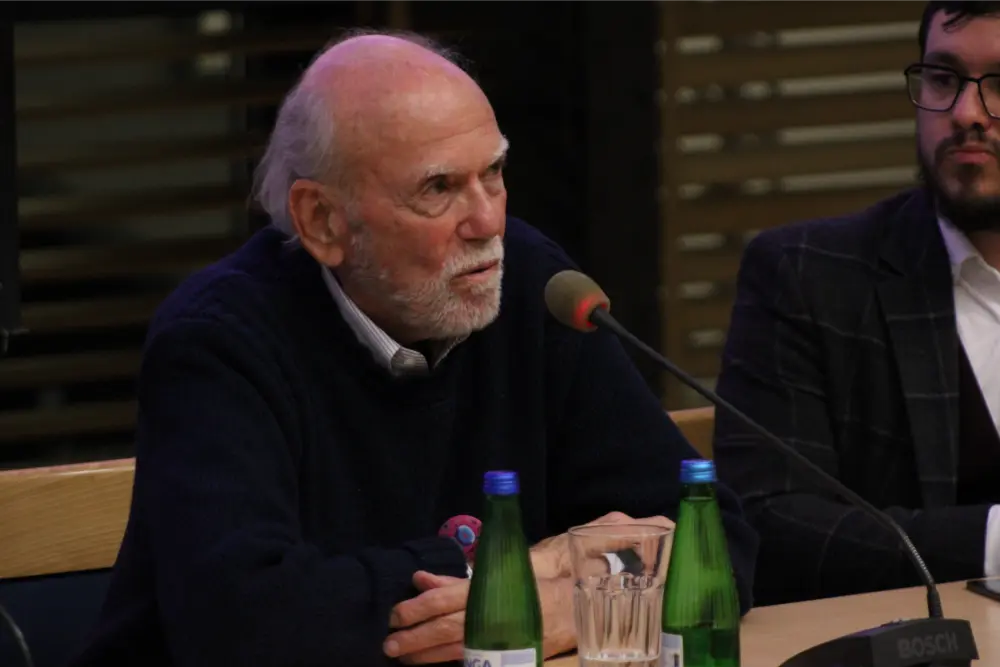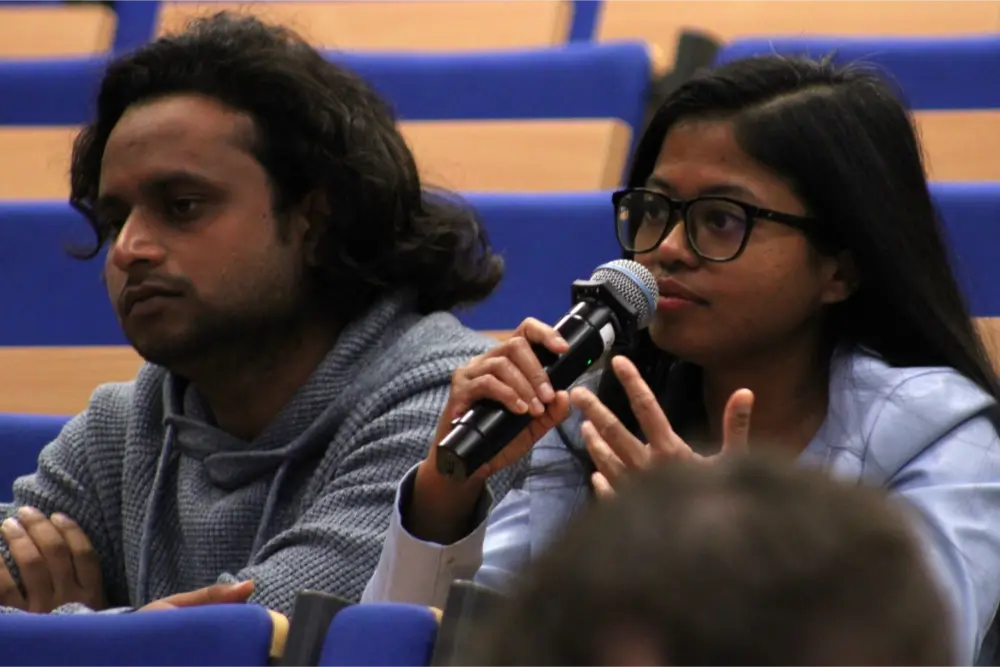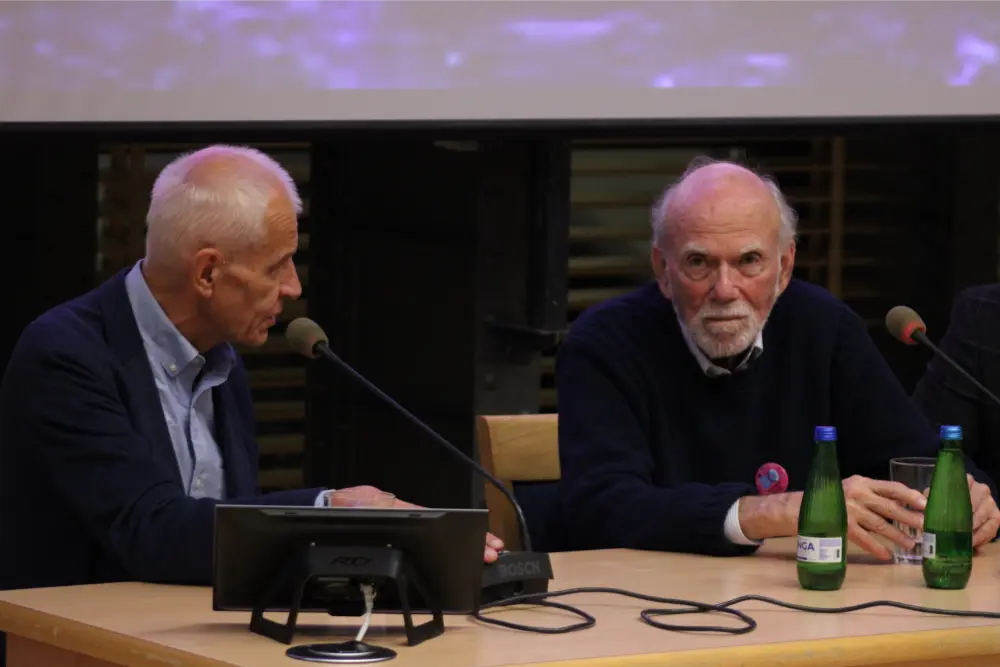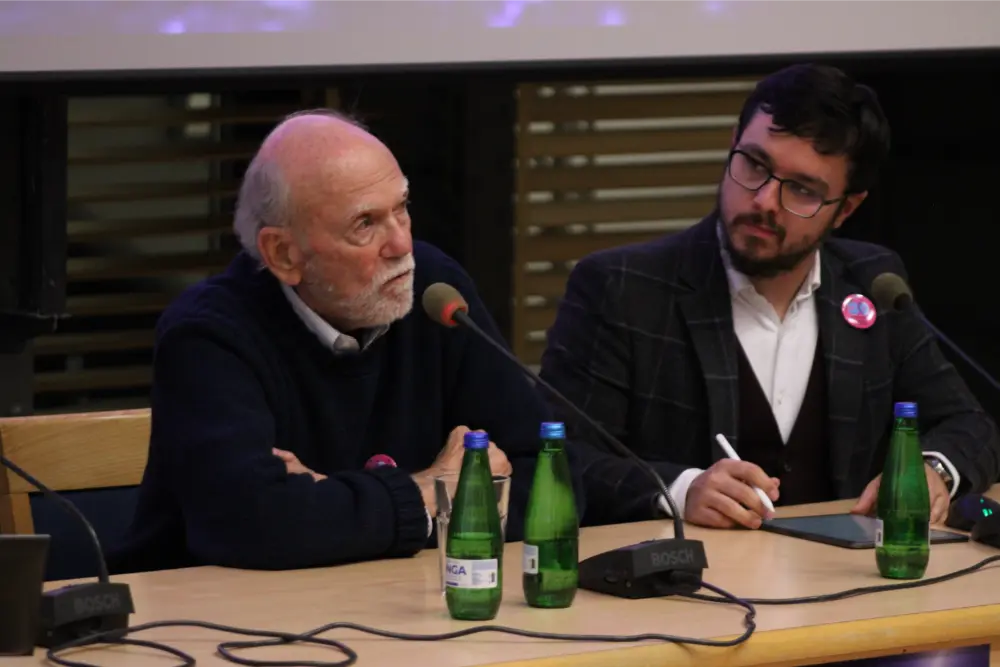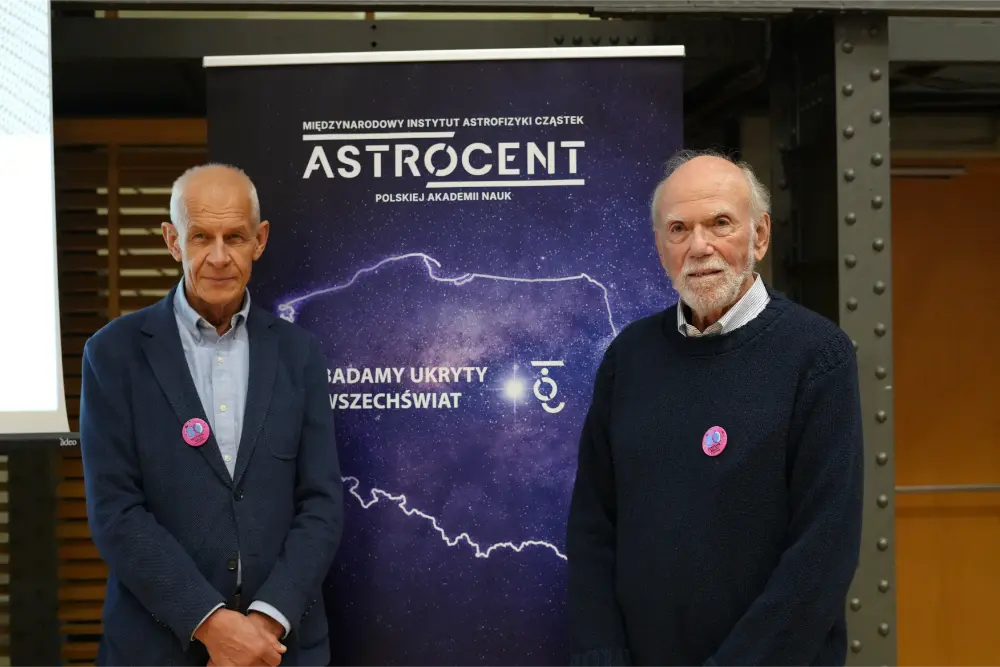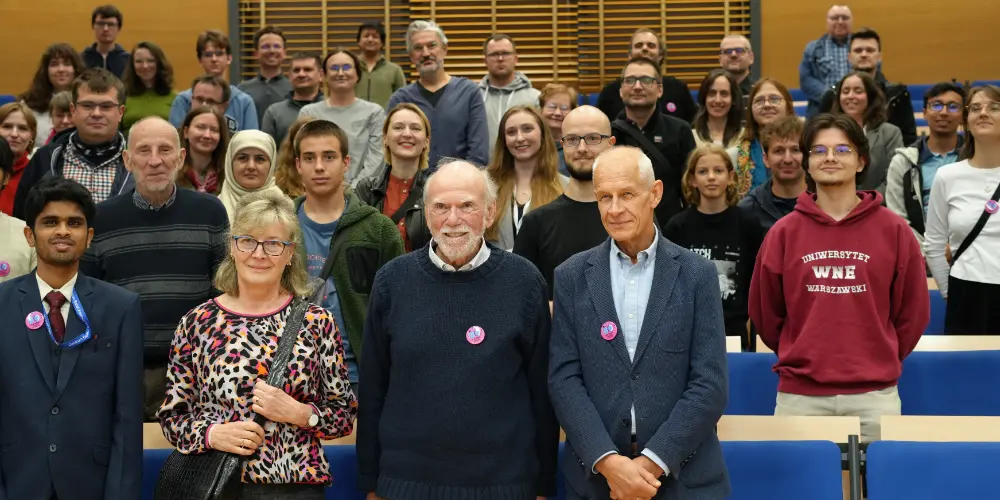
On September 26, 2026, we had the opportunity to attend a lecture by Professor Barry C. Barish, an eminent American physicist and the recipient of the 2017 Nobel Prize in Physics, at the historic Old University Library building at the University of Warsaw. The lecture was part of the Warsaw Science Festival. Professor Barish spoke about the discovery of gravitational waves, which opened up entirely new possibilities for exploring the universe.
Professor Barish is a member of the Nicolaus Copernicus Academy and one of the recipients of the Copernican Prize awarded by the Academy. His visit to Warsaw coincided with the inauguration of AstroCent, the Polish Academy of Sciences’ International Institute of Particle Astrophysics, which took place the previous day at Staszic Palace. The institute is headed by Professor Leszek Roszkowski, also a member of the Nicolaus Copernicus Academy. Professor Barish was a strong advocate for establishing a research institution in Poland dedicated to exploring the “hidden universe.”
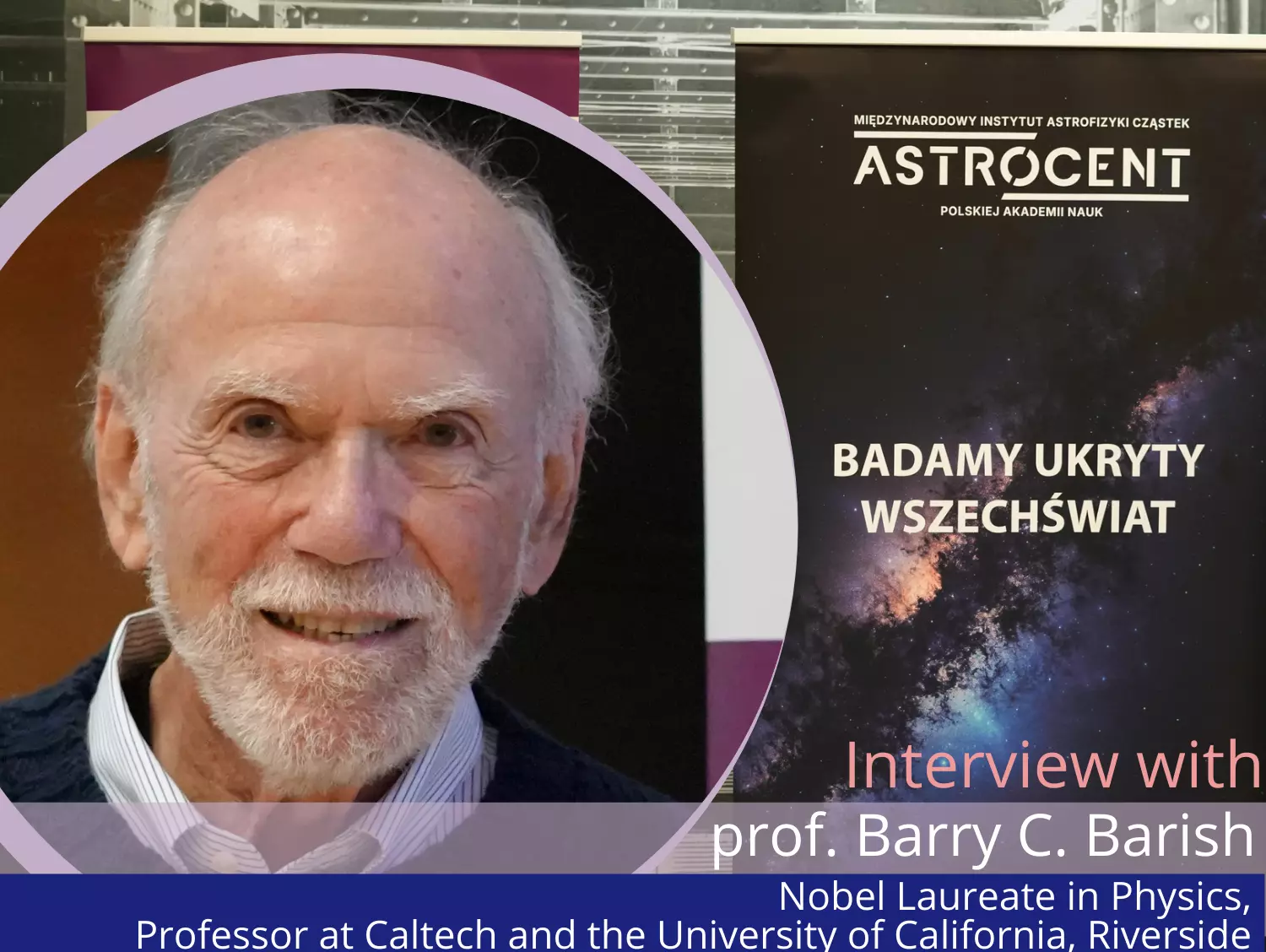
Following his lecture, Professor Barry Barish spoke with us in an interview, which we present below:
Q: What comes to mind when I say ‘Copernicus’??
Prof. Barry Barish:
Q: You have supported the idea of establishing AstroCent. What convinced you that an institute like that was worth building?
Prof. Barry Barish:
The people right there, and his (editor: prof. Roszkowski’s) colleagues I think, is the most important.
Then I visited, and I’d say the dedication and the enthusiasm were obvious. So, eventually it got realized by others, and now it’s officially the place that we saw these few days. But I knew that earlier.
Q: What would you like to see AstroCent achieve in the coming years?
Prof. Barry Barish:
In the coming years?
Q: Yes.
Prof. Barry Barish:
Coming years. Yeah, I think it’s already achieved, establishing itself and how to play a role in this field – between physics and astronomy. What I’d like to see is it, basically, play an important role in something like we’ve done, and
Q: Professor, you are also a member of the Nicolaus Copernicus Academy.
Prof. Barry Barish:
Yes
Q: And took part in the first Copernican Congress. So, the question is, how do you see the role of international scientific cooperation today, where major discoveries require researchers, institutions, and technologies to work across borders?
Prof. Barry Barish:
Science itself has no borders. We use the same formulas, the same journals, the same everything all over the world. So, in a sense, we have no borders. It’s only our institutions, our governments that have borders. So, in a positive way,
But basically, I think one of the wonderful and potentially good parts of being a scientist is that we are, it doesn’t matter where we are, what our background is, we have the same science, and we talk to each other and believe in each other, know each other as human beings, have the same goals.
And the world needs that to the extent that we can help break down these boundaries, which are there not because of necessarily evil things, but because of different, societal issues that made them happen that way.
Q: As a scientist working on some of the most complex questions about the universe, how do you approach the challenge of explaining this research to a wider audience?
Prof. Barry Barish:
First, my wife is a psychologist, not a scientist. If you have a good marriage, you communicate with your wife, so I have a natural person to deal with that what I have not been able to, and I think that’s the first step.
I have children and friends that aren’t scientists and so forth. So, I think starting from my personal life, I’d say. And then I was trained and had a goal to be a teacher, and all those give me the elements to be able to do that.
Q: What do you think is the most difficult part of communicating modern science to people who do not have a scientific background?
Prof. Barry Barish:
Yeah. I think the first thing is that our language is different. The language of physics anyway is mathematics. So, it’s hard to give lectures to a lot of people without the mathematics. And, the big challenge is to use the wrong language, which is you know, a language to communicate with each other rather than mathematics, which is our language, and so that’s a big issue.
And so how do you do that? You do it in ways that are not completely right, and you have to be comfortable.
As a teacher realizing that in communicating with someone who doesn’t know the mathematics, you have to be comfortable explaining it in ways that are not really right but have the right spirit, or the right element, or satisfy their interests and so forth.
Therefore, teaching is easier because I teach students who know the right background. And the real obstacle, I think, is that mathematics is our language, and as long as people have some mathematics and physics background – then they can understand. Otherwise, I have to try to make them understand it in a way that isn’t really right. All those numbers that I use and so forth are lost on most people. Or leave them with a gap because it’s sometimes impossible.
Q: The very last question is about the Copernican Congress, not the first, but the second one.
Prof. Barry Barish:
Coming up?
Q: Yes, in 2028. What do you think should be the role of the second Copernican Congress? And what would you hope to see come out of such a gathering of scientists from different countries, different Copernican fields?
Prof. Barry Barish:
As an outsider- it’s a little bit presumptuous. But Poland has the Polish Academy and now the Copernicus Academy, which are separate. And I think one academy, it’s not that I know the Polish Academy that well, but it’s made up in a different way of people who have established themselves in a way that’s based on a career, and their role, and their prestige and so forth. That doesn’t fully represent science. So in science, I think, it’s important for there to be a new organization like this.
Q: Thank you very much Professor.
Prof. Barry Barish:
Thank you