
International Conference in Turin with Prof. Krzysztof M. Górski of the Nicolaus Copernicus Academy May 26–30, 2025
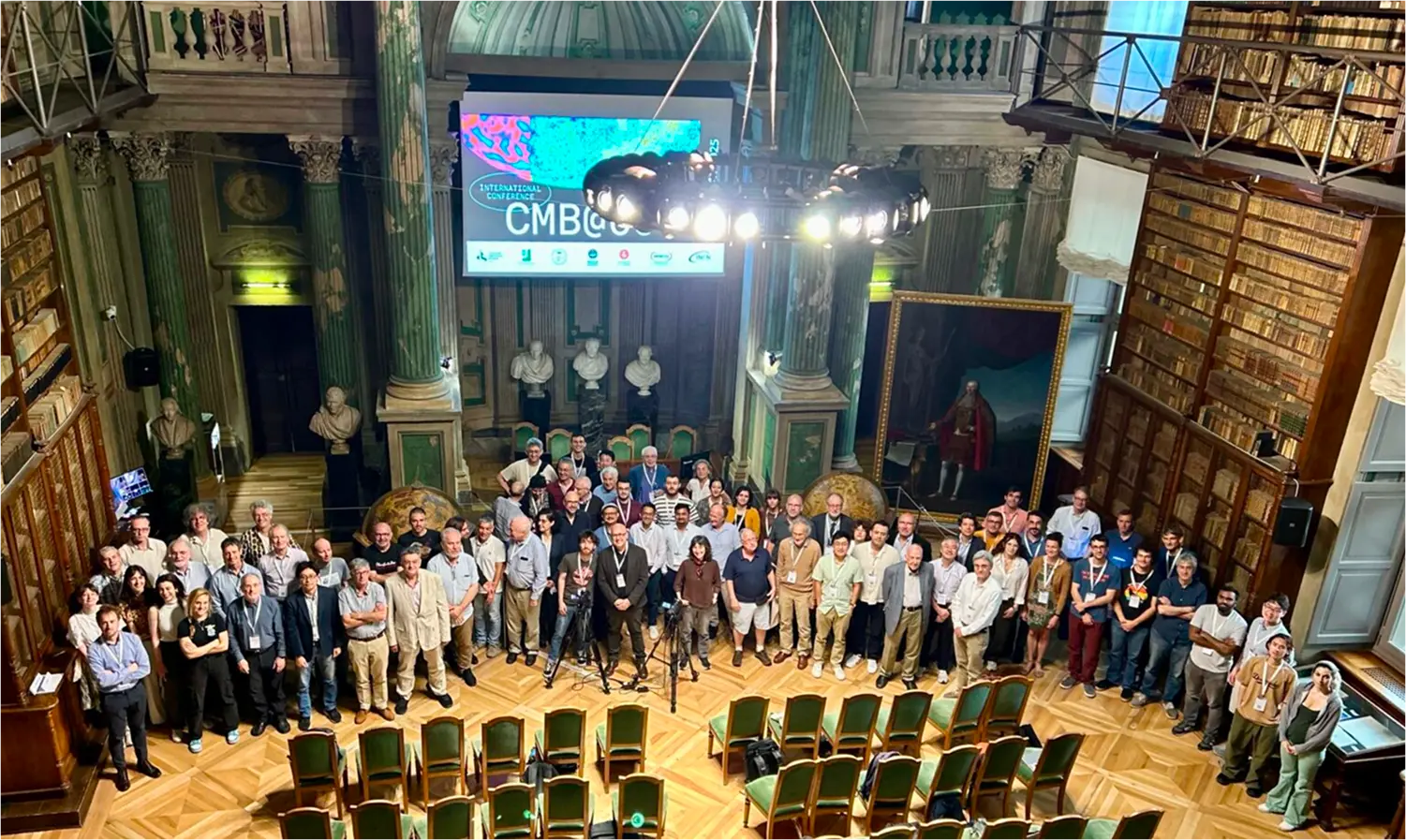
During the last week of May 2025, the anniversary conference “CMB@60” was held in Turin, Italy, marking the 60th anniversary of the discovery of the Cosmic Microwave Background (CMB). The discovery of the CMB—one of the most significant breakthroughs in the history of observational astronomy and cosmology—was announced in a scientific publication in 1965. In 1978, it was honored with the Nobel Prize, half of which was awarded to the discoverers A.A. Penzias and R.W. Wilson (shared with P. Kapitsa).
This discovery revolutionized cosmology, fundamentally defining our understanding of the physical nature of the early Universe and its evolution by establishing solid empirical foundations for the Big Bang model. It provided the impetus for a dramatically accelerated development of research and interpretation in the field.
On this 60th anniversary, scientists from around the world gathered in Turin to celebrate the incredibly rich observational and interpretative achievements in the field. These six decades represent the realization of numerous measurement experiments—including three pivotal satellite missions: COBE (Nobel Prize for J. Mather and G. Smoot in 2006), WMAP, and Planck. Over this time, cosmology has evolved from a speculative and somewhat imaginative domain of knowledge into one of the most precisely constrained domains of astronomy.
The conference brought together scientists whose careers began even before the discovery of the CMB, such as B. Partridge (Haverford College, USA, Emeritus), the eminent theorist R. Sunyaev (currently at the Max Planck Institute for Astrophysics in Garching, Germany), and Nobel laureate A. Riess (noted for the discovery of the accelerated expansion of the Universe). Also in attendance were key figures from major space missions: C. Bennett (Johns Hopkins University, USA) from COBE; L. Page (Princeton University, USA) from WMAP; and from the Planck mission: J.L. Puget (Institut d’Astrophysique Spatiale, Orsay, France), Nazzareno Mandolesi (INAF, Bologna, Italy), C. Lawrence (Jet Propulsion Laboratory, Pasadena, CA, USA), J.R. Bond (Canadian Institute for Theoretical Astrophysics, Toronto, Canada), and G. Efstathiou (Cambridge University, UK), among many others.
Among the invited participants was Prof. Krzysztof M. Górski, representing the Copernican Academy in Warsaw. Prof. Górski was involved in the COBE mission at NASA’s Goddard Space Flight Center in the early 1990s and spent over 20 years (from 1996) working on the Planck mission in Copenhagen, Munich, and at JPL in the USA.
Prof. Górski’s presentation, “Reminiscence of COBE,” was dedicated to the now-legendary satellite mission. His work within that team resulted in the phenomenally precise measurement of the electromagnetic energy distribution spectrum of the background radiation and the discovery of temperature anisotropy.
These anisotropies provide information about the initial conditions- approximately 400,000 years after the “birth” of the observable Universe in the Big Bang -regarding the evolution of matter density disturbances. These are the “seeds” of the astronomical objects we observe today, roughly 14 billion years after the Big Bang.
Prof. Górski has participated in previous landmark anniversaries: the 25th anniversary of the CMB in L’Aquila, Italy, and the 50th anniversary in Princeton, USA. The Turin conference, held at the prestigious Accademia delle Scienze di Torino, offered a magnificent opportunity to reconnect with longtime scientific colleagues in an inspiring setting.
The group photograph from CMB@60 features Prof. Górski’s collaborators from the Planck satellite project – an ESA mission with significant NASA participation. This mission provided the most precise measurements of CMB anisotropy across the entire sky to date, setting the most demanding theoretical constraints for physical models of the Universe.
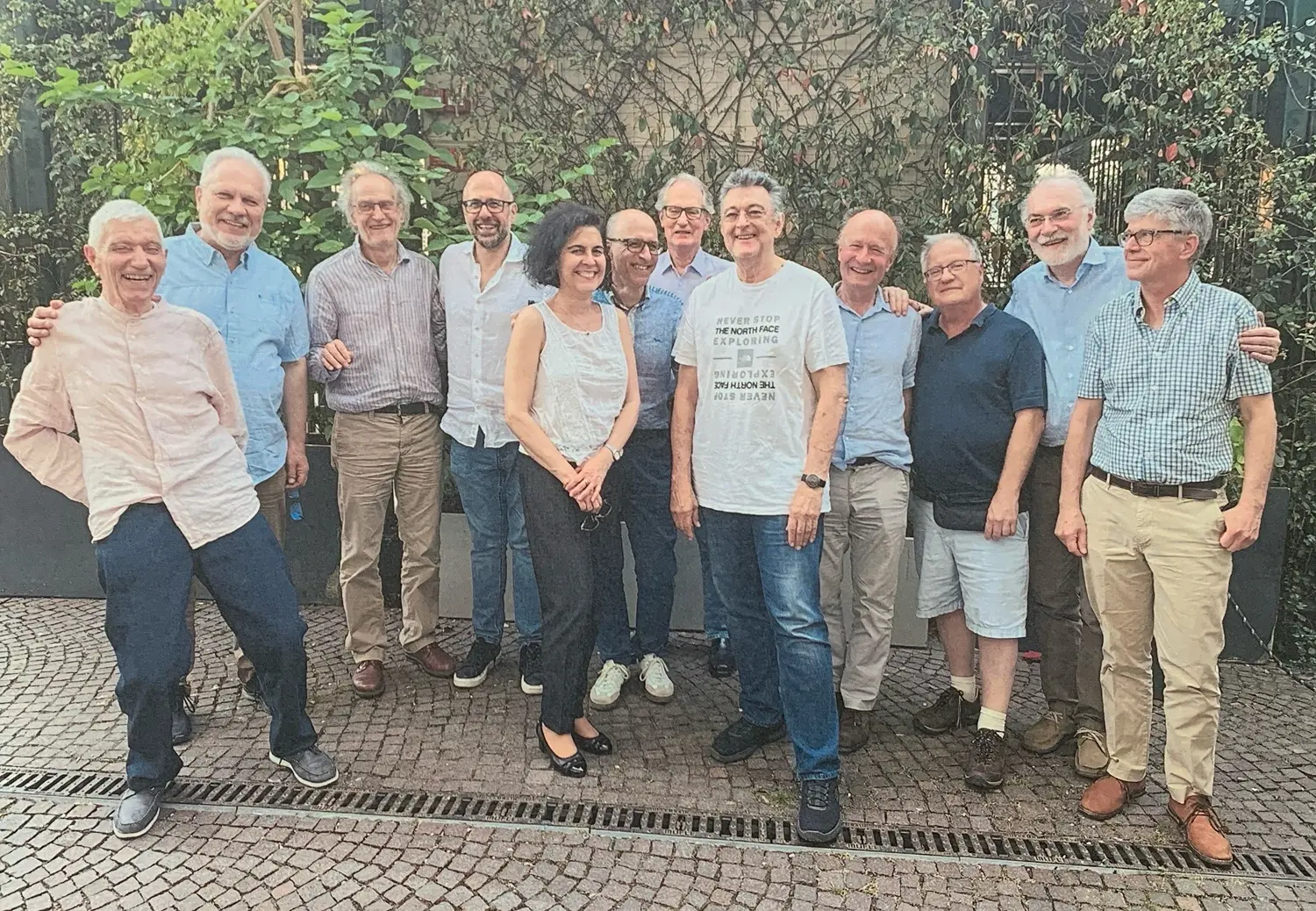
Visible in the photograph (from right to left):
- Dr. Jan Tauber, ESA Project Scientist for the Planck mission
- Prof. Marco Bersanelli, University of Milan
- Prof. J.R. Bond, CITA, Toronto, CA
- Prof. F. Boulanger, ENS, Paris, France
- Prof. F. Bouchet, IAP, Paris, France
- Dr. C. Lawrence, JPL, CA, USA
- Dr. A. Zacchei, Osservatorio Astronomico, Trieste, IT
- Dr. G. Rocha, JPL, CA, USA
- Prof. P. Natoli, University of Ferrara, IT
- Prof. J.L. Puget, ISA, Orsay, FR
- Prof. K.M. Górski, Nicolaus Copernicus Academy, Warsaw