
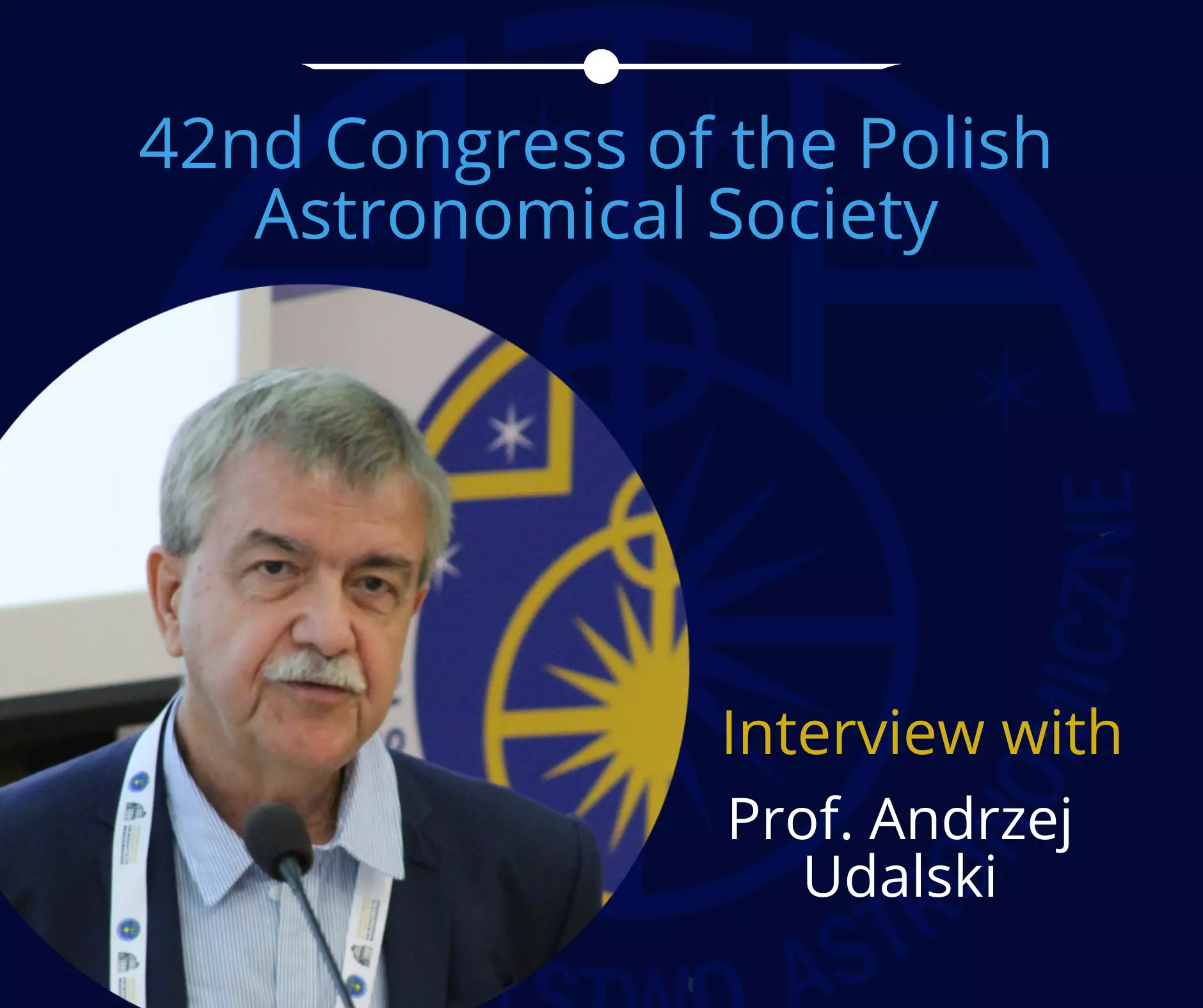
At the 42nd Congress of the Polish Astronomical Society (PTA), we spoke with Prof. Andrzej Udalski – Director of the University of Warsaw Astronomical Observatory and head of the OGLE project, one of the most renowned and longest-running observational programs in the world. Prof. Udalski is this year’s recipient of the Bohdan Paczyński Medal and a member of the Nicolaus Copernicus Academy, where he chairs the Chamber of Astronomy.
In this interview for the Nicolaus Copernicus Academy, Prof. Udalski discusses the inspirations behind OGLE, the stories behind its discoveries, the personal significance of the Bohdan Paczyński Medal, and the future of astronomical research in Poland.
What was the inspiration behind the OGLE project, and did you expect it to achieve such spectacular success?
Prof. Andrzej Udalski: Of course, I did not expect us to achieve this level of success. I must remind you that we started during a very intense period of systemic, social, and economic transformation in Poland. We had several ideas on how to create something unique. I should also mention that we already had significant experience, as individual members of our team had participated in sky observations at renowned international centers. However, we wanted to do something of our own, leveraging our own strengths and resources.
Together with Prof. Bohdan Paczyński, we came up with the idea of conducting a “large-scale sky survey” and focusing on searching for objects that were very difficult to detect at that time. Back then, it seemed like complete science fiction. That is how the OGLE project (Optical Gravitational Lensing Experiment) was born.
Initially, we began gathering ideas on how to organize it observationally and which location would be best for conducting observations. We also prepared backup programs in case the search for gravitational microlensing – which was our primary goal – did not succeed. This way, the project would have various other applications with the potential to revolutionize many areas of astronomy. In summary, we didn’t predict such a revolution, but we knew we were doing something new and very promising. The project is now over 30 years old; in hindsight, it’s clear we revolutionized many fields, mainly because we were the first to explore certain areas no one had addressed before.
Which of OGLE’s numerous discoveries was the biggest or most unexpected surprise for you?
You know, discoveries are like children – every child is loved, and it is hard for me to say which is the most important because so many are significant. Certainly, the first detection of a microlensing event was a breakthrough and the first major accomplishment; among other things, it confirmed that Albert Einstein was right, as these phenomena are predictable through the General Theory of Relativity.
Another very important achievement was the discovery of exoplanets using new methods. Discovering each of these objects brought immense satisfaction. We also discovered a very large object in our solar system, a dwarf planet named Dziewanna. One could jokingly say it is the largest “Polish” object in the solar system.
The University of Warsaw Astronomical Observatory has a magnificent history. How has the global success of the OGLE project influenced its current standing in the world of science?
The OGLE project is the flagship project of the UW Astronomical Observatory, but also of the entire University and even Poland, as it is a global phenomenon. It has existed for over 30 years and consistently delivers new discoveries of the highest scientific caliber every year or two. In recent years, we have produced several foundational papers that will soon enter scientific textbooks, and more discoveries are on the way. I believe the Observatory has gained a great deal thanks to OGLE.
The Bohdan Paczyński Medal is the highest honor in Polish astronomy. You had the privilege of knowing Professor Paczyński personally. How does it feel to receive an award named after someone who was not only a global scientific icon but also your mentor and colleague?
Professor Bohdan Paczyński was indeed a very important figure for the OGLE project. Unfortunately, he passed away prematurely while still in his creative prime, which was a huge loss for both Polish and global science. The Bohdan Paczyński Medal is the most important scientific award of the Polish Astronomical Society. Naturally, receiving it is a source of great satisfaction and honor for me, as well as recognition of our contribution to the development of science. Personally, I am also extremely pleased that such a high distinction is named after our colleague and the co-founder of the OGLE project.
Did Nicolaus Copernicus – his multidisciplinary interests and scientific legacy – have any influence on your career?
Historically, Nicolaus Copernicus is a figure who revolutionized the way we view the world, so there is a historical connection. In a sense, a continuity of strong results by Polish scientists in astronomy is visible. For me personally, Copernicus has always been an example of a scholar who does not succumb to stereotypes and who courageously presents new ideas if they are well-documented. In this sense, Copernicus remains a model for conducting scientific research.
What about the future of the OGLE project? Do you see prospects for new, major astrophysical discoveries?
The future is, of course, difficult to predict. Astronomy and astrophysics are developing very dynamically. Over the last 30 to 40 years, our understanding of the universe has changed dramatically. Various highly sophisticated space missions are planned that will provide a wealth of new information. Looking at our own work, we are also pursuing topics that could offer a completely new perspective within the next few years. Therefore, the results we obtain may revolutionize certain areas of astrophysics.