
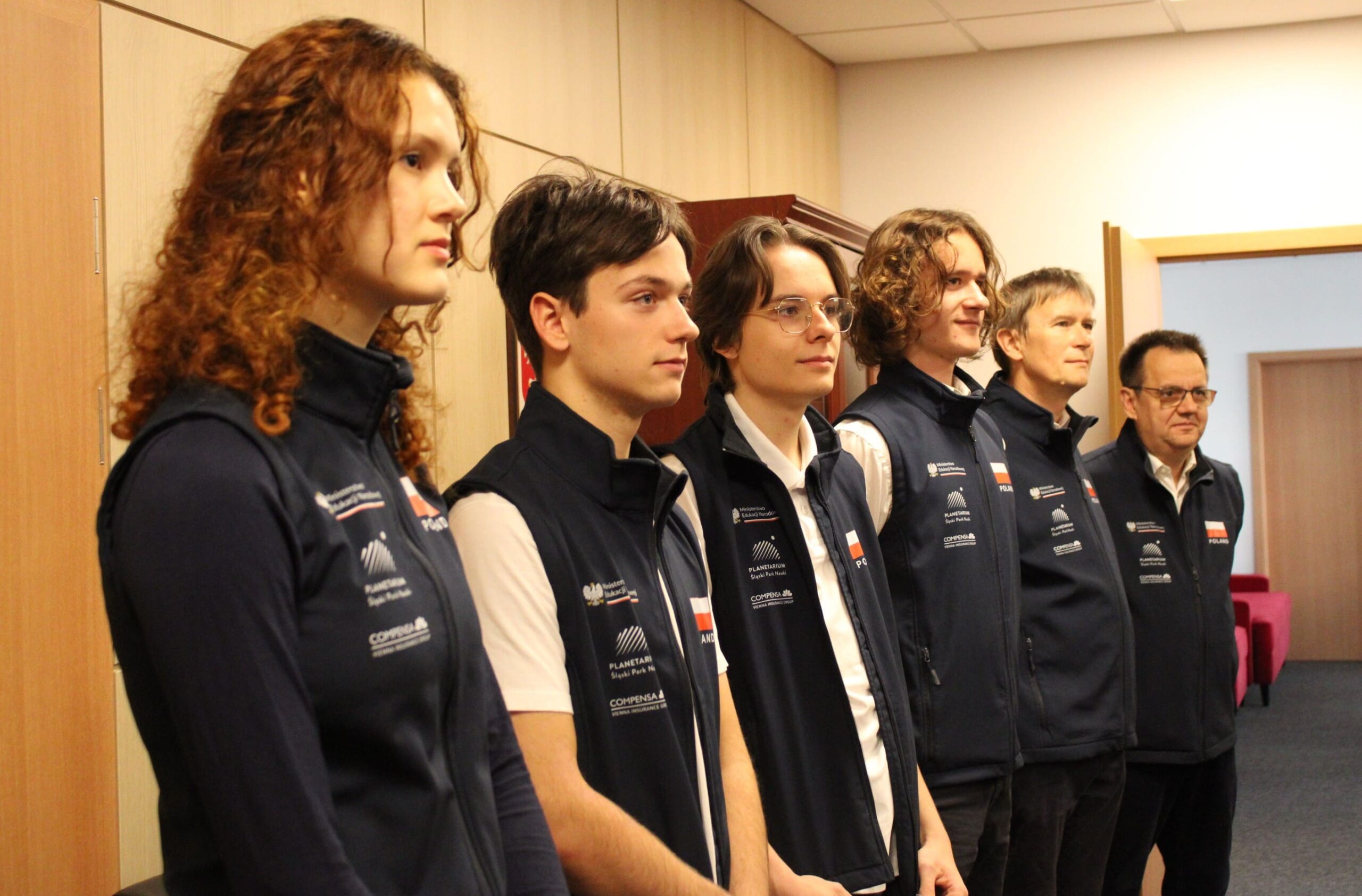
Polish medalists of the 18th International Olympiad on Astronomy and Astrophysics (IOAA) were welcomed at the Nicolaus Copernicus Academy and recognized for their outstanding achievements. The Polish team achieved remarkable success at the Olympiad in Mumbai, winning four medals, including one gold.
The IOAA challenges students with a wide range of interdisciplinary tasks, combining astronomy, astrophysics, and practical skills such as astronomical observation and data analysis. These competitions rank among the most demanding scientific contests for young people.
Prof. Krzysztof M. Górski, Acting Secretary General of the Nicolaus Copernicus Academy, praised the students’ achievements:
“Astronomy is obviously close to my heart, so I’m very impressed by what you’re doing (…).
President Reagan once said this when he visited his high school, where he was a student, that he’d always been a straight-A student, but when he thinks about what would have happened if he’d studied well, what he could have achieved in life, it’s mind-boggling. I can say the same, because I wasn’t an Olympian; my path to astronomy was different. But I wasn’t discouraged. I managed to work in the profession for forty-something years.”
“The situation is significantly different from what it was in the 1980s when I started (…). Our membership in the European Space Agency, the European Southern Observatory, and other large telescopic investments, dynamically operating in several centers, allows us to hope that what I perceive as an absolutely unique position among various scientific fields in Poland, which astronomy maintains and which provides results that are extraordinary in the scale of what – on a rather average basis – Polish science achieves, will continue. And we will pass this baton to you, of course with great emotion. I hope that some of you will actually take up astronomy, because it is worth it.”
“We meet here at the Copernican Academy (…). For my part, I believe that bearing this name, which so many institutions in Poland bear, is nothing but an obligation, but we are in a unique situation, because at least we have such a great inspirer as our own Mikołaj. We should be proud of this and we should carry it proudly into the future.”
Poland’s team consisted of Kinga Wysocka, Jasmina Nurković, Antoni Gazda, Dawid Chudzik, and Artur Ziółkowski—winners of the national Astronomy Olympiad organized by the Silesian Planetarium. The team earned one gold, two silver, and one bronze medal.
Prof. Andrzej Udalski, a leading Polish astronomer, also sent a congratulatory letter:
“I warmly congratulate you on winning gold, silver, and bronze medals at the International Olympiad on Astronomy and Astrophysics. This is a remarkable achievement and a gateway to a fascinating scientific career. I would be delighted to see you as students at our Observatory and, in the future, as collaborators on projects such as OGLE or other astronomical research.”
Waldemar Ogłoza, one of the Polish team’s coaches, expressed his excitement about visiting the Academy:
“It’s nice that you’re hosting us here (…) this year we’re preparing for a trip to Vietnam. The ’69 Olympics have started. We’re closing the start list tomorrow, but so far there are over 200 people [registered]. (…) We hope that everything will, so to speak, unfold as planned this year. We expect to select the national team at the competition in March, and we’ll be preparing them.”
Antoni Gazda, a two-time national Olympiad medalist and this year’s IOAA participant from the Mikołaj Kopernik High School in Krosno, described his passion for astronomy:
“Astronomy is my hobby, and my parents sparked my interest by buying me various astronomy books to read. I often hike in the mountains and observe the dark sky.”
How is the passion for astronomy passed on at your school?
“Our observational infrastructure contributes to this, primarily because we have an observatory, a dome, and many telescopes that we can use. This investment dates back 20 years. Since then, we’ve had many Olympians at the school – both international and national.
Secondly, our Olympians – when they graduate, they continue to engage in teaching younger generations as students. They organize online classes and pass on their knowledge to younger students. And so it goes from generation to generation. (…) There are new successes, new people, new talents that are eager to develop. This school gives them opportunities – mainly thanks to the alumni, but also thanks to the commitment of teachers and the entire school community. Because a lot is also passed on between students.”
You mentioned the number of finalists who left school and are now involved in imparting knowledge.
“There have been—I don’t remember exactly—five or even six international Olympians. Over the past twenty years, there have been many, many more national Olympians, because, for example, in the previous edition of the Olympiad, our school had two national Olympians. This year, my friend and I are coming up, maybe we can get someone else involved. I see that, going back in time, we’ve had many Olympians—I started before COVID. During COVID, the number of Olympians decreased, but now we’ve started a new trend. And each year, there are more and more finalists. Maybe this year there will be even more from our school.”
Antoni Gazda not only competes in the Olympiads himself, but also prepares his younger colleagues for them, sharing his knowledge, experience and passion for astronomy.
This year, the IOAA brought together 288 students from 60 countries. The success of the Polish team highlights the country’s potential in the sciences and offers a strong incentive to continue developing young talent in astronomy and related fields.
Congratulations once again to all the medalists!